
The digital economy of Laos is increasingly and steadily becoming a core pillar of long-term economic development. While it currently accounts for around 3% of the country's GDP, the government expects it to expand significantly to about 10% by 2040. To support this transformation, the Ministry of Technology and Communications has implemented a 2021-2030 National Digital Economy Development Strategy alongside a shorter 2021–2025 plan.
The development of the digital economy is accompanied by the gradual building of a legal framework to support and regulate the growth of digital trade and e-commerce. The years of work culminated in 2022, when Laos took a further step toward regulating the digital economy from a fiscal perspective and announced the introduction of VAT for non-resident digital service providers.
VAT Regulatory Framework for Non-Resident Suppliers
In February 2022, Laos published official instructions, commonly referred to as the Notification Act, that introduced a requirement for foreign providers such as digital platforms, e-commerce marketplaces, and online merchants without a physical presence in Laos to register for tax purposes, file returns, and pay VAT on supplies made to local consumers.
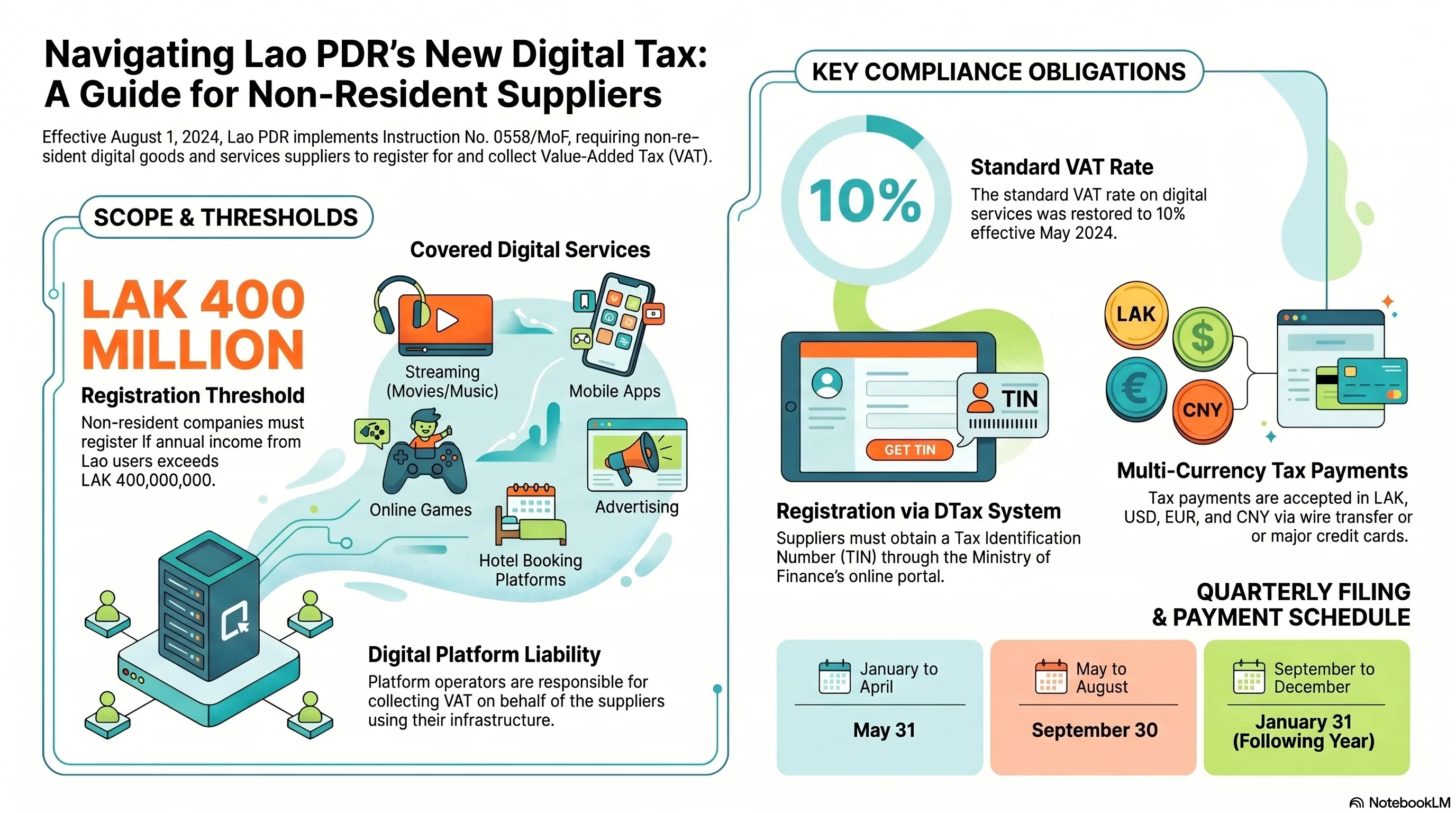
With the same instructions, the Laotian government set the revenue threshold of LAK 400 million (around USD 18,000), which determines when non-resident suppliers become liable for registration and VAT obligations. Additionally, the 2022 legislation extended compliance requirements beyond VAT, requiring foreign suppliers to pay corporate income tax under certain conditions, further broadening the tax reach over digital business activities targeting Lao consumers. The effective date of the Act was August 1, 2024.
Two years after publishing the Notification Act, in February 2024, the Ministry of Finance adopted a new Notification Act intended to update and clarify the earlier rules. The new Notification Act was finally published in the Official Gazette in March, 2024. The 2024 Notification Act removed ambiguities that had arisen since the introduction of the original framework. Moreover, it provided clearer guidance for foreign digital service suppliers on both indirect and direct tax obligations in Laos.
Scope of VAT for Non-Resident Digital Service Providers
The scope of VAT for non-resident providers in Laos resembles the international standards applied in many other jurisdictions in the region and globally. The list of digital services subject to VAT in Laos includes streaming services such as music and video platforms, downloadable digital content, mobile applications, software-as-a-service (SaaS), online gaming services, digital advertising, and cloud-based infrastructure services.
Key VAT Compliance Obligations
One of the first and most important compliance obligations is to register for VAT once the LAK 400 million is exceeded. From August 2024, non-resident providers must register for VAT through the online DTax system, either directly or by appointing a local representative to act on their behalf. Once VAT-registered, they must apply a 10% VAT rate on taxable transactions made in Laos and ensure full compliance with local reporting obligations.
Considering the invoicing and reporting requirements, the 2024 legislation requires that foreign suppliers issue e-invoices for B2B transactions using their own invoice templates, provided these include the mandatory information required under Laos regulations. For B2C transactions, the invoicing obligations are simplified, and formal invoices are generally not required. Regarding VAT returns, they must be filed and paid every four months.
Payment of due VAT is made directly to the Laos National Treasury account, with multiple payment methods accepted, including major international card networks such as Visa, Mastercard, JCB, American Express, UnionPay, as well as bank wire transfers. Additionally, foreign digital providers must also retain all VAT-related records and documentation for a period of ten years, ensuring long-term audit and compliance traceability.
One of the most significant novelties of the 2024 legislation was the introduction of the deemed supplier rule for foreign suppliers of digital goods and services, digital platforms, and e-commerce. Thus, for any digital service supplied through a digital platform, the platform operator is deemed the supplier and is accountable for calculating, collecting, and remitting VAT.
Difference Between B2B and B2C Transactions
As can be seen, the regime is designed to capture a wide spectrum of digital economic activity. While it applies regardless of whether the services are supplied on a B2B or B2C basis, there are some differences in who is on the receiving end of the service.
If the foreign supplier is not VAT-registered, in B2B transactions, the local customer must withhold, declare, and remit VAT on behalf of the foreign supplier. In a B2C transaction, the consumer must pay VAT through a withholding mechanism, with a 10% VAT applied to the payment made to the foreign supplier and collected via the payment process.
Penalties for Non-Compliance with VAT Rules
Laos officials are actively working to identify non-registered overseas suppliers as part of efforts to enforce the country’s VAT rules and regulations. Notably, the enforcement approach is far beyond purely administrative and includes a range of corrective and punitive measures. Therefore, apart from financial penalties, non-compliance with the relevant instructions may result in escalating consequences, including official warnings or even temporary suspension of access to digital service channels.
Some of the penalties for non-compliance include a fixed penalty of USD 800 per quarter for late VAT return filing, plus daily interest charges of 0.1% until full payment is made. If the Tax Department issues a formal demand for payment of outstanding taxes, a penalty equal to 30% of the outstanding VAT amount, increasing to 60% if a second demand is issued, is charged. If, however, the non-compliance remains, and the Tax Department issues a third formal demand, the penalty rises to 100% of the VAT due, effectively doubling the tax burden.
In more serious cases of non-compliance, the Tax Department may even suspend or cancel the payment processing channels used by non-compliant service providers, thereby restricting their ability to continue operating in the Lao digital economy.
Conclusion
By establishing clear registration thresholds, deemed supplier rules, and structured penalties, Laos not only aligned its fiscal policy with its digital economy ambitions but also with international standards and trends. Moreover, the VAT framework for non-resident digital service providers, introduced in 2022 and later updated in 2024, created a more predictable compliance environment for foreign operators. Given that Laos has ambitious targets with the digital economy, foreign providers entering this market should treat compliance as a prerequisite for long-term, legitimate participation in this evolving digital landscape.
Source: PwC, Department of Foreign Trade, Ministry of Industry and Commerce, BDO, Tax Department, International Trade Administration