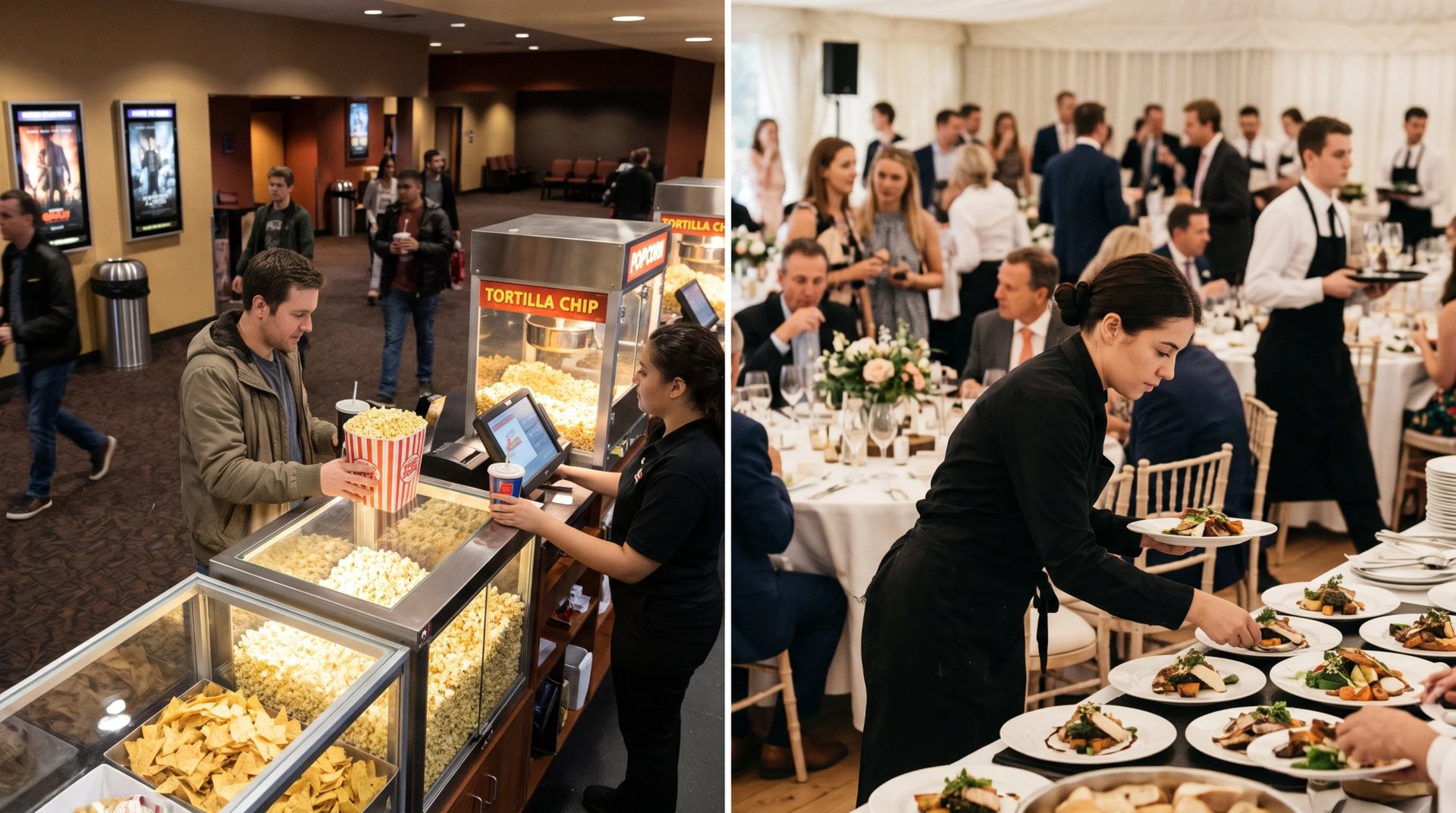
Is selling popcorn at the movies the same as providing a full-service party banquet under European tax law? The Court of Justice of the European Union drew a decisive line between the supply of goods and the supply of services for VAT purposes—with major consequences for businesses and consumers alike.
Snack Stalls, Mobile Snack Bars and Cinemas: Food Preparation as Part of the Sale
For example, the CJEU has explained in its case law that the preparation of popcorn, which effectively coincides with its production, and the serving of popcorn and tortilla chips in packaging form an integral part of the sale of those products and are therefore not separate transactions. Moreover, the food is prepared and kept at a certain temperature regularly rather than in response to an order from a particular customer.
The Role of Furniture and Facilities in Cinemas
It should also be noted that the provision of furniture (standing tables, stools, chairs and benches), although such furniture is not available in every cinema, is generally unconnected with the sale of popcorn and tortilla chips; it is intended for people gathered in the waiting area and meeting point. In practice, the food is usually consumed in the auditoriums. For that purpose, some cinema seats are fitted with cup holders, which also help to keep the auditoriums clean. The mere provision of such furniture, intended, albeit not exclusively, to facilitate the consumption of the food, cannot in itself be treated as an element of a supply of services that changes the overall transaction into a supply of services.
Overall Assessment: Food Supply as the Dominant Element
Taken as a whole, in activities of this kind the dominant element of the transaction is the supply of meals and food prepared for immediate consumption. The simple and standardised preparation that is inseparable from the supply, together with the use of basic facilities that allow a limited number of customers to consume the food on the premises, is merely ancillary and of minor importance. Whether customers actually use those basic facilities is irrelevant, because immediate consumption on the premises is not an essential characteristic of the transaction and therefore cannot determine its nature.
Party Catering: Range of Possible Service Combinations
When considering the activities of a party caterer at events and ceremonies such as those at issue in the main proceedings in Case C-502/09, it should first be noted that different combinations of transactions are possible depending on customers' wishes. These can range from merely preparing and delivering meals to a full-service package that may also include crockery, furniture (tables and chairs), presentation of the dishes, decoration, serving staff, advice on the composition of the menu and, where appropriate, the choice of drinks.
It should also be recalled that, where there is a single supply, whether the transaction is classified as a supply of goods or a supply of services depends on all the factual circumstances, with particular regard to the qualitatively predominant elements from the consumer's point of view.
As regards meals supplied by a party caterer, unlike food supplied from snack stalls, mobile snack bars and cinemas, such meals are not the result of a simple standardised preparation process. They involve a clearly greater service component and require a great deal of work and considerable skill. The quality, creativity and presentation of the dishes are usually decisive for the customer. Customers are frequently offered not only the option of putting together their own menu, but also of having individual dishes prepared to order. The terminology used in everyday language also reflects that service component: one speaks of a "catering service" (service traiteur), of meals prepared "to order" rather than "purchased", and of a home catering service (traiteur à domicile).
The caterer then delivers the meals hot in suitable containers or reheats them on site. It is also important to the customer that the meals are delivered at precisely the time specified in the order.
A party catering service may also include elements that create the conditions for consumption, such as the provision of crockery, cutlery and even furniture. Unlike the mere provision of basic infrastructure in the case of snack stalls, mobile snack bars and cinemas, these elements also require a degree of human intervention, for example to deliver, collect and, where necessary, clean the items.
Conclusion on Party Catering Activities
In light of these considerations, except where the caterer supplies only standard meals without any additional service element, or where other specific circumstances show that the supply of the food is the predominant element of the transaction, party catering activities should be treated as supplies of services.
The CJEU's Conclusions
On this basis, the CJEU concludes that:
- the supply of freshly prepared food and meals intended for immediate consumption from snack stalls or mobile snack bars, or in cinema foyers, constitutes a supply of goods within the meaning of Article 5 of the Sixth VAT Directive (77/388/EEC) where a qualitative assessment of the transaction as a whole shows that the elements of a supply of services preceding and accompanying the supply of the food are not predominant;
- except where a party caterer merely supplies standard meals without any additional service element, or where other specific circumstances show that the supply of the food is the predominant element of the transaction, party catering activities constitute supplies of services within the meaning of Article 6 of that Directive.