The switch from Sales Tax to the Goods and Services Tax (GST) marked one of the most significant fiscal reforms in Bhutan's recent history. After years of preparation, at the beginning of 2026, the new regime replaced the longstanding sales and excise tax framework with a modern, consumption-based tax system.
The shift from one tax system to another is anything but a cosmetic change, influencing not only the country's economy but also fundamentally changing how taxable persons register, account for tax, interact with customers, and manage compliance. While modernizing the taxation system, broadening the tax base, and embracing fundamental best practices to suit the ever-changing business environment were stated as the primary drivers behind the reform, these changes introduce new obligations and operational challenges for taxable persons.
The Previous Indirect Tax Regime and Why Reform Was Inevitable
In 2000, Bhutan introduced a fragmented system of indirect taxes, including sales tax, customs duties, and excise duties. While it resembles more common indirect tax systems, such as VAT or GST, which also include customs and excise duties, it was often criticized for being complex, inefficient, and lacking transparency.
Although the sales tax regime was updated several times up to 2014, it remained structured around a selective approach rather than a broad-based consumption tax. By 2017, it was applied only to a select group of non-essential, luxury-oriented, or administratively easier-to-monitor goods. The sales tax also applied to certain services, particularly those associated with higher-income consumption, such as telecom services, upscale hotels and restaurants, and entertainment services.
As such, the system was designed to target revenue collection from consumption patterns associated with higher purchasing power or import-intensive goods. This, and the fact that the system provided a wide range of exemptions, was one of the main critiques of the sales tax regime.
Multiple tax rates, including nine ad valorem rates and two specific tax slabs, ranging from 0% to 100%, only added a layer of complexity to the system. One additional issue or feature of the sales tax system was its limited reach within the domestic economy. Only a small number of goods and services were taxed at the point of sale, and around 37% of imports were taxed at 0% rate.
Essentially, Bhutan's indirect tax system was narrow in scope, uneven in application, and heavily reliant on categorization of goods and services. To address ongoing issues and critiques of the existing regime, in 2020, Bhutan’s National Assembly passed the law implementing GST. Originally, it was planned that the GST would replace the sales tax in mid-2022, with the standard GST rate set at 7%. However, the GST came into effect on January 1, 2026, at the 5% rate, covering nearly all goods and services.
Key Changes for Taxable Persons
Even though the Department of Revenue and Customs (DRC) stated that GST is not an entirely new tax, and that it represents the “modernization and reform of the existing sales tax system to make it more fair, efficient, and sustainable”, this reform has a significant impact on taxable persons.
With the broader scope of goods and services subject to GST, including the economically significant tourism, transport, and consultancy sectors, one of the most important changes for businesses and individuals is the obligation to register for GST once they exceed the mandatory registration turnover threshold of BTN 5 million (around USD 56,600). Mandatory registration must be completed within 30 days from the day the threshold is exceeded. Notably, those with annual turnover between BTN 2.5 million (around USD 28,300) and BTN 5 million may voluntarily register for GST.
Another vital novelty is the introduction of input tax credits. Under the previous regime, multiple taxes applied at different stages, often at different rates, and in some cases even on top of each other, resulting in cascading effects in which tax was charged on already-taxed values. The GST put an end to this, where the taxes paid at earlier stages are fully credited, and the tax rests only with the final consumer.
To claim input tax credits, GST-registered taxable persons must keep all GST invoices for business-related purchases, calculate the total GST paid on eligible purchases during the tax period, monthly or quarterly, subtract this amount from the GST collected, and pay only the net difference, if appropriate, to the DRC through their GST return.
While the sales tax regime had a limited domestic reach, the GST applies to digital and cross-border services. In other words, foreign digital service providers and online platforms are now subject to GST rules and requirements in Bhutan.
Penalties for Non-Compliance with GST Rules
Besides bringing many novelties and changes to the tax system, the GST rules also brought new penalties for non-compliance:
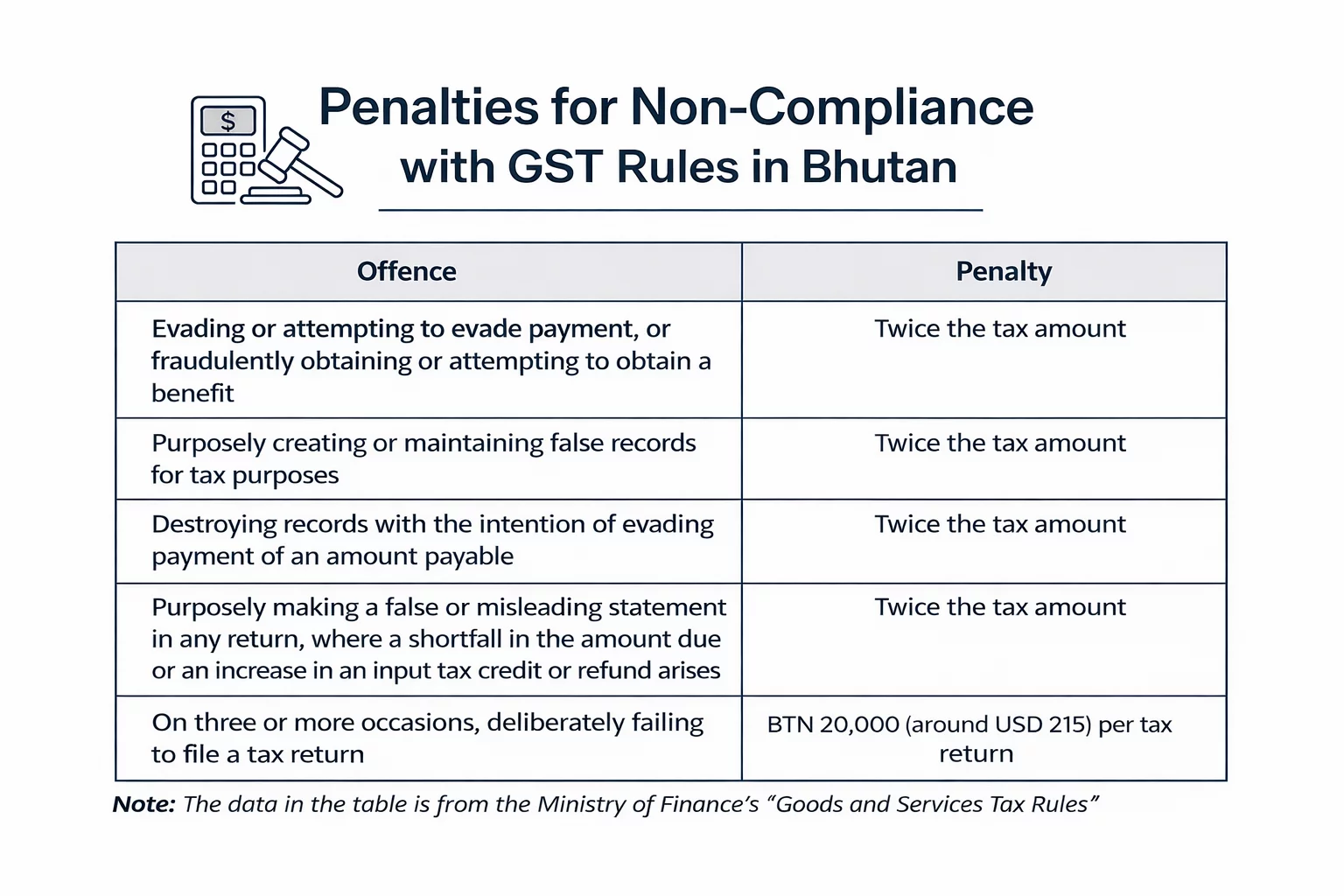
In addition to these penalties, administrative penalties may be imposed on those who fail to meet their obligations, such as failing to register, notify DRC of any changes, or file a return upon DRC's request.
Impact on Bhutan's Economy
The GST is expected to increase indirect taxes for households across the distribution, which could result in a temporary increase in poverty. As the economy grows and incomes rise, the overall poverty rate is expected to return to levels similar to those observed in 2017. Thus, the initial welfare losses caused by the GST may be offset over time by broader economic improvements and increased earning capacity.
With a much broader tax base, the government's revenue stream should be steadier. In the long term, the government could reallocate part of these funds to targeted social measures, such as direct financial support for low-income households, to mitigate the adverse impact on vulnerable groups. Overall, while GST initially places pressure on household budgets, it also creates opportunities for more structured and effective redistribution policies.
For taxable persons, the reform brings predictability and a more structured framework on the one hand, and demand for greater compliance, improved record-keeping, and strategic adaptation on the other.
Source: VATabout, Department of Revenue and Customs, Ministry of Finance - Goods and Services Tax Rules, Parliament of Bhutan - Consolidation of Goods and Services Tax Act of Bhutan 2020, Ministry of Finance - Rules on Sales Tax, World Bank