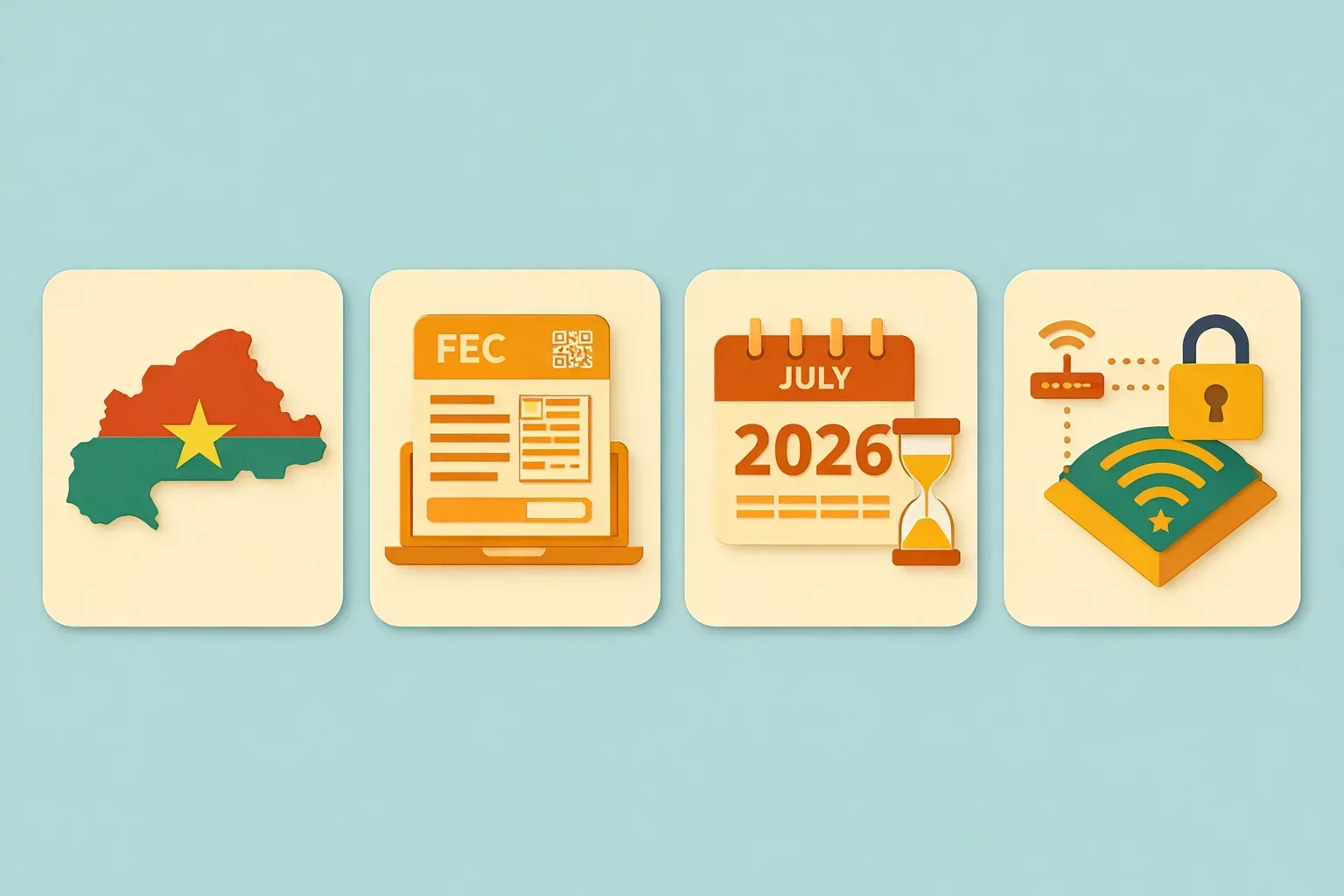
On January 6, 2026, Burkina Faso’s Ministry of Economy and Finance officially launched the Certified Electronic Invoice (Facture électronique certifiée - FEC) system. While the launch marked the beginning of a "preparatory phase," the grace period is short: compliance becomes mandatory for the first wave of taxpayers on July 1, 2026.
This move shows Burkina Faso’s transition from the 2017 "normalised invoice" regime to a modern Continuous Transaction Control (CTC) model. It isn’t just about replacing paper with PDFs; it is about real-time transparency and the digitalization of the entire tax reporting chain.
System Overview
The FEC operates through the SECeF platform, requiring certified software for issuing invoices with unique authentication codes and QR codes for instant verification. This setup ensures real-time data transmission to the DGI as invoices are generated, turning every transaction into a verifiable digital record. Businesses must either certify their proprietary systems or adopt approved third-party solutions to comply.
Implementation Timeline
The system launched on 6 January 2026, followed by a preparation phase from January to June for taxpayer onboarding and software certification. It becomes mandatory on 1 July 2026.
Who It Applies To
Phase one targets businesses above the XOF 50 million (approx. €76,200) turnover threshold, excluding foreign entities without a permanent establishment, air traffic, and urban public transport. This focuses initial enforcement on high-impact taxpayers to maximize revenue gains and compliance. Smaller operators should prepare, as expansions are expected soon.
The Scope
The DGI is prioritizing high-impact taxpayers to ensure a robust start to the rollout.
Under the first phase, the mandate applies to:
- Threshold: Domestic businesses (legal entities and individuals) under the standard tax regime with an annual turnover (excluding tax) equal to or exceeding XOF 50 million (approx. €76,200).
- Transactions: The system covers B2B, B2C, and B2G domestic transactions.
- Exemptions: Currently, the mandate excludes foreign companies without a permanent establishment, air transport, and urban public passenger transport.
Future phases will extend to SMEs and other categories, with details pending from the DGI.
Anatomy of a Certified Invoice
Under the FEC system, an invoice is only valid if it is "certified" by the government’s interoperable platform, SECeF (Système Électronique Certifié de Facturation).
To be compliant, every electronic invoice must feature:
- Unique Authentication Code: A digital fingerprint that ensures the document cannot be tampered with.
- QR Codes: To facilitate instant verification by both the customer and tax auditors.
Compliance Pathways
Taxpayers cannot simply send an email and call it an e-invoice. You must adopt a system that "talks" to the DGI in real-time. Businesses have two primary options:
- Certify Proprietary Software: Larger enterprises with in-house ERPs can undergo a technical certification process to integrate their systems directly with the SECeF.
- Third-Party Certified Solutions: SMEs and businesses looking for a faster route can utilize software provided by certified third-party vendors who have already cleared the DGI’s technical hurdles.
Penalties: The Cost of Non-Compliance
The DGI has introduced a strict penalty framework to ensure the July deadline is taken seriously.
- Failure to issue a FEC: Fines equal to 5x the compromised VAT amount (minimum XOF 500,000). For repeat offenders, this jumps to 10 times the VAT (minimum XOF 1,000,000 approx. €1,525).
- Non-compliant software: Using uncertified systems can result in fines of up to XOF 2,000,000 (approx. €3,050).
- Fraud/Falsification: A flat fine of XOF 2,000,000 (approx. €3,050) per invoice, alongside potential criminal prosecution.
Key Dates for Your Calendar
- January 6 – June 30, 2026: The Awareness & Transition Window. Use this time for software certification and staff training.
- July 1, 2026: Go-live for Phase One (Turnover ≥ XOF 50M).
The Bottom Line
The transition to real-time clearance is no longer a "future project" it is a current requirement. Waiting until June to evaluate your software architecture is a recipe for compliance failure.
Sources: RTC, Ecofin Agency