
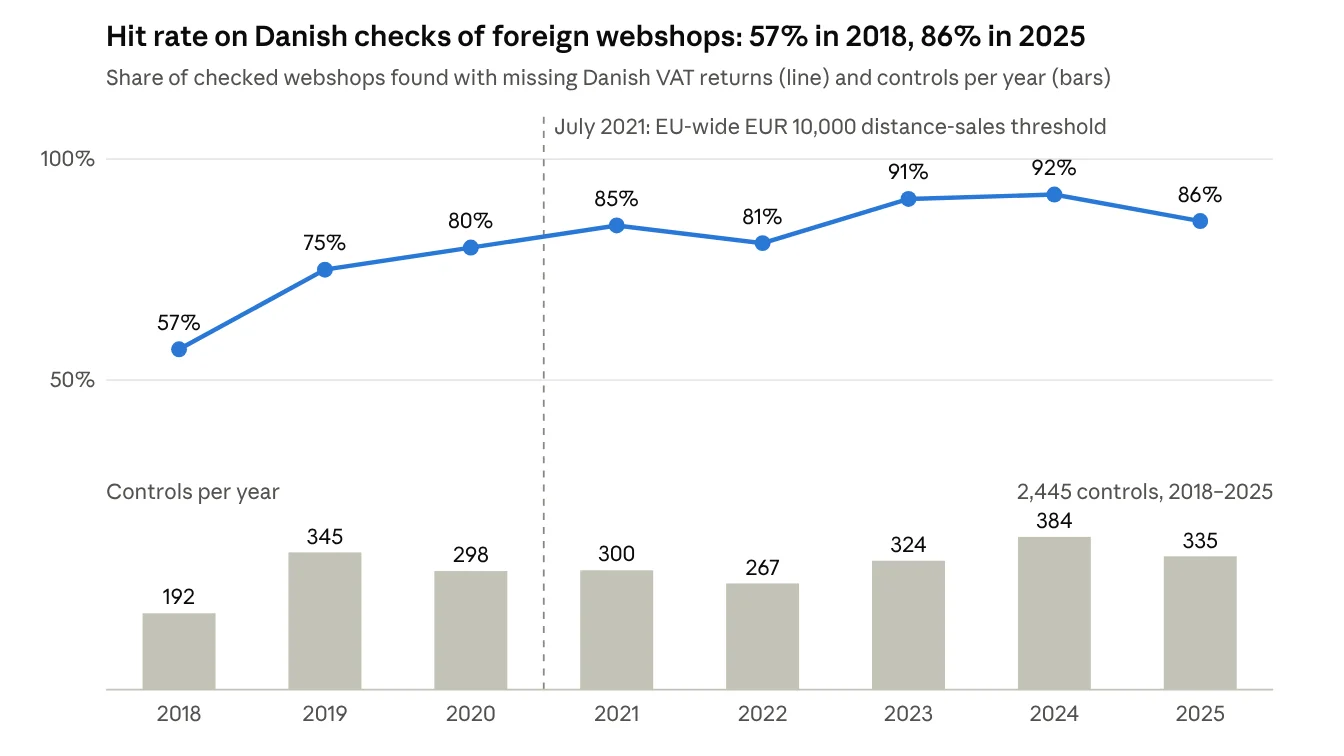
Denmark finds foreign webshops that skip Danish VAT by following the money: its Tax Authority uses Danish card payments to spot sellers who never registered. In 2025, the authority conducted 335 targeted inspections of businesses suspected of being unregistered for VAT. 86% of these inspections identified non-compliance, resulting in additional VAT assessments of approximately DKK 32 million. In an interview with VATabout, the Danish Tax Authority provided insights into how they operate and how detecting foreign webshops works.
The Red Flags: What Triggers the Monitoring
Banks report the total monthly payments made by Danish private individuals to each foreign recipient, both in the original currency and in Danish kroner. The authorities then identify each business using information such as its name, address, country, website and sector. If the transaction data suggests that a webshop should be registered for Danish VAT but is not, it may be selected for an audit.
The legal basis for this system is Sections 75(5) and 75(6) of the Danish VAT Act. Section 75(5) allows the tax authorities to request payment data to investigate distance sales of goods and electronic services to consumers, provided the Tax Council grants permission. Section 75(6) requires individual buyers to remain anonymous. Each authorization covers a defined period of past transactions. Since 2017, the Tax Council has approved six such requests, most recently in February 2025, covering payments made in 2023 and 2024.
Since the controls began, the non-compliance rate has risen from around six in ten shops in 2018 to nine in ten by 2023, across more than 1,700 controls. The authority attributes this to two main factors: better targeting and changes to the VAT rules, particularly at EU level.
“Our targeting has improved as we have become more familiar with the opportunities the payment card data provides us, but the EU-wide threshold for distance sales of goods introduced in 2021 has also played a role.” - Danish Tax Authority.
The Most Common Non-Compliance Error
When asked what the common VAT errors found across the roughly 600 shops examined since 2020 were, the Tax Authority replied that failure to register for VAT in Denmark, rather than incorrect VAT calculations or other technical errors, was the one that caused the biggest issues to webshops.
In most cases, the businesses were already registered for VAT in their own country but had not fulfilled their Danish VAT registration obligations. This applied both to businesses selling physical goods and those supplying digital products and services, such as software and streaming. They had failed to register in Denmark either directly with the Danish tax authorities or through the EU's One Stop Shop (OSS) system, which simplifies VAT compliance for eligible cross-border sales.
The findings indicate that the main compliance problem was not necessarily a failure to register for VAT altogether, but rather a failure to register in the additional country where VAT obligations arose.
A Case in Practice
Although the Danish Tax Authority did not point out any specific case or situation, we managed to find a case law that illustrates how this model works in practice. In 2024, the Danish National Tax Court upheld the Danish Tax Authority’s decision to assess a company for DKK 2,940,091 (around EUR 393,000) in Danish VAT for the period from January 1 to September 30, 2019.
The dispute concerned whether the company’s sales of goods to private customers in Denmark qualified as distance sales, even though the company was established in another EU country and claimed to have declared and paid VAT in Germany.
Because the company failed to provide its accounting records or sufficient information about its sales to Danish customers, the Tax Authority estimated its taxable turnover using payments received from Danish private individuals. The estimated turnover amounted to DKK 11,760,364, resulting in a VAT assessment of DKK 2,940,091, calculated at 25% of the turnover. Although the decision describes the rate as 20% of the VAT-exclusive amount, the figures correspond to 25% of the net turnover, or 20% of the VAT-inclusive amount.
The company argued that it had already declared and paid German VAT on the sales. However, the court rejected this argument, relying on KrakVet, which established that tax authorities in different EU Member States are not necessarily required to coordinate their decisions or agree on a common VAT treatment. Consequently, the fact that Germany had already taxed the transactions did not prevent Denmark from assessing Danish VAT.
What Happens When a Shop Stays Quiet
Identifying non-compliant foreign webshops is one thing. Ensuring they pay due VAT is another. That is why we asked the Danish Tax Authority what happens when a webshop clearly knows it must register and pay VAT in Denmark but deliberately does not.
The Tax Authority emphasized that failure to comply with Danish VAT obligations can lead to both financial penalties and criminal liability, depending on the circumstances and severity of the case. Businesses that register or pay VAT late may be subject to interest and penalties, while more serious cases can result in administrative sanctions or referral to the police and the Prosecution Service for further investigation. Importantly, criminal liability in Denmark can arise not only from intentional non-compliance but also from gross negligence.
The Tax Authority works with other authorities to enforce VAT rules and determine the appropriate response to non-compliance. Where a business appears to have deliberately avoided its registration or payment obligations, the case may go beyond the assessment of unpaid VAT and financial penalties. However, the authorities' response depends on the specific facts and the seriousness of the violation.
The collection of unpaid VAT and other public debts is handled separately by the Danish Debt Collection Agency. It is responsible for recovering outstanding public debts and can pursue debtors in both EU and non-EU countries. This means that foreign businesses cannot necessarily avoid their Danish tax debts simply because they are established outside Denmark.
However, the Tax Authority does not escalate the matter properly:
“We do follow up on the businesses that do not register to see if their sales to Danish consumers continue and if there is basis for new cases and decisions regarding non-registration and non-payment of VAT. The payment card data gives us a basis to assess VAT even when the businesses do not respond to our request for records. Continued non-compliance is clearly relevant for our assessments as to whether escalation is necessary.”
Other Means of Gathering Data
In addition to using payment card data to identify potentially non-compliant foreign webshops, the Danish Tax Authority accepts reports from individuals and businesses about suspected VAT violations. For example, a Danish competitor who believes that a foreign webshop is failing to charge or pay VAT can report the suspected non-compliance to the authorities. Reports can be submitted anonymously, allowing the person reporting the issue to remain unidentified.
The Tax Authority assesses each report to determine whether further investigation is warranted. Since 2023, the authority has considered at least 45 cases involving VAT in connection with its ongoing controls of cross-border distance sales that originated from reports of suspected non-compliance.
These reports provide an additional source of information alongside payment card data, helping the authorities identify potential VAT violations that might otherwise go undetected. However, the figure of at least 45 cases refers to cases considered following reports, not necessarily confirmed violations or successful enforcement actions. The authorities have not specified how many of these cases resulted in additional VAT assessments or penalties.
The Role of the EU's One Stop Shop (OSS)
The Danish Tax Authority is expanding its use of payment card data to monitor not only foreign webshops that are not registered for VAT in Denmark, but also businesses registered through the EU's One Stop Shop (OSS) system. Although OSS simplifies VAT compliance for businesses engaged in cross-border e-commerce, it does not eliminate the need for effective tax controls.
The OSS system reduces administrative barriers by allowing eligible businesses to register for and declare VAT on qualifying cross-border sales through a single system, rather than registering separately in every relevant EU Member State. The Tax Authority expects this simplified process to encourage better compliance and create a more level playing field between businesses that meet their tax obligations and those that do not.
However, OSS registration does not guarantee that a business will declare and pay VAT correctly. The Danish Tax Authority explained that: “We do see quite a few businesses who fail to make a declaration as required or declare every period on time, even if they did not have any sales during that period.” For that reason, payment card data is used alongside other information to assess risk and materiality and identify businesses that may not be complying with their VAT obligations.
A Model for the Future
The Danish tax authorities consider data-driven enforcement increasingly important as cross-border e-commerce grows. The approach is also relevant to other European countries. In 2024, the EU introduced new rules intended to give tax authorities across Europe access to information broadly similar to the payment data used in Denmark.
Cooperation between European tax authorities remains key:
“...further cooperation between the European tax authorities is necessary due to the cross-border nature of e-commerce. We have shared our experiences with European tax authorities, and we have benefitted in turn from information shared by them. Later this year, we will host a workshop on this subject with participation from other European tax authorities.” - Danish Tax Authority
A Piece of Advice from Danish Tax Authority
Rather than offer our own advice, we asked the authority for one piece of advice that would keep foreign businesses out of trouble in the first place:
“If you have cross-border sales, take the time to read up on the Danish VAT rules. You can learn more about the VAT rules, VAT rates and record-keeping requirements on our website or by calling us.” - Danish Tax Authority