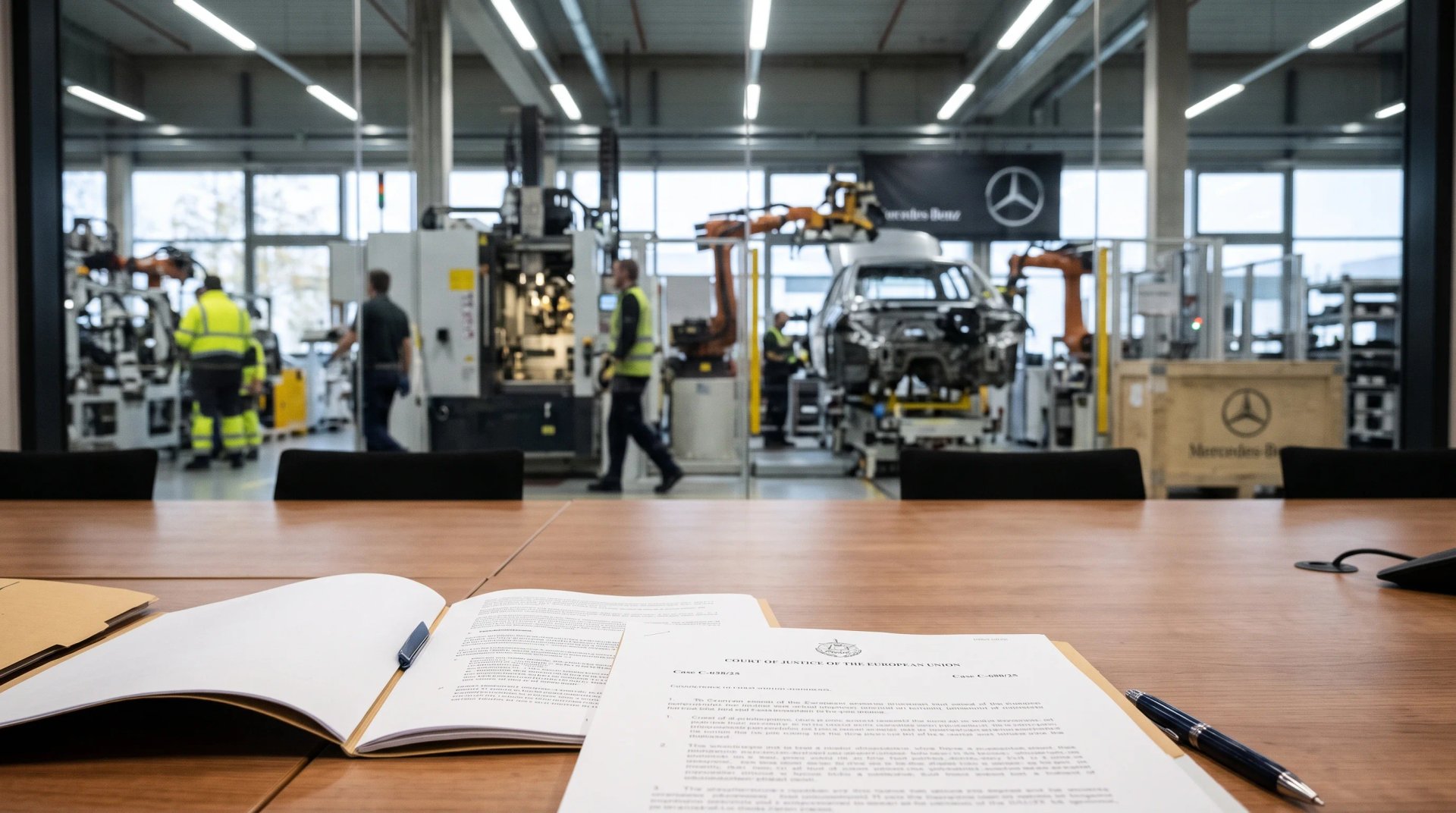
Can providing specialized equipment to subcontractors free of charge trigger an unexpected multi-million-euro VAT bill? In Case C-680/25, Mercedes-Benz AG (MB) challenged a EUR 2.4 million VAT assessment from the Romanian tax authorities. The Court of Justice of the European Union (ECJ) has now clarified where taxable services end and non-taxable business support begins.
Background of the Case
MB, a company established in Germany and VAT-registered in Romania, manufactures road transport vehicles in Romania. In 2020, it acquired certain equipment and claimed to have made it available free of charge to Romanian manufacturers for producing automotive components for MB.
Following a tax audit, the Romanian Tax Authority issued an assessment on April 3, 2023, requiring MB to pay additional VAT of RON 12,174,729 (approximately EUR 2.4 million). The assessment included VAT relating to the provision of the equipment to the manufacturers.
The Tax Authority considered that making the equipment available free of charge constituted a service supplied for consideration under Article 26(1) of the VAT Directive. It argued that MB failed to identify the manufacturers using the equipment or demonstrate that it was used exclusively to produce components for MB's own business.
According to the Tax Authority, MB had to prove that the equipment served its own economic activity rather than benefiting other taxable persons for the arrangement to qualify as a free provision of services outside the scope of VAT.
MB challenged the tax assessment through an administrative appeal, which was rejected on November 15, 2023. The competent authority argued that the equipment provided free of charge to component manufacturers would not constitute a taxable service only if the manufacturers used it exclusively to produce goods or provide services for MB.
However, it found that this condition had not been met in at least one case, where a manufacturer invoiced the goods produced using the equipment to the equipment supplier rather than to MB. The authority therefore concluded that the direct link between the free provision of the equipment and MB's own business activities had been broken.
MB subsequently appealed both the April 3, 2023 tax assessment and the decision rejecting its administrative appeal before the Bucharest Court of Appeal. It argued that the Romanian Tax Authorities had incorrectly interpreted Article 26 of the EU VAT Directive when treating the free provision of equipment as a service supplied for consideration.
Since the interpretation of Article 26 of the VAT Directive was not sufficiently clear, the Court of Appeal considered that reasonable doubts remained regarding its application. Consequently, it decided to suspend the national proceedings and refer questions to the ECJ for a preliminary ruling.
Main Questions from Request for Ruling
The Court of Appeal raised two questions before the ECJ. First, the Court asked whether Article 26 of the EU VAT Directive applies where a company provides equipment or a die free of charge to a supplier, which then makes it available to subcontractors. These subcontractors use the equipment to manufacture components for the equipment owner, sell them to the supplier, and the supplier subsequently resells them to the equipment owner.
Second, the Court asked whether the EU VAT Directive allows national courts to interpret the law in such a way that the free provision of equipment is not treated as a service for consideration only when the manufacturer sells the components directly to the equipment owner.
Applicable EU VAT Directive Articles
Three EU VAT Directive articles were relevant for this case: Articles 2, 24(1), and 26(1). Article 2 establishes that VAT applies to supplies of goods and services made for consideration within an EU country by a taxable person acting in that capacity. Article 24(1) further clarifies that any transaction that does not qualify as a supply of goods is treated as a supply of services for VAT purposes.
Under Article 26(1), certain transactions are treated as services supplied for consideration even when no payment is made. These include the use of business assets for the private needs of the taxable person or their employees, or for other purposes unrelated to the business, provided that the assets gave rise to a full or partial right to deduct VAT.
Romanian National VAT Rules
The ECJ outlined Article 271 of the Romanian Tax Code, and Point 8, paragraph 7, of Section 2 (entitled “Provision of services”) of Chapter IV of Title VII of the Implementing procedures for the Tax Code as the most relevant ones.
Importance of the Case for Taxable Persons
This case is highly relevant for multinational enterprises with multi-tiered supply chains. In sectors such as automotive, electronics, and aerospace, principal companies often give sub-suppliers specialized machinery or tooling free of charge to maintain quality standards and precise specifications. The ruling bears on cross-border supply chain structuring, input VAT deduction rights, and the evidence tax authorities may demand. It also shows how routine operational support can lead to a very large assessment.
Analysis of the Court's Findings
Admissibility
Before analyzing the raised question, the ECJ had to decide on the admissibility of the case. The Romanian Government argued that the preliminary questions referred to the ECJ were inadmissible because they were based on two contradictory factual assumptions. The first question assumed that the goods manufactured using the equipment were delivered to its owner through intermediary companies. The second assumed that the goods were delivered directly to the owner.
However, the ECJ considered that the referring court had described the circumstances of the dispute in sufficient detail. In particular, it explained that the additional VAT was imposed because the goods manufactured using the equipment were either sold through intermediaries or supplied to persons other than MB. Additionally, the ECJ clarified that the two preliminary questions were not based on contradictory assumptions.
Since it found no reason to consider the questions hypothetical or unrelated to the actual dispute, the ECJ rejected the Romanian Government's objections and declared the request for a preliminary ruling admissible. After completing this part of the procedure, the ECJ moved on to interpreting the relevant provisions and answering the main questions.
Interpreting Article 26(1)
First, the ECJ noted that the Court of Appeal referred to Article 26 of the VAT Directive without specifying the relevant paragraph. Based on the questions, it determined that they concerned Article 26(1). More specifically, the key issue was the meaning of the expression "purposes unrelated to the taxable person's business", which appears in both Article 26(1)(a) and (b).
The ECJ explained that Article 26(1) of the VAT Directive identifies two situations in which transactions carried out without payment are treated as services supplied for consideration for VAT purposes. The first, under Article 26(1)(a), concerns the use of business assets for the private needs of the taxable person or their employees, or for other purposes unrelated to the business, provided that the assets gave rise to a full or partial deduction of input VAT. The second, under Article 26(1)(b), covers services provided free of charge for private purposes or other activities unrelated to the taxable person's business.
Notably, the ECJ combined the two preliminary questions into a single issue: whether the absence of a direct invoicing relationship between the two manufacturers automatically results in the free provision of equipment becoming a taxable service.
First, the ECJ recalled that Article 26(1) of the VAT Directive ensures equal VAT treatment between taxable persons who use business assets or services for private purposes and final consumers who purchase equivalent goods or services and pay VAT.
Article 26(1)(a) closes a loophole. Without it, a taxable person could deduct VAT on goods bought for business use and then use them privately without paying VAT. Similarly, Article 26(1)(b) prevents taxable persons or their employees from receiving services free of charge for private purposes without VAT, where an ordinary consumer would have had to pay VAT for the same services.
Under the established case law, a transaction is not considered to serve purposes unrelated to a taxable person's business if it contributes to the proper functioning and profitability of that business. Likewise, transactions carried out to meet the needs and serve the interests of the business cannot be treated as activities unrelated to its economic activity.
Application to Mercedes-Benz
The free provision of equipment was not a supply of goods or services for consideration under Article 2(1)(a) and (c). But the absence of payment did not automatically take it outside the scope of VAT. Under Article 26(1), it could still be a taxable service if it served purposes unrelated to MB’s business.
While providing these clarifications, the ECJ left it to the Bucharest Court of Appeal to determine whether the equipment genuinely served MB's economic activity, particularly by examining whether the components manufactured using that equipment were used exclusively by MB.
Nonetheless, it stated that if the components were used exclusively by MB, the free provision of equipment to third-party manufacturers could not be considered an activity carried out for purposes unrelated to MB's business under Article 26(1) of the VAT Directive. Consequently, it would not be treated as a taxable service supplied for consideration.
Importantly, the ECJ recognized that MB's vehicle manufacturing business depends on specialized equipment and tooling to produce automotive components. The equipment in question was used to manufacture components intended for incorporation into MB's vehicles, meaning that MB had a clear commercial interest in ensuring that these components met its precise technical specifications.
Furthermore, the ECJ clarified that the absence of a direct invoicing relationship between MB and the component manufacturers was not decisive when determining whether the free provision of equipment served purposes unrelated to MB's business under Article 26(1) of the VAT Directive.
As a final remark, the ECJ emphasized that differences in the interpretation of national law cannot override the uniform application of EU VAT rules. Since the VAT Directive establishes a common VAT system based on a consistent definition of taxable transactions, its concepts must be interpreted and applied uniformly across all EU countries, regardless of how national legislation may interpret them.
Court's Final Decision
Under Article 26(1) of the VAT Directive, the free provision of equipment by a road vehicle manufacturer to a component manufacturer is not a taxable service supplied for consideration. This holds even where the components are sold through an intermediary rather than directly to the vehicle manufacturer. The absence of a direct invoicing relationship does not automatically trigger VAT. This applies only where the vehicle manufacturer uses the components exclusively.
Conclusion
The ruling gives useful clarity for multinationals with multi-tiered supply chains. It confirms that providing equipment free of charge to subcontractors does not, in itself, create a VAT liability, provided the national court confirms that the equipment is used exclusively for the taxable person’s own business. By focusing on the economic purpose of the arrangement rather than invoicing formalities, the decision protects common manufacturing arrangements and reinforces the uniform application of EU VAT rules.
In practice, companies should keep documentation showing how and by whom the equipment is used, since the burden of showing exclusive use is where disputes are likely to arise.