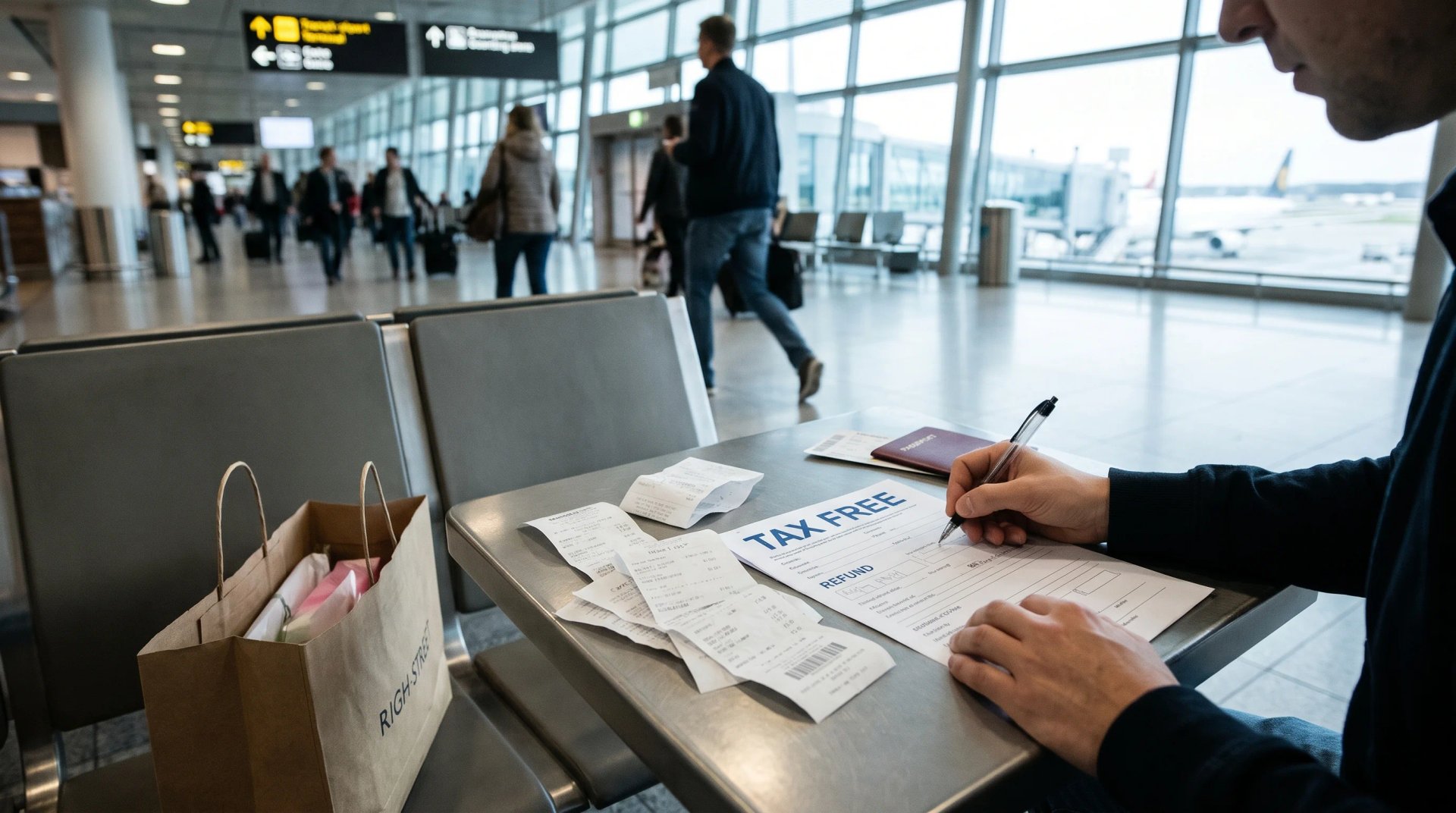
Many international travelers leave money behind. Tourist VAT refunds let you legally recover consumption taxes on eligible purchases, turning souvenir shopping and luxury finds into real savings. This guide explains how the schemes work, what they require, and how to claim your refund before you head home..
What Are Tourist VAT Refunds and How Do They Work?
VAT is generally charged on goods and services consumed within a country. However, many jurisdictions allow eligible international visitors to recover VAT paid on certain goods that they purchase during their stay and subsequently export in their personal luggage.
Tourist VAT refunds are therefore based on the destination principle of VAT, meaning that consumption should generally be taxed where it takes place. When a visitor purchases goods and exports them for use outside the country, the transaction may qualify for VAT exemption or a refund, subject to specific conditions.
The process usually involves three parties: the tourist, the retailer, and the tax refund operator or customs authority. At the time of purchase, the retailer issues a tax-free invoice or registers the transaction through an approved refund system. The tourist then presents the relevant documentation and, where required, the purchased goods to customs when departing.
Depending on the country, the VAT may be refunded directly by the retailer, through a specialized refund operator, or after customs confirms that the goods have been exported. Refund operators typically charge administrative or processing fees, meaning that the amount received by the tourist may be lower than the VAT originally paid.
General Eligibility Requirements for Tax-Free Shopping
Although eligibility requirements vary, most tourist VAT refund schemes share several basic conditions.
First, the purchaser must generally be a visitor who is not resident in the country where the goods are purchased. In the EU, for example, VAT refunds are generally available to travelers whose permanent residence or habitual address is outside the EU. EU nationals living outside the EU may also qualify if they can provide evidence of their foreign residence.
Second, the goods must generally be intended for personal or family use rather than commercial resale. They must also be physically exported within the period prescribed by the relevant jurisdiction. In the EU, eligible goods must be taken outside the EU within three months of purchase.
Third, tourists must retain the original invoices, tax-free forms, and other required documentation. Depending on the system, they may also need to present their passport, boarding pass, and purchased goods for customs inspection.
Finally, purchases must generally be made from retailers participating in the relevant tax-free shopping scheme. Not every retailer offers this service, even where the country operates a national tourist refund program.
VAT Refund Thresholds by Country
The minimum purchase required to qualify is one of the biggest differences between schemes. Some countries set a minimum value per invoice, while others let you combine several purchases under certain conditions.
European Union
The EU provides a common framework for refunds to eligible non-EU travelers, but each member state sets its own minimum purchase threshold. The three-month export rule applies across all the EU countries listed below.
Where a threshold ends in ".01", the purchase must exceed the stated amount. Other countries treat the figure as a minimum that must be reached.
Country of Purchase | Standard VAT Rate | Minimum in Local Currency |
Austria | 20% | EUR 75.01 |
Belgium | 21% | EUR 125.01 |
Bulgaria | 20% | EUR 128 |
Croatia | 25% | EUR 100.01 |
Cyprus | 19% | EUR 50.01 |
Czech Republic | 21% | CZK 2,001 |
Denmark | 25% | DKK 300.01 |
Estonia | 24% | EUR 38.01 |
Finland | 25.5% | EUR 40 |
France | 20% | EUR 100.01 |
Germany | 19% | EUR 50.01 |
Greece | 24% | EUR 50 |
Hungary | 27% | HUF 68,000 |
Ireland | 23% | EUR 75 |
Italy | 22% | EUR 70.01 |
Latvia | 21% | EUR 44 |
Lithuania | 21% | EUR 40 |
Luxembourg | 17% | EUR 74 |
Malta | 18% | EUR 50 |
Netherlands | 21% | EUR 50 |
Poland | 23% | PLN 200 |
Portugal | 23% Mainland 22% Madeira 16% Azores | EUR 61.50 Mainland EUR 61 Madeira EUR 58 Azores |
Romania | 21% | EUR 175 |
Slovakia | 23% | EUR 100.01 |
Slovenia | 22% | EUR 50.01 |
Spain | 21% | Not available |
Sweden | 25% | SEK 200 |
Other European Countries
Country of Purchase | Standard VAT Rate | Minimum in Local Currency |
UK | 20% | No refund |
Iceland | 24% | ISK 12,000 |
Norway | 25% | NOK 315 |
Serbia | 20% | RSD 6,000 |
Switzerland | 8.1% | CHF 300 |
Turkey | 20% | TRY 1,000 |
The UK no longer offers tourist VAT refunds, so visitors cannot reclaim VAT on purchases made there.
Americas
Country of Purchase | Standard VAT Rate | Minimum in Local Currency |
Bahamas | 10% | BSD 25 |
Colombia | 19% | COP 157,122 |
Peru | 18% | PEN 100 |
Uruguay | 22% | UYU 600 |
Asia-Pacific
Country of Purchase | Standard VAT Rate | Minimum in Local Currency |
Australia | 10% | AUD 300 |
China | 13% | CNY 200 |
Japan | 10% | JPY 5,000 |
Kazakhstan | 16% | KZT 43,250 |
Lebanon | 11% | USD 100 |
Saudi Arabia | 15% | SAR 500 |
Singapore | 9% | SGD 100 |
South Korea | 10% | KRW 15,000 |
Africa
Country of Purchase | Standard VAT Rate | Minimum in Local Currency |
Morocco | 20% | MAD 2,000 |
South Africa | 15% | ZAR 250.01 |
Note: VAT rates and thresholds change often. Confirm the current figures with the retailer or the national tax authority before you travel.
How to Claim a VAT Refund When Leaving a Country
The VAT refund process generally begins at the retailer. Tourists should inform the retailer that they are eligible for tax-free shopping and present their passport or other required identification. The retailer then issues the necessary tax-free documentation or registers the purchase electronically.
Before departure, tourists should check whether their purchases must be presented to customs at the airport, seaport, or another designated exit point. Where physical validation is required, the goods should remain accessible for inspection. Travelers checking their purchases into hold luggage should complete customs validation before handing over their baggage.
Depending on the country, validation may take place through electronic kiosks, customs counters, or digital systems. Once the export has been confirmed, the tourist can request the refund through the retailer, an authorized refund operator, or an airport refund counter.
Refunds are commonly issued to credit or debit cards, although some jurisdictions also permit cash payments or other electronic payment methods. Processing times and fees vary depending on the provider and payment method.
Common Challenges and Reasons for Refund Rejection
Despite the availability of tax-free shopping schemes, tourists may encounter several practical difficulties when claiming refunds.
One common issue is failing to meet the minimum purchase threshold. In countries where the threshold applies per invoice or retailer, combining purchases from unrelated shops may not be permitted. Tourists should therefore verify whether separate transactions can be aggregated before making purchases.
Another frequent problem is incomplete or incorrect documentation. Missing invoices, incorrect passport details, improperly completed tax-free forms, or failure to register purchases through the required system can prevent a refund from being approved.
Failure to export goods within the prescribed deadline is another reason for rejection. Tourists must ensure that purchases are taken out of the country or customs territory within the applicable period. Similarly, goods that cannot be presented for inspection when required may not qualify for a refund.
Tourists should also be aware that not all VAT paid is necessarily recoverable. Refund operators may deduct administrative fees, transaction charges, or commissions. Certain goods and services may also be excluded from individual schemes. Consequently, the final refund can be considerably lower than the VAT initially paid.
Final Takeaways
Tourist VAT refunds let international visitors recover consumption taxes on eligible goods they export after purchase. But availability and procedures differ considerably between countries. For travelers, the key points are eligibility, minimum spending thresholds, export deadlines, documentation, and refund fees. Retailers and refund operators also need to understand the national rules so that every transaction is correctly documented and validated.