
Since 2017, Taiwan has implemented VAT rules targeting foreign e-commerce operators (FECO), requiring those engaged in in-scope activities to register, collect, and remit VAT on certain cross-border digital services supplied to local consumers. These rules are part of Taiwan's ongoing effort to align its tax system with international developments and address the challenges posed by the ever-changing digital economy.
Who Qualifies as a Foreign E-commerce Operator (FECO)
The 2017 amendments expanded the scope of Taiwan’s VAT rules to cover foreign e-commerce operators that provide digital or online services to customers in Taiwan, regardless of whether they have a physical presence or a registered business in the country.
The term electronic services was intentionally redefined to include streaming services, online gaming, mobile applications, software-as-a-service (SaaS), e-books, online advertising, and cloud-based services. As a result, a wide range of digital platforms, including hotel booking websites, ridesharing applications, and online auction or bidding platforms, fell within the scope of VAT. The system primarily targets B2C transactions, whereas the reverse charge mechanism applies to B2B transactions.
VAT Obligations Under FECO Rules
Foreign e-commerce operators that fall under the scope of the regime are subject to several key VAT obligations, starting with registration. The VAT registration threshold set in 2017 was NTD 480,000 (Approximately USD 15,000). However, this threshold was increased in 2025 to NTD 600,000 (around USD 18,700). Once foreign e-commerce operators that provide digital services to consumers in Taiwan exceed the threshold, they must register for VAT.
To complete the VAT registration process, foreign e-commerce businesses must provide several pieces of information and documents, including company registration papers from the country of origin and a Power of Attorney to appoint a tax agent if they are not registering for VAT themselves. Importantly, FECOs can register for VAT only via the eTax portal, an electronic platform established by the Ministry of Finance.
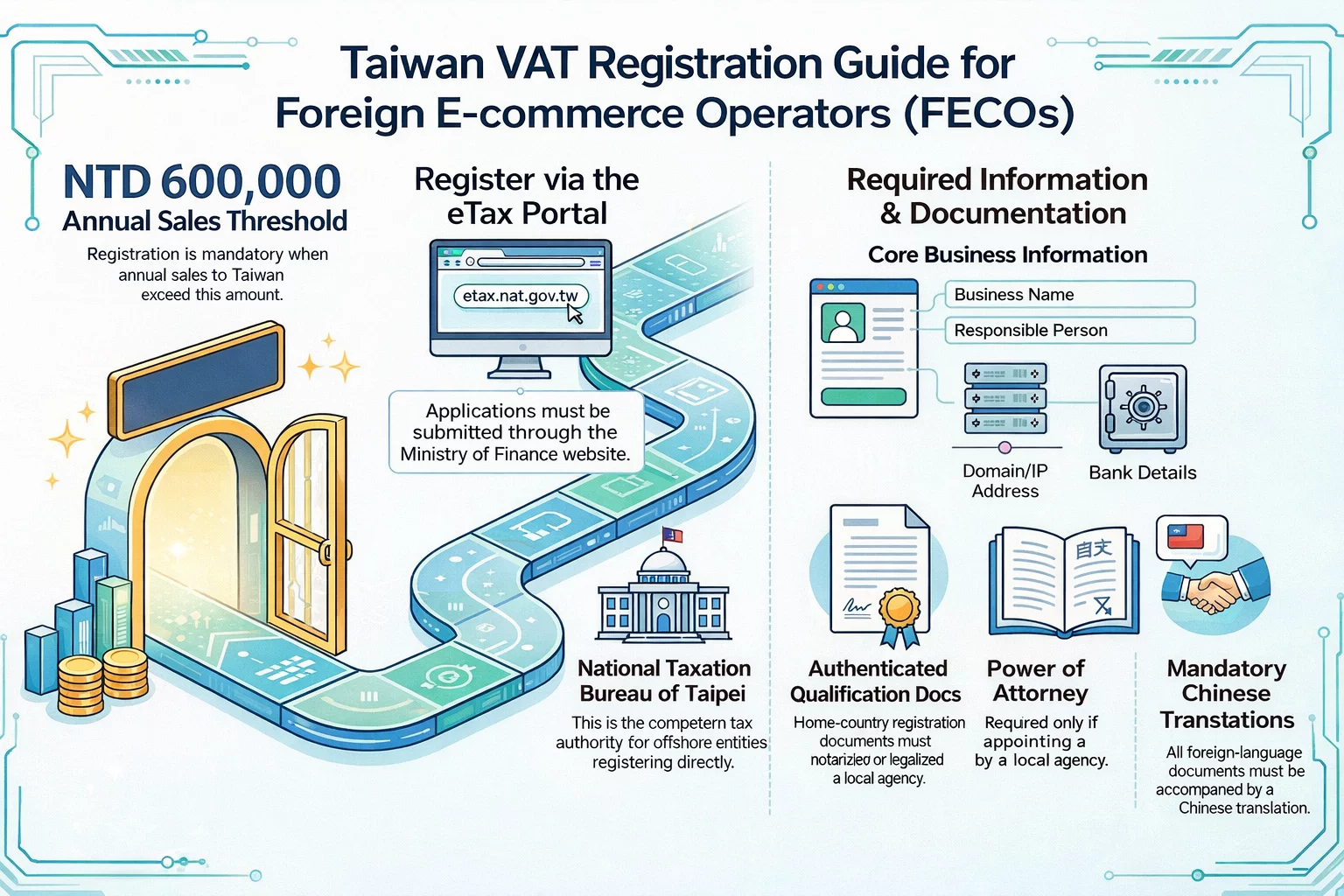
Note: Data in the image is from the Fiscal Information Agency - Tax on Cross-Border Electronic Services
Once registered, foreign operators must apply a 5% VAT rate on all transactions and issue Government Uniform Invoices (GUI), a standardized invoice used in Taiwan, to Taiwan customers. Since 2019, cloud-based GUIs have been required for all transactions with local consumers. The foreign digital suppliers must also file a bi-monthly VAT return.
Failure to Comply with VAT Rules
Failure to comply with these rules may result in severe financial penalties. For example, failing to register for VAT can result in fines ranging from NTD 3,000 (approximately USD 94) to NTD 30,000 (around USD 940). If foreign operators fail to comply with this requirement after receiving a formal notification, it can trigger additional, consecutive penalties, increasing the financial consequences.
On the other hand, filing a VAT return late incurs penalties based on the extent of the delay and whether any tax is owed. Thus, if the return is filed within 30 days after the 15-day grace period, a late fee of 1% of the tax due is applied every two days, with a minimum of NTD 1,200 (about USD 37.5) and a maximum of NTD 12,000 (around USD 375). Those who file a return more than 30 days late face a steeper penalty of 30% of the tax due, ranging from NTD 3,000 to NTD 30,000.
Foreign taxable persons must file a return even if tax is owed. Filing a late return in this case may lead to penalties of NTD 1,200 if filed within 30 days of the due date or NTD 3,000 if filed after 30 days.
Penalties are also defined for non-compliance with the obligation to issue cloud-based GUIs. The penalty for this violation can go up to five times the tax that should have been collected through the invoice. If the offense is repeated more than three times within 12 months starting from the first offense, the defined penalty is the closure of the FECO’s business.
Tax Transparency Meets Consumer Rewards: Taiwan’s Invoice Lottery
To reduce underreporting of business income and promote proper tax compliance, the Taiwanese Tax Authority developed a lottery system using GUI serial numbers. The idea behind this lottery system is to incentivize individuals to request GUIs when making purchases, as the serial numbers on their invoices can be checked against government-announced lottery numbers.
Prizes are awarded every two months, and the latest result for the January–February 2026 Uniform Invoice lottery shows that 109 winners claimed the four main prizes, including the Special Prize, Grand Prize, First Prize, and a dedicated million-NTD prize for e-invoices.
Best Practices for FECO Compliance
Being proactive is always the key compliance approach. To comply with Taiwanese VAT rules and regulations, the first step is to determine whether their services fall within Taiwan’s digital services rules. However, since the scope of electronic services is broad, most services are likely to fall under this category. Thus, the next step is to monitor the revenue threshold.
To determine whether services are provided in Taiwan, foreign operators must assess whether their consumers are located there. There is evidence suggesting the consumer is there. For example, data including whether the purchaser uses a computer or mobile device connected to the internet from within Taiwan, whether a mobile device has the country code 886, and information provided by the buyer, such as billing address, payment bank account, or the IP address of their devices, may establish the customer’s location for VAT purposes.
Additionally, foreign businesses should carefully examine whether they might benefit from appointing a tax representative or agent for VAT purposes. Apart from assisting with the VAT registration, a tax agent may also help with invoicing and reporting obligations, thereby reducing the administrative burden on internal teams.
Concerning the administrative tasks, maintaining proper documentation is another critical element of compliance. All VAT-related documents and records must be stored for 10 years and made available upon request by the Taiwanese Tax Authority.
Staying informed about regulatory changes is another common piece of advice for successful compliance. Some recent changes, such as exempting foreign influencers from VAT registration, filing, and payment obligations in Taiwan, and shifting the responsibility to foreign platforms, which can credit the input tax on services purchased from influencers against their own output tax, only confirm how important regulatory oversight is.
Source: Grant Thornton, PwC, Deloitte, VATabout - Taiwan VAT Threshold Increase, EY, VATabout - Taiwan VAT Late Filing Penalties Explained, VATabout - Taiwan's Cloud Invoice Lottery for Foreign Digital Services, Fiscal Information Center, Ministry of Finance, Fiscal Information Agency - Tax on Cross-Border Electronic Services