
Chile has, in recent years, significantly updated its VAT rules to address the rapid growth of cross-border trade, particularly in e-commerce and the digital economy. Similar to many other countries with more traditional VAT rules in place, Chile's national rules applied broadly to goods and services consumed within the country, leaving a large portion of revenue from digital trade out of the VAT scope.
With a precise goal of expanding the tax base and increasing revenue, the Chilean Tax Authority, known as SII, extended and clarified VAT obligations for non‑resident sellers and digital platforms, equalizing the tax treatment of domestic and foreign sellers.
Legal Framework Overview
The change in VAT rules for foreign digital service providers began in 2020, when supplies of digital services to local consumers became subject to a 19% standard VAT rate. Moreover, the 2020 rules required registration and tax collection under a simplified regime administered by the SII, through an online portal. However, that was only the beginning of changes, which continued in 2024 and 2025.
In 2024, the SII issued a Directive that expanded Chile’s digital VAT regime from covering only digital services to also include digital platforms and marketplaces facilitating cross-border sales of low-value goods to Chilean consumers.
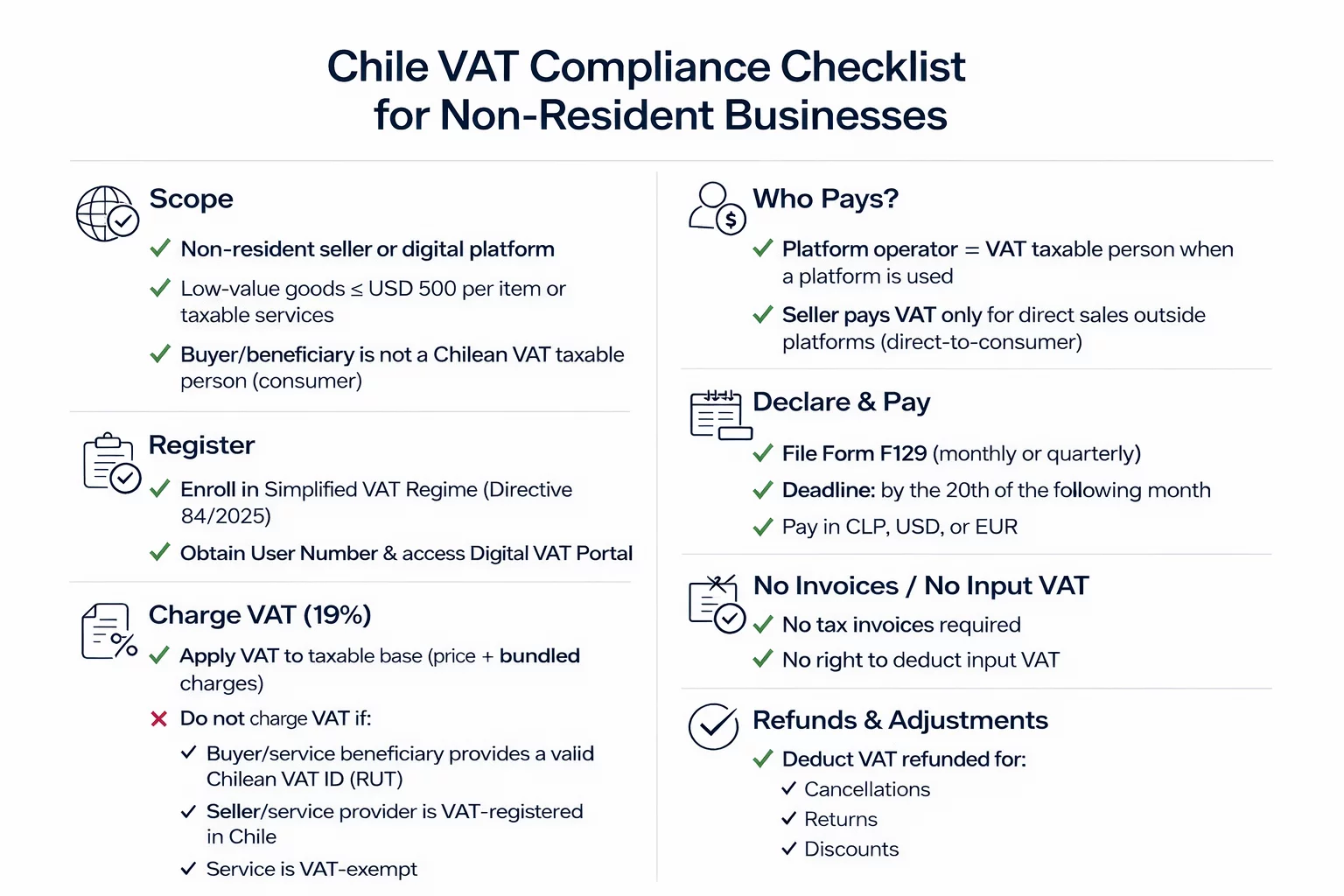
Moreover, the Directive amended rules for low-value goods by removing the de minimis exemption previously set at approximately USD 41, and setting a new USD 500 threshold. As a result, low-value goods with a value of up to USD 500 purchased through digital platforms and marketplaces became subject to VAT under the simplified regime, replacing import VAT and customs duties.
Notably, the USD 500 threshold includes charges bundled with the purchase of the goods, such as shipping, insurance, or additional packaging, which are charged to the consumer for each item or article as part of the price. In cases when such additional charges are not charged to the consumer for each item or article, they must be proportionally allocated among the various items included in the transaction.
Nonetheless, the reform did not end there because not all aspects of these new rules and requirements were adequately addressed or defined. Thus, in April 2025, SII published the Guidance regarding the 2024 amendments to the VAT Law, followed by a Directive in July 2025, which established a procedure for non-resident businesses to register under the simplified VAT regime.
Compliance Requirements for Foreign E-commerce Sellers and Digital Platforms
Under the new rule, from October 25, 2025, foreign sellers of low-value goods to local consumers, digital platform operators facilitating such sales or services, and resellers and dropshippers must register for VAT purposes in Chile. However, registration is only part of the compliance process, which includes changing, collecting, reporting, and filing VAT.
Registration Under Simplified Tax Regime
To declare and pay VAT in Chile, foreign sellers of low-value goods and digital platforms that facilitate such sales must register with the SII’s Digital VAT Portal. The registration process begins by completing the Registration Form in the Enrollment and Registration section of the Digital VAT Portal, available in both English and Spanish. Once the form is completed, it must be submitted electronically to the SII using the Send Form option.
To confirm the accuracy of the information provided, the SII sends a verification email containing a validation code to the email address specified in the form. After this verification step is completed, the taxable person receives a Tax ID known as the User Number, which is then used to create a password. With these credentials in place, the business can securely access and navigate the Digital VAT Portal to manage its VAT compliance obligations.
What is important to underline is that the registration does not create a permanent establishment for income tax purposes, and taxable persons under this regime do not issue traditional Chilean VAT invoices. The registration is only relevant for reporting and paying VAT through simplified forms. For digital platforms or marketplaces that intermediate multiple types of remote sales to Chilean customers, registration must reflect both goods and services.
The regulators offered a voluntary registration option from August 1, 2025, until registration became mandatory on October 25, 2025. As reported by the SII, 20 international digital platform operators and businesses registered before October 25, through the simplified regime. These 20 companies, including AliExpress, Amazon, eBay, Shopee, Shein, and Temu, account for 90% of the remote sales of low-value goods to local consumers.
Charging and Collecting VAT
As already stated, registered e-commerce sellers and digital platforms must apply the 19% VAT rate to sales of digital services to consumers in Chile and on low‑value goods sold through digital platforms or direct online stores.
When a digital platform facilitates a sale by a third‑party foreign seller, the platform itself is treated as the taxable person responsible for VAT if neither the seller nor the consumer is a registered taxable person for VAT in Chile. This deemed supplier rule shifts the compliance burden to the marketplace to ensure VAT is charged correctly, reported, and remitted.
VAT Filing and Payment Obligations
Ultimately, charged and collected VAT must be reported and paid. To meet this obligation, foreign businesses must submit VAT returns electronically through the SII’s portal using simplified reporting forms and make payments in accordance with the payment timelines set by the authority. Notably, filing and payment frequency are typically monthly or quarterly.
Additionally, both reporting and payments can be made in CLP, EUR, or USD, at the taxable person's choice. However, if the taxable person changes the reporting and payment currency, all subsequent reports, payments, modifications, and corrections must be made in the new currency.
It is necessary to clarify that taxable persons registered through the simplified regime are not entitled to recover input VAT credits, which simplifies reporting but increases the importance of accurate tax collection at the point of sale.
Also, as clarified under the so-called “Hierarchy Rules,” even if the foreign seller has registered under the simplified regime, the platform remains responsible for payment of VAT on underlying transactions facilitated through its system.
Practical Compliance Recommendations
Foreign e-commerce sellers and suppliers must determine whether their goods or services are subject to VAT and the simplified regime. Since there is no VAT registration threshold and the threshold for low‑value goods now encompasses items up to USD 500, almost all direct‑to‑consumer e‑commerce transactions are likely VAT‑taxable when sold to Chilean consumers. Additionally, sellers must adapt their pricing and checkout systems to reflect 19% VAT where applicable.
Digital platforms have an additional layer of responsibility and must proactively verify the VAT status of third‑party sellers on their marketplaces to ensure accurate identification for tax purposes. Sellers may declare they are exempt from this obligation due to tax-exempt status.
Still, platforms must annually report to the SII those who claim exemption, including their total number of transactions and amounts. This initial compliance verification began on October 1, 2025, where platforms and payment providers must conduct periodic six-month supplier compliance verifications starting from January 1, 2026.
In either case, maintaining detailed documentation and establishing a robust reporting system, including regular reconciliation of sales data with VAT filings, is critical. Even though appointing a local representative is not required, engaging with local experts or advisors who have a deep understanding of Chilean rules and regulations can further enhance compliance and mitigate the risk of fines or penalties.
Source: VATabout - Chile Expands VAT Rules for Digital Platforms in 2025, SII - Directive No. 93, SII - Digital VAT and the Simplified Tax Regime, EY, KPMG, SII - Notice