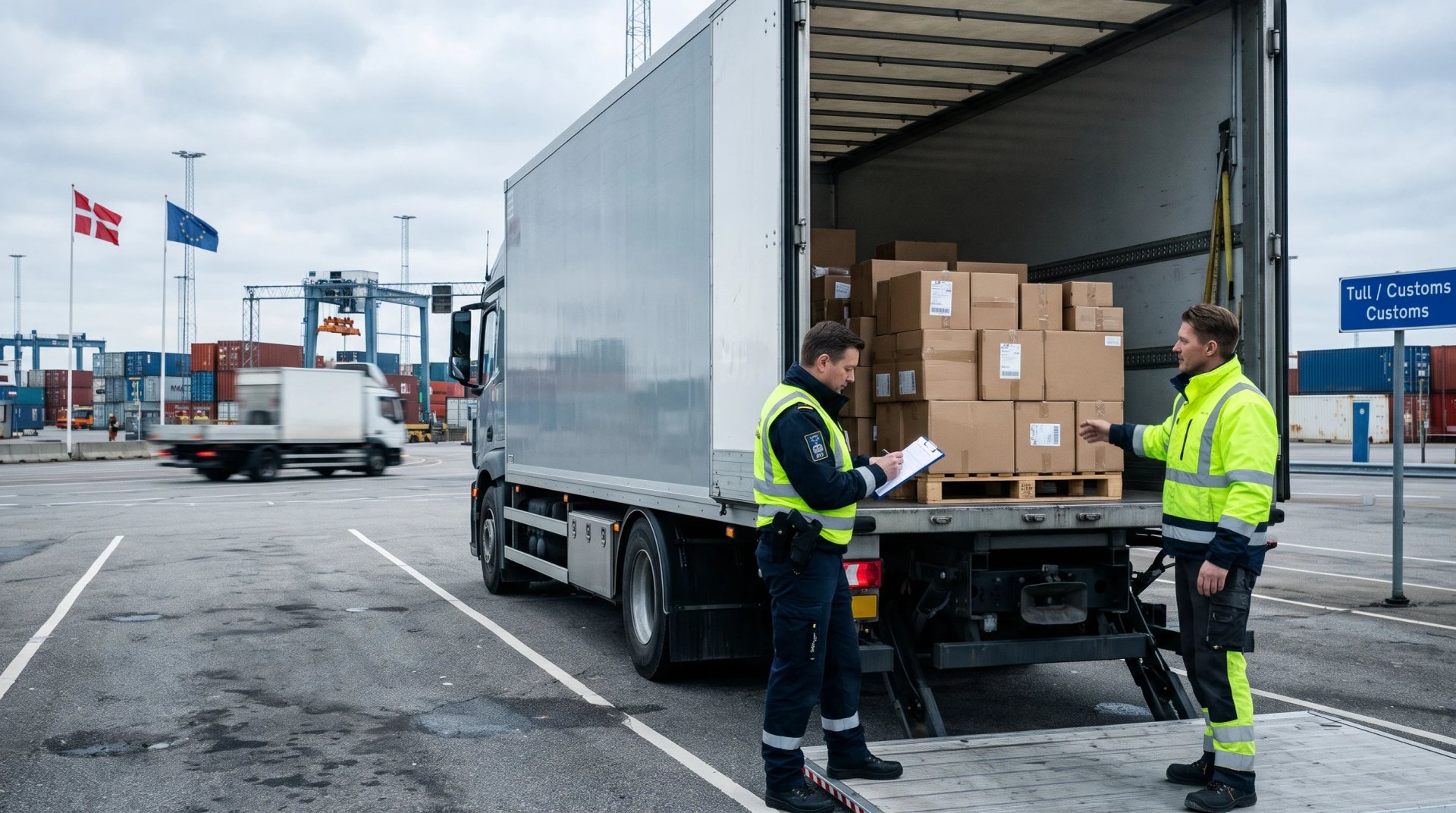
When goods temporarily escape customs oversight during international transit, who bears the cost: the carrier or the tax authorities? In this case, the Court of Justice of the European Union (ECJ) examined whether procedural errors in moving electronic goods across EU borders automatically give rise to a customs debt and deny a carrier the right to deduct import VAT.
Background of the Case
DSV, a Danish transport and logistics company, initiated two external Community transit procedures in 2007 and 2008 to transport 148 and 703 packages of electronic goods, respectively, from the free port of Copenhagen in Denmark to Jönköping in Sweden. The Danish customs authorities released the goods without physically inspecting them and set deadlines for their presentation at the destination customs office.
In both cases, the consignee in Jönköping refused to accept the goods. DSV therefore returned the shipments to Copenhagen without presenting them to the customs authorities at either location and without formally closing the original transit procedures.
The company maintained that the same 148 and 703 packages were subsequently included in new shipments to Jönköping, alongside other electronic goods. New transit procedures and documents were issued for these second shipments, comprising 573 and 939 packages, respectively. Both new transit procedures were properly completed.
However, the Danish Ministry of Taxation disputed DSV’s claim that the packages covered by the original transit procedures were also included in the subsequent shipments. The central issue was therefore whether the original goods were transported under the second transit procedures, despite the failure to formally discharge the first procedures.
The Danish Tax and Customs Authority demanded that DSV pay customs duties for each of the two original transit procedures that had not been formally discharged. The claims relied primarily on Article 203 of the Customs Code, unlawful removal of goods from customs supervision, and alternatively on Article 204, non-compliance with customs obligations. The authority also demanded import VAT on the goods under the relevant provision of Danish customs law.
The company paid the import VAT, but it was denied the right to deduct it. Consequently, DSV challenged these decisions, and the dispute was brought before the Eastern Regional Court of Appeal in Denmark. The court subsequently suspended the proceedings and referred questions to the ECJ for a preliminary ruling on the interpretation of the applicable EU customs and VAT rules.
Main Questions from the Request for Ruling
The Eastern Regional Court of Appeal raised four questions before the ECJ. The first question concerned whether the goods had been removed from customs supervision under Article 203(1) of the Customs Code, which could trigger a customs debt. The court asked whether the outcome would differ depending on whether the goods returned to Copenhagen were the same goods subsequently dispatched to Sweden under new transit procedures or whether their identity could not be established.
The second question concerned Article 204 of the Customs Code and whether a customs debt arose from the failure to comply with the obligations associated with the original transit procedures. With the third question, the Danish court addressed Article 859 of the Implementing Regulation, asking whether the alleged breach could be treated as an infringement that had no significant effect on the proper operation of the customs procedure, potentially preventing a customs debt from arising.
The fourth question focused on import VAT deductibility under Article 168(e) of the VAT Directive. More specifically, whether Denmark could refuse DSV the right to deduct import VAT when DSV had been charged that VAT as the carrier responsible for transporting and handling the customs formalities, even though it was neither the importer nor the owner of the goods.
Applicable EU VAT Directive Articles
To answer this question, the ECJ interpreted Articles 168 and 201 of the EU VAT Directive. Additionally, the ECJ noted the importance of Articles 37, 92, 96(1), 203, and 204(1) of the EU Customs Code, as well as Articles 256 and 859 of the Implementing Regulation.
Denmark National VAT Rules
The ECJ outlined Article 39(1) of the Danish Customs Law and Article 37 of the VAT Law, as most relevant for settling this case.
Importance of the Case for Taxable Persons
Carriers and freight forwarders often act as principals in transit procedures, so customs authorities approach them first when something goes wrong, even though they do not own the goods. Routine events such as refused deliveries or consolidated cargo can lead to large customs and VAT claims years later. The case is a useful reference for risk assessments and contract terms.
Analysis of the Court's Findings
Was There Removal from Customs Supervision?
Concerning the first question, the ECJ considered two possible scenarios: first, where it could be established that the same goods were subsequently transported to their destination under a second transit procedure that was correctly completed; and second, where it could not be proven that the goods covered by the first and second transit procedures were identical.
In its analysis, the ECJ emphasised that Articles 203 and 204 of the Customs Code address different situations. Article 203 applies when goods are removed from customs supervision. On the other hand, Article 204 concerns failures to fulfil customs obligations or comply with the conditions of a customs procedure that do not result in the goods being removed from customs supervision. Article 204 therefore applies only when the circumstances fall outside the scope of Article 203.
Therefore, determining whether a customs debt arises under Article 203 or Article 204 of the Customs Code requires a sequential assessment. First, it must be established whether the goods were unlawfully removed from customs supervision within the meaning of Article 203(1). Only if no such removal occurred can Article 204 be considered as a possible basis for the customs debt.
In this sense, the ECJ clarified that removal from customs supervision covers any act or omission that prevents the competent customs authorities, even temporarily, from accessing goods under customs supervision and carrying out the necessary checks and monitoring. As a result, a customs debt under Article 203 may arise even if the goods are inaccessible to customs authorities only for a short period.
If it could not be established that the goods transported under the first and second transit procedures were the same, the conditions for a customs debt were satisfied. Conversely, if it was established that the goods were identical, and they were eventually presented to the destination customs office during the second dispatch, the circumstances did not automatically constitute removal from customs supervision.
The ECJ explained that because the first transit procedure had not been formally discharged or the customs destination and procedure of the goods officially changed, the goods remained subject to the original transit procedure when they returned to Copenhagen. Customs supervision during transit is inherently remote: authorities cannot track goods at every moment. Goods that are temporarily out of the authorities’ immediate reach have therefore not necessarily been unlawfully removed from supervision.
The ECJ added that customs supervision is not automatically compromised when goods are not presented at the destination customs office or at the customs office of a free port, provided that all other requirements of the transit procedure are satisfied. In such circumstances, the goods remain covered by an authorized transit procedure and the corresponding transit documents, allowing customs authorities to access and inspect them.
Late Presentation and Insignificant Infringements
In light of its answer to the first question, the ECJ held that the second and third questions needed to be examined only if it could be established that the goods transported under the first and second transit procedures were identical. The ECJ considered the second and third questions together, focusing on whether the late presentation of goods under a second transit procedure, when those goods had originally been placed under a first transit procedure, constituted a failure to fulfil customs obligations giving rise to a customs debt.
In that regard, the ECJ noted that exceeding the deadline for presenting goods at the customs office of destination generally constitutes a failure to fulfil an obligation under the transit procedure and can therefore give rise to a customs debt. Additionally, the ECJ highlighted an exception under Article 356(3) of the Implementing Regulation.
Under this exemption, if goods are presented after the deadline because of circumstances beyond the control of the carrier or principal, and those circumstances are satisfactorily explained to the customs office of destination, the deadline is deemed to have been met. However, it is up to the Danish court to determine whether DSV’s circumstances satisfied these conditions.
The ECJ then examined whether the failure to comply with the original transit procedure could be considered an infringement that had no significant effect on the proper operation of the customs procedure, thereby preventing a customs debt from arising under Article 204 of the Customs Code.
Under the relevant provisions, including Article 859 of the Implementing Regulation, the formalities necessary to regularise the situation of the goods must subsequently be completed, and the goods must have been presented intact at the customs office of destination. The Danish Government argued that these conditions were not satisfied because the goods were not initially presented to customs and were mixed with other goods before a new transit procedure was initiated.
On that account, the ECJ held that if it could be established that the goods transported under the first and second transit procedures were identical and that the second procedure was correctly completed, the relevant conditions under Article 859 of the Implementing Regulation would be satisfied.
The fact that the first transit procedure had not been properly discharged did not, by itself, prevent the subsequent completion of the formalities necessary to regularise the goods. Furthermore, the goods had ultimately been presented intact at the customs office of destination.
One further requirement remains. Under Article 859(2)(c), if the deadline was exceeded and Article 356(3) does not apply, the goods must still have been presented within a reasonable period. The national court must decide whether DSV met this requirement.
Can a Carrier Deduct Import VAT?
The right to deduct import VAT exists only where the imported goods are used for the taxable person's own taxable transactions. That condition is met when the cost of the goods or input services forms part of the price of specific taxable supplies or of the taxable person's general overheads.
Here, the value of the transported goods was not included in the prices DSV charged for transport. Because DSV was paid only to carry the goods, and did not buy or resell them, there was no link between the imported goods and DSV's taxable transactions.
Court's Final Decision
The ECJ ruled that customs debt does not automatically arise when goods are returned to the port of departure after an unsuccessful delivery attempt without being presented to customs, provided it can be established that the same goods were subsequently transported to their destination under a second correctly completed external Community transit procedure. If the identity of the goods cannot be established, a customs debt arises under Article 203 of the Customs Code.
Furthermore, presenting goods late at the destination customs office under a second transit procedure generally constitutes a failure to fulfil obligations under Article 204, potentially giving rise to a customs debt. However, the debt may be avoided if the conditions under Article 356(3) or the relevant provisions of Article 859 of the Implementing Regulation are satisfied. The national court must determine whether these exceptions apply in the circumstances of the case.
Lastly, Article 168(e) of the VAT Directive does not prevent national legislation from denying the deduction of import VAT paid by a carrier that is neither the importer nor the owner of the goods and whose role is limited to providing taxable transport and customs-handling services. This is because the value of the imported goods is not incorporated into the costs of the carrier’s taxable transport services, meaning the required link between the imported goods and its taxable transactions is not established.
Conclusion
The judgment shows how strict EU customs law is in practice. Administrative irregularities do not automatically create customs liability if the goods ultimately reach their destination intact under a valid procedure. Yet failing to discharge transit formalities properly remains a serious legal risk, and it can be decisive when the identity of the goods cannot be proven.
The ruling also confirms that transport providers cannot recover import VAT when they do not own the goods. Logistics companies should therefore close every transit procedure properly, keep records that can prove the identity of the goods, and structure their commercial contracts so that import VAT and customs charges do not become unrecoverable costs.