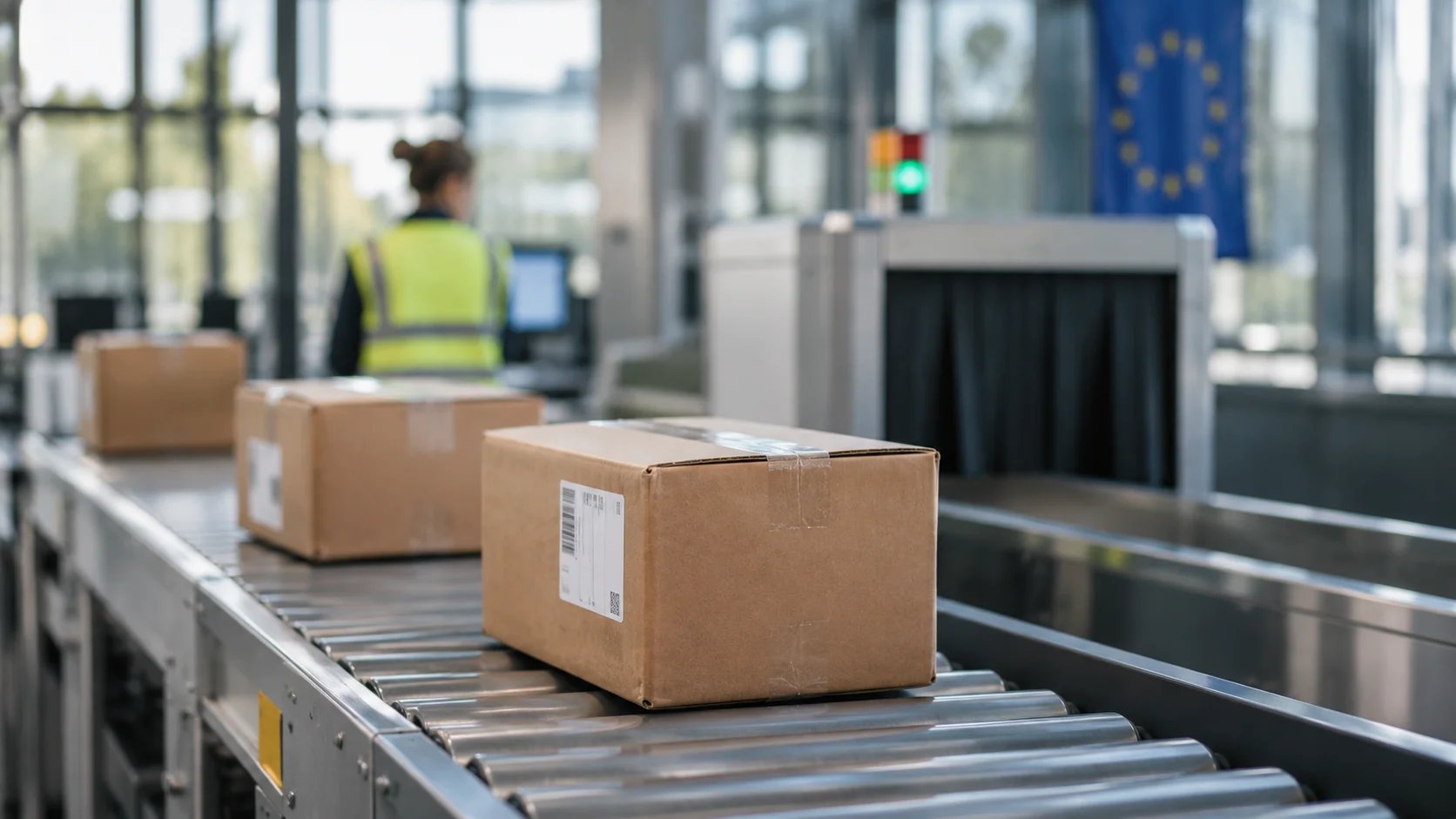
On November 9, 2026, the Council reached a general approach on a draft Directive amending Directive 2006/112/EC, removing the EUR 150 threshold from both the Import One Stop Shop (IOSS) and the deemed supplier regime. The text is Council document 15480/26. Member States would apply the new rules from July 1, 2028, subject to a condition worth reading closely.
What the Draft Directive Changes
The deemed supplier regime loses its ceiling. Article 14a(1) of the VAT Directive currently treats a platform as having received and supplied the goods itself only where it facilitates distance sales of imported goods in consignments not exceeding EUR 150. The amended text deletes that limit, so the regime covers all distance sales of imported goods irrespective of value.
The IOSS loses the same ceiling. Recital 3a explains the purpose: so that taxable persons making distance sales of imported goods "are not obliged to register for import VAT in each Member State of destination of the goods". Products subject to excise duty remain outside the scheme under the amended Article 369l. The scheme's existing shape, including the exemption and threshold rules for low-value goods, is otherwise unchanged.
The definition of distance sales widens, so that goods dispatched from a customs warehouse for distance sales inside the customs territory of the Union count as distance sales of imported goods.
Who the Deemed Supplier Rule Catches
The Council's press release describes the change as meaning that non-EU online platforms will be treated as the deemed supplier. The Directive text does not say that.
The amended Article 14a(1) reads: "Where a taxable person facilitates, through the use of an electronic interface such as a marketplace, platform, portal or similar means, distance sales of goods imported from third territories or third countries that taxable person shall be deemed to have received and supplied those goods himself."
There is no establishment condition. A marketplace established in the EU that facilitates sales of imported goods is caught on the same terms as one established outside it. For sellers already working through the distance sales framework as it applies at national level, that is the part to check first.
Customs Warehouses: One Kind, Not All
Recital 4 states that the IOSS "can be applied only for supplies from special customs warehouses for distance sales as provided for in Regulation (EU) 2026/2108", and adds: "For other customs warehouses, the normal VAT rules remain applicable."
The Regulation, which brought in the 2026 Union Customs Code and a set of e-commerce changes with it, makes that narrower than it first appears. Under Article 145(1), only importers for distance sales using the IOSS scheme who hold Trust and Check trader status, or their indirect representatives holding that status, may be authorised to operate such a warehouse. Article 31(1) requires two years of regular customs operations before a trader can apply for that status, and Article 31(3)(g) requires, for an importer for distance sales, two years of registration and appropriate use of the IOSS scheme.
Article 145(2) adds conditions on the goods. They must already comply with the rules that would apply on release for free circulation, be packed in collective packages of alike goods before individual consignments are prepared, and arrive in quantities that allow effective customs controls. Recital 20 of the Regulation explains the intent: to shift volume from individual parcels to bulk.
There is an incentive attached. Under Article 20(4) of the Regulation, the per-item Union handling fee is lower for goods sold in distance sales from a customs warehouse for distance sales than for goods shipped directly to the consumer.
Article 145 applies from July 1, 2028. A business that wants this route available then needs the status in place by then, and the two-year IOSS condition means the clock on that started well before the Council agreed to remove the threshold.
Optional in Name
The IOSS does not become mandatory. Businesses can still choose whether to use the scheme. That choice, however, now carries a cost that did not exist before.
Council Directive (EU) 2025/1539, adopted on July 18, 2025, already governs what happens outside the scheme, and it applies from July 1, 2028. This is the instrument behind the 2028 rules for non-EU importers agreed at ECOFIN last year. Its replaced Article 201(2) makes the supplier or deemed supplier the person liable to pay the import VAT on distance sales that would be eligible for the IOSS.
Recital 1 describes what follows from that, and it is careful about it. Those persons "should, as a rule, be made liable for import VAT and VAT on distance sales of imported goods in the Member States of final destination of the goods, which would require registration in each of those Member States." So the liability itself is stated in the enacting text, while multiple registration is the normal consequence rather than an automatic one in every case.
Two further provisions matter. Under the replaced Article 201(3), a supplier or deemed supplier established in a third country with which neither the Union nor the Member State of importation has a mutual assistance agreement similar in scope to Directive 2010/24/EU shall appoint a tax representative in the Member State of importation. The amended Article 205 allows Member States to make an additional person jointly and severally liable for the import VAT. Running the other way, the inserted Article 201a allows Member States to let the customer pay the import VAT due by those persons. The old Title XII Chapter 7 arrangements, under which the customer could be the person liable, are deleted.
So the IOSS remains optional in the sense that nothing compels registration. For qualifying distance sales, declining it generally means import VAT liability in the destination Member States, separate registrations there, and for certain non-EU businesses a tax representative. Removing the EUR 150 ceiling widens both sides of that choice at once, bringing higher-value consignments into the scheme and into the liability rule that refers to it.
The Date, and What Could Move It
Member States must adopt and publish the implementing measures by June 30, 2028, and apply them from July 1, 2028.
The second subparagraph of Article 2(1) is the part to plan around. Where the functionality relevant to the IOSS scheme under Article 285(2) of Regulation (EU) 2026/2108 is not operational by June 1, 2028, Member States apply the provisions instead from the date on which the transitional solution under Article 285(7) of that Regulation is no longer in place.
Both dates sit in the Regulation itself. Article 285(2) sets June 1, 2028 for the functionality. Article 285(7) requires the Commission to provide a transitional solution where a functionality is not ready, and limits it: the solution "shall be in place for no longer than six months after the deadlines set out in this Regulation", and the Commission must make the functionality operational before it expires. As the relevant deadline is June 1, 2028, that points to a latest end of around December 1, 2028, subject to how the provision is applied in practice.
What a delay would not do is separate the liability from the simplification. The replaced Article 201(2) applies to distance sales "that would be eligible" for the IOSS, which is a reference to the scheme's scope rather than a fixed value. If the draft Directive has not taken effect, IOSS eligibility still stops at EUR 150, and so does the liability rule that points at it. The same holds for the deemed supplier regime, since Article 14a(1) and Article 369l are amended by the same instrument on the same date.
What is unconditional is the change for consignments already within the scheme. From July 1, 2028, Directive (EU) 2025/1539 applies whatever happens to the draft Directive. For those goods it moves the import VAT liability onto the supplier or deemed supplier, deletes the Title XII Chapter 7 arrangements, and brings in the tax representative requirement for certain third-country suppliers. That part is already law.
Harmonised Minimum Standards for IOSS Intermediaries
Recital 3c identifies the problem as an absence of EU-wide harmonisation rather than an absence of national controls: where non-EU taxable persons appoint an intermediary, "the controls carried out by Member States are currently not subject to any harmonization".
The replaced Article 369o requires the Member State of identification to ensure that an intermediary has sufficient administrative capacity, financial solvency and probity, where the trader is established in a third country without a comparable mutual assistance agreement. The minimum criteria are to be set by the Council under Article 397, on a Commission proposal to be submitted by December 31, 2027.
A new Article 369la requires the Commission to report to the European Parliament and the Council by December 1, 2030 on how the scheme is functioning, including the effectiveness of VAT collection, and to submit a legislative proposal if appropriate.
What Has Not Happened Yet
The Directive is not adopted. The legal basis is Article 113 TFEU, so this runs under a special legislative procedure in which the European Parliament is consulted rather than co-legislating. Its opinion does not bind the Council, but the consultation must happen before formal adoption.
The EUR 150 figure has not left the customs rules. The de minimis duty relief ended on June 30, 2026. Council Regulation (EU) 2026/382 then introduced a temporary customs duty of EUR 3 per item for qualifying consignments valued at no more than EUR 150. Under its Article 2 that covers goods whose importation is exempt from import VAT through the IOSS mechanism, and goods in postal consignments. The charge is per item rather than per parcel. The measure is scheduled to end on July 1, 2028, but Article 3(2) allows the Commission to propose extending it if the necessary customs IT infrastructure will not be operational on schedule.
Conclusion
The practical work is not the threshold itself. Platforms have to assess their deemed supplier position, which applies by operation of Article 14a(1) whether or not they ever register for the IOSS. Sellers have to decide whether the scheme is a cheaper way to meet obligations that otherwise land in the Member States they sell into. Businesses eyeing the customs warehouse route have a status to obtain first, and a two-year IOSS history behind it.
The date to watch is June 1, 2028 rather than July 1, because that is when it becomes clear whether the customs functionality is ready. A delay would push the threshold removal back on both sides at once, the scheme and the liability that tracks it. What a delay would not touch is the effect of Directive (EU) 2025/1539 on consignments already inside the scheme, which starts on July 1, 2028 either way.