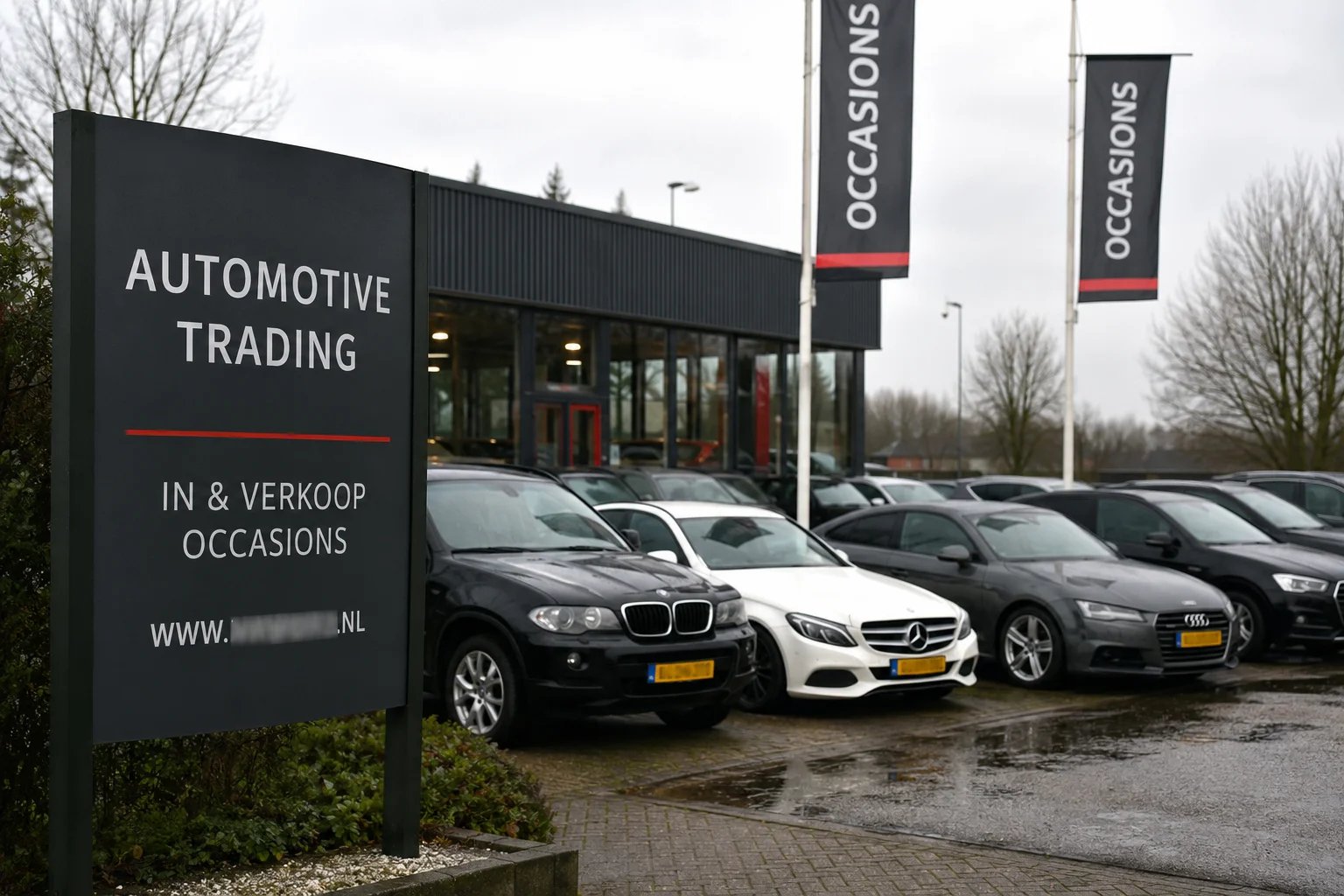
In its judgment of 28 April 2026, the District Court Noord-Nederland addressed the scope of the Dutch transfer of a going concern (“TOGC”) regime under Article 37d of the Dutch VAT Act 1968 (“Wet OB”). The case concerned the transfer of 59 vehicles by a financially distressed automotive trading company and the question of whether that transfer formed part of a broader continuation of the business or merely constituted a taxable supply of inventory.
The judgment is particularly relevant because the court explicitly accepted that a TOGC may exist through a series of interconnected transactions involving intermediary entities. At the same time, the case demonstrates the strict evidentiary burden resting upon taxpayers seeking to rely on Article 37d Wet OB.
Facts and Background
The claimant operated a business engaged in the purchase and sale of passenger vehicles between 2018 and 2020. Most vehicles traded by the company were physically located at dealers, often on a consignment basis. During its operations, the claimant purchased vehicles from several related entities and accumulated debts exceeding EUR 1 million. In addition, the claimant had entered into a separate financing arrangement amounting to another EUR 1 million.
By the spring of 2020, the claimant’s financial position had deteriorated significantly. Creditors demanded repayment of the outstanding liabilities, after which negotiations commenced concerning the restructuring and continuation of the automotive business. An important email dated 24 March 2020 referred not only to debt repayment, but also to the continuation of operational infrastructure such as websites, software subscriptions, insurance arrangements, mail servers, RDW registrations, and BPM permits through a newly incorporated entity.
On 14 April 2020, the claimant entered into a settlement agreement (“VSO”) with several creditors and related entities. Pursuant to that agreement, 59 vehicles were transferred to a company identified in the judgment as [bedrijf 4]. Rights and obligations relating to dealers and intermediaries connected to those vehicles were also transferred, while one creditor assumed the claimant’s financing obligations toward another creditor.
Although the wording of the VSO primarily referred to vehicles, the surrounding factual circumstances suggested that the broader automotive business may have continued through another entity, namely [bedrijf 6]. The case file contained evidence indicating that websites, customer communication systems, operational infrastructure, fuel card arrangements, and certain business activities had been transferred or continued through this entity. Customers were informed that the automotive activities previously carried out by the claimant would continue under [bedrijf 6], while the annual accounts of [bedrijf 6] showed a significant increase in inventory during 2020.
Following a VAT audit, the Dutch Tax Authorities concluded that the transaction constituted a taxable transfer of vehicles. According to the Inspector, the consideration for the transfer consisted of debt forgiveness and debt assumption totaling EUR 2,061,232, resulting in an additional VAT assessment of EUR 357,734 for 2020.
The Dispute
The dispute before the District Court concerned whether the transfer of the 59 vehicles qualified as a transfer of a going concern within the meaning of Article 37d Wet OB.
The claimant argued that the transaction involved far more than a mere transfer of inventory. According to the claimant, the transaction formed part of a broader continuation of the automotive business and included the transfer of operational assets such as customer relationships, websites, email accounts, accounting systems, fuel card arrangements, and other business infrastructure. The claimant maintained that the continuation of activities through [bedrijf 6] demonstrated that the transaction was aimed at preserving and continuing the business rather than liquidating isolated assets.
The Inspector rejected this position and argued that [bedrijf 4] had merely acquired inventory vehicles. According to the Dutch Tax Authorities, no autonomous business unit had been transferred, and therefore the requirements for applying Article 37d Wet OB had not been satisfied. The dispute therefore centered on whether the transaction constituted the transfer of an autonomous economic activity or merely a taxable supply of goods.
Legal Framework
Article 37d Wet OB provides that, in the event of the transfer of all or part of a business, no supply of goods or services is deemed to occur for VAT purposes and the transferee steps into the VAT position of the transferor. The provision implements Article 19 of the VAT Directive 2006/112/EC and is intended to preserve fiscal neutrality by preventing VAT from obstructing genuine business transfers and reorganizations.
The interpretation of Article 19 VAT Directive has been shaped extensively by the jurisprudence of the Court of Justice of the European Union (“CJEU”). In the landmark case Zita Modes (C-497/01), the CJEU held that the TOGC regime applies where assets constituting a business or autonomous business unit are transferred with the intention that the transferee continue the economic activity. The Court emphasized that the assessment requires a holistic analysis focused on the economic reality of the transaction rather than purely formal contractual arrangements.
Subsequent CJEU case law, including Schriever (C-444/10), clarified that not every individual asset must necessarily be transferred. The decisive question is whether the transferred assets are sufficient to continue an autonomous economic activity. The jurisprudence therefore consistently adopts a substance-over-form approach.
In its judgment, the District Court itself relies specifically on several Dutch Supreme Court decisions, including HR 29 January 2021, ECLI:NL:HR:2021:154, HR 26 February 2010, ECLI:NL:HR:2010:BH0527, HR 5 March 2010, ECLI:NL:HR:2010:BG7206, and HR 8 April 1992, BNB 1992/272 – rather than citing Zita Modes or Schriever directly. These judgments confirm that the assessment requires a comprehensive factual analysis, that inventory alone is generally insufficient, and that the transferred assets must be transferred for the purpose of continuing the underlying economic activity.
Application of the Law by the Court
The court first confirmed that the burden of proof rested upon the claimant because the claimant invoked the legal consequences of Article 37d Wet OB. The claimant therefore had to demonstrate that the transaction constituted the transfer of an autonomous economic activity rather than merely a transfer of inventory.
When examining the wording of the settlement agreement in isolation, the court concluded that [bedrijf 4] appeared to have acquired only vehicles together with associated obligations toward dealers and intermediaries. On that basis alone, the transaction resembled nothing more than a transfer of inventory, which under settled VAT jurisprudence does not qualify as a transfer of a going concern.
Importantly, however, the court did not restrict its analysis to the contractual wording of the VSO. The judgment explicitly states that all factual circumstances surrounding the transaction must be taken into account. The court acknowledged several indications suggesting that the automotive business may in fact have continued through [bedrijf 6]. These indications included the continuation of websites, operational systems, customer relationships, fuel card arrangements, and business infrastructure, as well as the transfer of at least one employee.
One of the most significant aspects of the judgment is the court’s explicit recognition that a TOGC may exist through a chain of interconnected transactions involving intermediary entities. The court accepted that a conceivable scenario existed in which the transfer of vehicles to [bedrijf 4] formed part of a closely connected set of transactions ultimately aimed at transferring the claimant’s automotive business to [bedrijf 6]. In doing so, the court adopted a clear substance-over-form approach consistent with the economic reality doctrine developed by the CJEU.
Despite this broader interpretation, the claimant ultimately failed because the evidence was insufficient. The decisive issue was that the claimant could not adequately demonstrate what had happened to the transferred vehicles after the initial transfer to [bedrijf 4]. According to the evidence before the court, only two vehicles could demonstrably be traced to [bedrijf 6], while eighteen vehicles were transferred to unrelated third parties. The remaining vehicles could not be adequately traced at all.
The increase in inventory shown in the financial statements of [bedrijf 6] was considered insufficient to establish that the transferred vehicles had become part of the continuing business. As a result, the court concluded that the claimant had failed to prove that an autonomous economic activity had actually been transferred. Consequently, neither [bedrijf 4] nor [bedrijf 6] could be regarded as having acquired a business or independent business unit within the meaning of Article 37d Wet OB. The VAT assessment therefore remained fully in place, and the appeal was dismissed.
Practical Implications and Conclusion
The judgment of the District Court Noord-Nederland is an important contribution to Dutch VAT jurisprudence concerning transfers of going concerns under Article 37d Wet OB. The decision confirms that Dutch courts are willing to assess TOGC transactions on the basis of the overall factual circumstances surrounding the transaction rather than solely the contractual wording of the arrangements. In the present case, the court looked beyond the wording of the settlement agreement and examined whether the broader restructuring effectively resulted in the continuation of the underlying automotive business.
At the same time, the judgment clearly illustrates the evidentiary burden resting upon taxpayers seeking to rely on the TOGC regime. Businesses involved in restructurings or continuation scenarios must carefully document the continuation of the economic activity. Evidence concerning the transfer of customer relationships, personnel, operational systems, inventory, and ongoing commercial activities may prove essential in establishing that a genuine business transfer has occurred.
The decision is particularly relevant for sectors such as automotive trading, wholesale, and logistics, where restructurings often involve substantial inventory transfers combined with operational continuations through newly established entities. Importantly, the judgment demonstrates that intermediary structures and multi-step transactions do not necessarily preclude the application of Article 37d Wet OB. What remains decisive is whether the taxpayer can sufficiently demonstrate that the transferred assets together enabled the continuation of an autonomous economic activity.