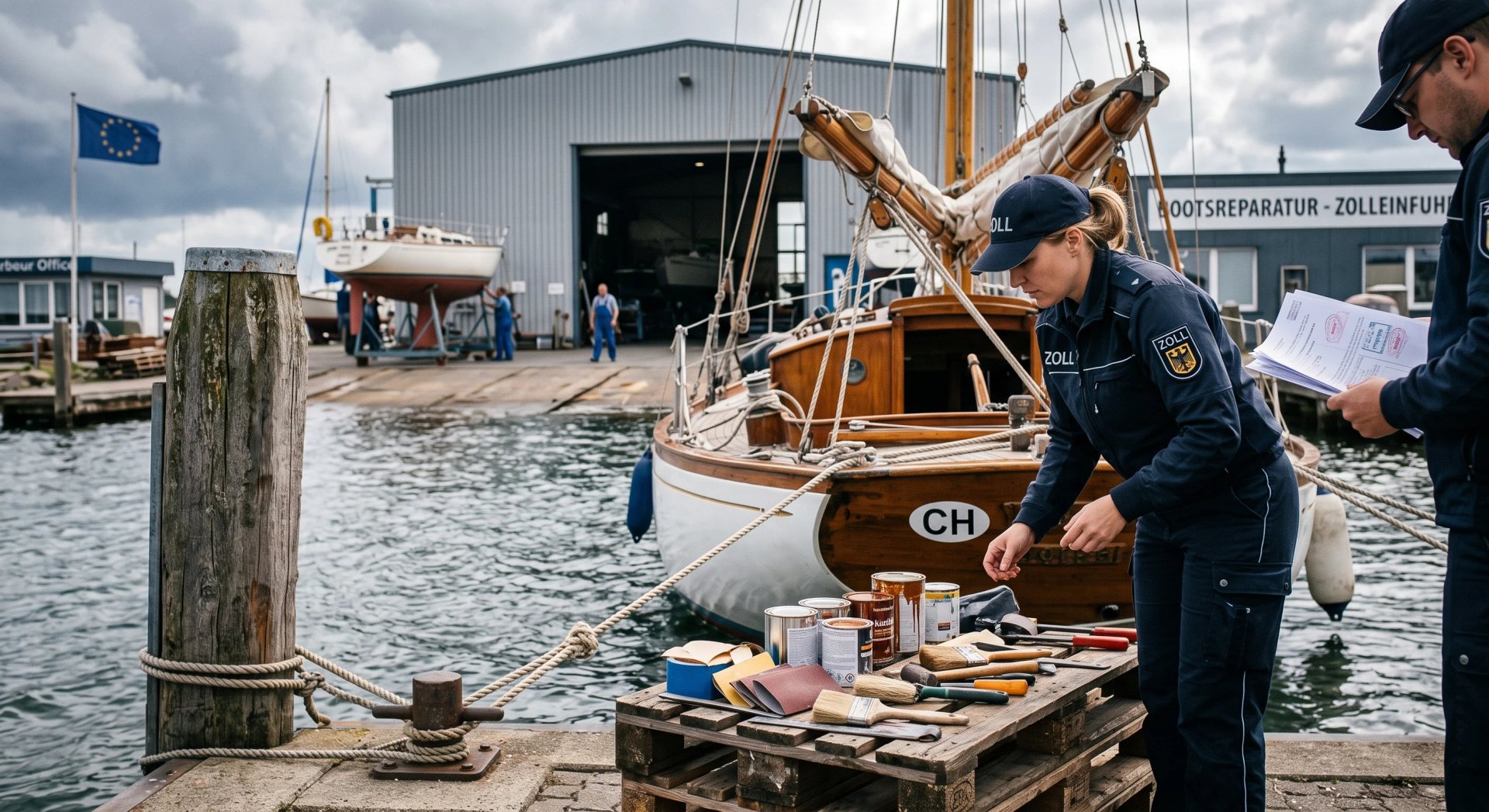
A sailing boat that enters the EU from outside solely to be repaired is never used for sailing within the EU, and is subsequently returned to its owner outside the EU. At first sight there seems little reason to treat such a boat as having become part of the EU's economic network. From a VAT and customs perspective, however, the answer is more nuanced: this is the core of Case T-383/25, Segelbootwartung, in which Advocate General Maja Brkan delivered her Opinion on 3 June 2026 at the General Court of the European Union. The case turns on when goods are considered to have entered the economic network of the European Union, and on what "use" means under Article 124(1)(k) of the Union Customs Code (UCC).
The facts
A private individual residing in Switzerland owned a sailing boat registered in Switzerland. On 28 March 2017, he transported the boat overland into Germany on a trailer towed by a private vehicle, entering via a German customs office without customs clearance.
During a roadside inspection, he explained that he was travelling to a company in Germany to have maintenance and repair work carried out on the boat's outboard motor. The German Hauptzollamt subsequently issued an assessment imposing both import customs duties and import VAT.
Following the assessment, the owner had the boat transported to the German company, where the work was carried out. On 18 May 2017, the boat went back to Switzerland, without having been used for any other purpose while in the EU, in particular not as a means of transport.
The owner challenged the assessment. His objection was rejected, so he brought proceedings before the Finanzgericht, which doubted whether import VAT was actually due and, in any event, considered that both the customs debt and any potential VAT debt had been extinguished under Article 124(1)(k) UCC. The Hauptzollamt appealed to the Bundesfinanzhof, which referred questions for a preliminary ruling.
The questions referred
Notably, a separate action was still pending before the Finanzgericht: the Hauptzollamt had rejected the owner's application for a retroactive inward-processing authorisation, and he had appealed that rejection. Article 211(2) UCC allows such an authorisation under certain conditions, and the outcome of those proceedings could be decisive for the VAT and customs treatment considered in the Opinion.
The Bundesfinanzhof essentially asked two questions. The first concerns import VAT: does a means of transport enter the economic network of the European Union where it is not used as a means of transport in a Member State, but is merely subject to maintenance and repair there? The second concerns the customs debt: does maintenance or repair of a non-Union good constitute "use" within the meaning of Article 124(1)(k) UCC where the good is subsequently re-exported?
The Commission argued that physical entry of the boat without inward processing was decisive, and that the presumption of entry into the economic network could only be rebutted through a retroactive authorisation. The Greek Government stressed that the effectiveness of Articles 70 and 71(1) of the VAT Directive must be preserved. The owner argued that, given the actual circumstances, the boat had never genuinely become part of the EU's economic network.
Legal framework
The starting point for the VAT analysis is Article 2(1)(d) of the VAT Directive: importation of goods is a transaction subject to VAT. Unlike supplies of goods and services, import VAT can arise even where a private individual imports the goods, regardless of consideration. Article 30 defines "importation" as the entry into the Union of goods not in free circulation.
The moment VAT becomes chargeable follows from Article 70: as a general rule, the chargeable event occurs at the time of importation. Article 71(1) provides an exception: where goods are placed, on entry, under one of the customs arrangements listed there, VAT becomes chargeable only once that arrangement ends.
Particularly relevant here is inward processing. Under Article 256(1) UCC, this procedure allows non-Union goods, repair expressly included, to undergo processing operations in the EU without import duty becoming due. Using the procedure requires an authorisation (Article 211 UCC), which was absent when the boat entered Germany.
The second part of the case turns on Article 124(1)(k) UCC, which provides for a customs debt to be extinguished on re-export of non-Union goods, provided those goods have not been "used or consumed."
The Advocate General's analysis
Physical entry as the starting point
Brkan reads Articles 70 and 71 of the VAT Directive as a general rule with an exception. The general rule is that the physical introduction of goods from a third country triggers the chargeable event. Only where goods are properly placed under an arrangement such as inward processing does that presence not immediately trigger VAT, because the customs procedure keeps the goods under customs supervision. Because the sailing boat was never placed under inward processing, it was not subject to the customs supervision inherent in that procedure.
Potential use is decisive in Brkan's approach
The most fundamental point in the Opinion concerns the distinction between actual use and potential use. Although the boat was never actually used as a means of transport in Germany, according to the AG this does not prevent import VAT from arising where no relevant customs procedure has been applied: goods physically present in the EU without such supervision are potentially available for consumption or use.
She relies on the judgment in Kauno teritorinė muitinė (C-489/20), concerning cigarettes illegally introduced into the EU and later seized. There too, import VAT had already become chargeable: what mattered was not actual consumption, but that there had been potential for consumption until the moment of seizure. The AG applies the same reasoning to the sailing boat: once it entered the Union without inward processing, it could potentially have been used. That this potential was never realised does not change the outcome.
Why re-export alone is not enough
The AG also rejects the idea that subsequent re-export can, by itself, reverse the VAT consequences. Nothing in the VAT Directive provides that import VAT ceases to be chargeable simply because goods that were never actually used are later re-exported. She grounds this in the underlying purpose of import VAT: taxing goods from third countries at entry preserves "external neutrality," so traders established in the EU are not placed at a disadvantage compared with suppliers based outside it. Allowing the import VAT charge to be avoided merely on a post-hoc
assertion that the goods were not used would undermine that objective. Were re-export alone sufficient, customs authorities would also have little way of verifying what actually happened to goods during their stay: a boat ostensibly brought in for a brief repair could remain for months and even be chartered before being re-exported. Although nothing of that kind occurred here, the AG is wary of an interpretation that could open the door to abuse.
Existence versus place of the import VAT liability
The AG also addresses the case law on the place where import VAT is incurred (Federal Express, C-26/18; Hauptzollamt Münster, C-7/20; Hauptzollamt Hamburg, C-368/21), where actual and permanent use is relevant. She draws a principled distinction: that case law concerns which Member State may collect once it is already established that VAT is due. Here the question is the prior one of whether an import VAT liability exists at all, for which potential consumption or use suffices.
The relevance of retroactive authorisation
The AG nevertheless identifies a possible remedy. Under Article 211(2) UCC, customs authorities may still grant an inward processing authorisation with retroactive effect: this is the mechanism through which, she considers, the presumption of entry into the economic network can be rebutted in circumstances such as those of the present case. The applicant would need to supply sufficient evidence, such as registration or ownership documents, invoices for the repair work, and possibly the logbook, so the customs authorities can establish what happened to the boat.
Maintenance and repair as "use"
On the second question, the AG relies on Combinova (C-476/19), in which the Court held that "use" within the meaning of Article 124(1)(k) UCC must be read in context: under inward processing, "use" covers only activity going beyond the authorised processing operations. She applies that reasoning to a situation where no authorisation exists: if there is none, any processing necessarily goes beyond what is authorised, simply because nothing has been authorised. Maintenance and repair therefore constitute "use", even though the boat was never used to sail. Re-export does not automatically extinguish the customs debt, unless a retroactive authorisation changes the outcome.
Why the case matters more broadly
The practical significance of Segelbootwartung extends well beyond a privately owned sailing boat. The reasoning may be relevant more broadly where non-Union goods are temporarily brought into the EU for maintenance, repair or other processing without being placed under an appropriate customs procedure: machinery sent to an EU manufacturer for repair, aircraft undergoing maintenance, vehicles brought in for restoration, or other high-value assets requiring specialist work available within the EU.
The lesson is that the intended temporary nature of an import does not, by itself, determine the VAT outcome, nor, under Brkan's approach, is it necessarily sufficient to demonstrate afterwards that the goods were not actually used in the EU. What matters is the customs procedure, or its absence, under which the goods entered the EU. The customs analysis therefore needs to take place before goods cross the external border; a retroactive authorisation is no substitute for correct planning from the outset.
The General Court has yet to deliver its judgment, so the AG's Opinion is not the last word. If the Court follows her approach, the judgment could become an important authority on the distinction between actual and potential use of imported goods and on the role of customs supervision in determining whether goods have entered the economic network of the Union.