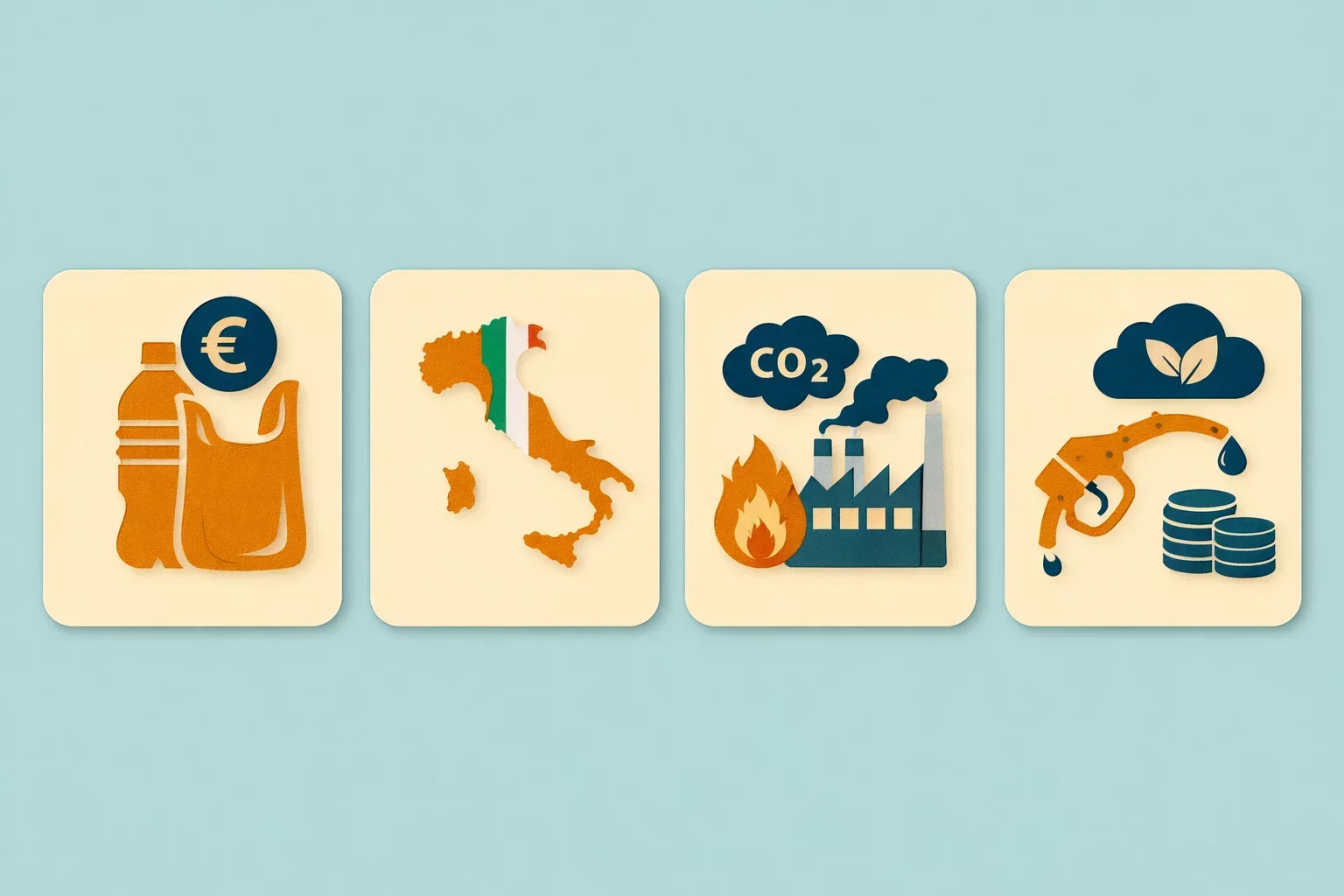
Italy’s environmental taxation framework is entering a new and decisive phase. Although the country has not adopted a standalone, comprehensive carbon tax, it is nonetheless deeply embedded in Europe’s evolving carbon pricing architecture. At the same time, domestic initiatives such as the much-anticipated plastic tax and the expansion of reporting obligations are transforming indirect tax compliance for businesses operating in Italy.
For VAT and customs professionals, environmental taxation is no longer a peripheral issue. Carbon pricing mechanisms, environmental excise duties, and sector-specific levies are increasingly interacting with VAT treatment, customs valuation, reporting obligations, and administrative penalties. Therefore, understanding how Italy is positioning itself within this green fiscal transition is essential for anticipating compliance risks and for strategic tax planning.
This article explores Italy’s current and emerging environmental taxation initiatives, including implicit carbon pricing, the plastic tax due to be introduced in 2027, European carbon border measures, and other environmental levies. The focus is on how these initiatives may affect indirect tax obligations.
Italy’s Environmental Tax Framework: A Strong Existing Base
When it comes to environmental taxation, Italy is not starting from scratch. Broadly defined as taxes on energy, transport, pollution, and resources, environmental taxes already represent a significant proportion of Italian public revenue. Energy taxes, particularly excise duties on fuels and electricity, account for the largest proportion of environmental tax revenue.
While Italy does not currently impose an economy-wide carbon tax, the high level of excise duty on petrol, diesel, and other energy products effectively constitutes a form of implicit carbon pricing. These taxes increase the cost of fossil fuel consumption and contribute to reducing emissions, albeit indirectly.
This structure provides an important foundation. Italy’s environmental fiscal policy primarily relies on energy taxation rather than a separate carbon dioxide levy. For businesses, this means that environmental costs are often embedded within existing excise frameworks that are integrated into VAT calculations and supply chain pricing mechanisms. Environmental taxation in Italy, therefore, already affects pricing models, contractual structures, and VAT taxable bases. Any additional environmental levy must be considered in the context of this existing fiscal system.
Carbon Tax: Historical Attempts and Current Policy Position
Italy previously experimented with carbon-related fiscal measures in the late 1990s, as part of its international climate commitments. However, no permanent, comprehensive carbon tax regime has remained in force since then.
As of 2026, Italy does not have a standalone carbon tax applicable across sectors. Instead, carbon pricing is achieved through energy excise duties, participation in the European Union Emissions Trading System (EU ETS), and upcoming inclusion in the new ETS2 regime. Italy also complies with the European Carbon Border Adjustment Mechanism (CBAM).
The absence of a national carbon tax does not mean that the issue is politically dormant. Discussions are ongoing regarding potential fiscal instruments to support Italy’s decarbonisation targets under its National Energy and Climate Plan. If a carbon tax were to be introduced in the future, it would likely need to be coordinated with European mechanisms to avoid duplication and ensure competitiveness.
From an indirect tax perspective, this distinction is critical. Although there is no direct carbon tax refund today, the costs of carbon pricing are already embedded within excise and energy taxation, affecting VAT bases, margins, and supply chains. If a carbon tax were to be introduced in the future, its design would need to clarify whether it would operate as an excise-type levy, a standalone environmental charge, or an integrated energy component.
The Carbon Border Adjustment Mechanism: Customs Meets Carbon
The Carbon Border Adjustment Mechanism is one of the most transformative environmental measures affecting Italian businesses. Introduced at a European level, it imposes a carbon cost on certain imported goods, ensuring that non-European producers face an equivalent climate price to that faced by European manufacturers.
Initially, the mechanism applies to cement, steel, iron, aluminium, fertilisers, electricity, and hydrogen. Italian importers operating in these sectors must comply with new regulations that closely resemble customs procedures. They must register as authorised declarants, report the embedded emissions of imported goods, and purchase and surrender certificates corresponding to their carbon content. While not formally classified as VAT or customs duty, the mechanism interacts directly with customs processes and import valuation strategies.
The additional carbon cost may influence transfer pricing decisions, supply chain restructuring, customs valuation methodologies, and VAT treatment on importation. Italian policymakers have expressed particular concern about the impact of sudden carbon cost increases on the competitiveness of the domestic agricultural sector, particularly with regard to fertilisers. Nevertheless, the mechanism represents a structural shift towards integrating environmental considerations into trade policy.
Indirect tax departments must integrate compliance into their customs and VAT risk management systems. Failure to report accurately or surrender certificates can lead to administrative penalties and damage to your reputation.
ETS2 and the Extension of Carbon Pricing
Another development at the European level is the planned introduction of ETS2, which is expected to come into effect in 2027. This new emissions trading system will extend carbon pricing to road and heating fuels. Unlike the traditional ETS, which targets industrial installations and power plants, ETS2 will operate at the fuel supplier level, i.e., upstream. The carbon cost is likely to be passed down the supply chain to end consumers.
In Italy, this development could have a significant impact on fuel distributors, logistics companies, industries that rely heavily on transport, and energy retailers. Although ETS2 is not a traditional tax, its economic impact is similar to that of a carbon levy embedded within energy pricing. The pass-through effect may alter VAT bases, pricing models, and contractual arrangements.
Therefore, indirect tax professionals must monitor how ETS2 costs are reflected in invoicing structures, as well as whether any domestic mitigation measures are introduced to offset the burden on vulnerable sectors.
Italy’s Plastic Tax: A Concrete Domestic Environmental Levy
One of the most tangible environmental taxes on the Italian horizon is the plastic tax, which is scheduled to come into effect on 1 January 2027 following several postponements. The tax will target single-use plastic products, particularly plastic packaging. It is expected to be charged at forty-five euro cents per kilogram of virgin plastic contained in the taxable product. It will apply to producers of plastic packaging in Italy, importers of plastic goods from non-European countries, and acquirers of plastic packaging from other EU Member States.
Those subject to the tax will be required to register with the Italian Revenue Agency or customs authorities, maintain dedicated accounting records, submit periodic returns and pay the tax by the prescribed deadlines. While the regime resembles excise administration more than traditional VAT reporting, it intersects with indirect tax obligations in multiple ways.
The cost of the plastic tax will form part of the overall cost structure and may influence VAT-able amounts if it is incorporated into the final price of goods. Importing plastic products will require compliance with customs and environmental tax regulations. Incorrect reporting may trigger penalties that affect broader tax risk assessments.
Administrative sanctions are expected for late filing or non-payment. In serious cases of omission, fines may be proportionate to the unpaid tax, with statutory minimum thresholds. Therefore, the plastic tax represents a significant expansion of compliance requirements for the manufacturing, retail, and logistics sectors operating in Italy.
Other Environmental Levies and Sector-Specific Charges
In addition to carbon and plastic taxation, Italy has several environmental charges that are relevant to indirect tax professionals. These include vehicle registration taxes linked to emissions levels, waste disposal and landfill levies, regional environmental surcharges, and energy system charges embedded in electricity bills.
While not always classified as taxes in the strict sense, these levies can impact pricing, VAT bases, and invoicing structures. For instance, certain environmental charges included in utility bills may be included in the VAT taxable amount, depending on their legal classification and whether they constitute consideration for a supply. Understanding the legal nature of each levy is therefore essential for correct VAT treatment. The distinction between a tax, a parafiscal charge, and a regulatory fee can determine whether VAT applies and how it should be reported.
Indirect Tax Implications for Businesses
Developments in environmental taxation in Italy may affect indirect tax obligations in several concrete ways. Firstly, if they form part of the consideration, environmental levies embedded in the price of goods may increase the VAT taxable amount. Therefore, businesses must carefully analyse whether a levy is passed on as a separate item or incorporated into the overall price.
Secondly, customs valuation may be influenced by environmental surcharges and carbon-related costs, particularly if they are included in the price of imported goods. Thirdly, additional registration and filing requirements increase compliance burdens, necessitating collaboration between tax, customs, sustainability, and accounting teams.
Fourthly, contractual risk allocation becomes crucial. Businesses may need to renegotiate contracts to determine who will bear the costs of environmental taxes and how adjustments will be handled in long-term supply agreements. Finally, decisions regarding cross-border supply chains may be affected by carbon pricing differentials within and outside the European Union. Environmental taxation is therefore not merely a sustainability issue. It is also a core indirect tax governance challenge.
Conclusion
Italy’s environmental taxation initiatives demonstrate an unmistakable, albeit gradual, shift towards integrating climate policy into fiscal systems. While the country has not introduced a standalone carbon tax, it fully participates in European carbon pricing mechanisms and plans to implement domestic environmental levies, including a plastic tax, by 2027.
For businesses, these measures extend beyond environmental compliance. They also impact VAT calculations, customs procedures, pricing strategies, reporting systems, and risk management frameworks.
The Italian experience illustrates a broader European trend: the convergence of environmental sustainability and indirect taxation. As the costs of carbon become more apparent and new environmental levies come into effect, indirect tax professionals must adapt to a landscape in which green policy and fiscal compliance are becoming increasingly intertwined.