
The combination of Vietnam's young population, rising internet penetration, and a growing appetite for online services positioned Vietnam as one of Southeast Asia’s most dynamic digital economies. To keep up with the development and challenges of the digital economy, in 2022, Vietnam introduced VAT requirements for foreign digital service providers. However, since the introduction of obligations for foreign digital service providers, the rules have been updated, demonstrating that the government is prepared to adapt to new circumstances.
Evolving Rules for the Emerging Digital Market
In September 2021, the Ministry of Finance issued Circular 80, which detailed the implementation of the Tax Administration Law and included a separate chapter on taxation for overseas or foreign suppliers who do not have a permanent establishment in Vietnam but conduct e-commerce or digital-based businesses in Vietnam.
As a result, from January 2022, foreign e-commerce and digital-based businesses became subject to local VAT rules and requirements. Two terms were critical at that time: e-commerce and digital business.
E-commerce activities include any part or the entirety of a commercial process conducted through electronic means, as long as those means are connected to the internet, mobile networks, or other open digital systems. Consequently, even partial online involvement in a transaction, such as advertising, ordering, or payment, can bring a business within the scope of the law.
The concept of digital-based business activities, which primarily focuses on businesses operating through digital platforms that act as intermediaries connecting companies with customers, highlights the role of platforms, apps, and online ecosystems as central actors in the digital economy. However, this was only the beginning of establishing the current taxation system for digital services. In 2024 and 2025, Vietnam enacted several acts that updated these rules.
First, on January 1, 2025, the government reclassified foreign suppliers operating through e-commerce or digital platforms. Under these changes, these businesses were no longer treated as businesses without a permanent establishment, which effectively broadened Vietnam’s authority to tax their activities. Also, the platform operators with integrated payment functions became liable for withholding, declaring, and paying taxes on behalf of individual sellers and business households using their systems, shifting part of the compliance burden onto intermediaries.
This was followed by new legislation that took effect on July 1, 2025, providing much-needed clarity on who is responsible for VAT in the context of e-commerce and digital platform transactions involving foreign suppliers. Under the new legislation, foreign suppliers and organizations that manage foreign digital platforms are required to register. became explicitly recognized as taxable persons, reflecting the government’s intention to bring cross-border digital services more firmly within the domestic tax net.
On December 10, 2025, the Ministry of Industry and Trade announced that the National Assembly adopted the Law on E-commerce, which replaces the older rules under Decree 52 and reflects the significant growth and evolution of the e-commerce sector over the past decade. Notably, the new law is not just an update of the existing rule but a significant shift toward a more structured, stricter system for managing online commercial activity.
New e-commerce rules, designed to support continued e-commerce expansion and address rising concerns about consumer rights, data protection, and market transparency, will come into effect on July 1, 2026.
Key VAT Obligations for Platforms, Sellers, and Intermediaries
The term e-commerce is widely used to include not only traditional online marketplaces but also social networks, live-streaming platforms, and influencer-driven commerce. Thus, foreign digital service providers must register for VAT in Vietnam immediately upon making their first sale to a Vietnamese customer. From July 2025, foreign suppliers must apply a 10% VAT rate. However, a temporary 2% reduction is in effect until December 31, 2026, for certain goods and services. Therefore, in some cases a 8% VAT rate applies.
After all the amendments and changes to VAT rules, both domestic and foreign digital platforms with payment functions, such as e-commerce platforms, must withhold, declare, and remit VAT and personal income tax on behalf of individual sellers. Regarding VAT return filing frequency, it depends on the revenue: monthly for revenue above VND 50 billion, or quarterly for revenue below that threshold.
What is significant is that banks and payment intermediaries are required to report or withhold taxes in certain cases, particularly when suppliers fail to register or when payments cannot be directly traced for tax purposes.
Also, it is worth mentioning that in 2025, Vietnam removed tax exemptions for low-value imported goods sold through e-commerce platforms. Thus, cross-border sellers who previously benefited from VAT exemptions on small consignments had to start charging 10% VAT on these transactions.
What the New E-Commerce Law Means for Digital Platforms
With all the changes over the past two years, foreign digital service providers and e-commerce businesses faced many challenges in keeping up and complying with evolving rules and regulations. The adoption of the Law on E-Commerce in December 2025 may only further complicate things, even though the main goal of adopting this legislation is to establish a more comprehensive and stringent approach to governing e-commerce activities.
Under the new law, which serves as an umbrella term covering any digital system that facilitates commercial activity in an online environment, several types of digital platforms have been classified to reflect how digital ecosystems actually operate. More precisely, four types of digital platforms have been recognized: direct e-commerce platforms, intermediary e-commerce platforms, social media with e-commerce functions, and multi-service integrated platforms.
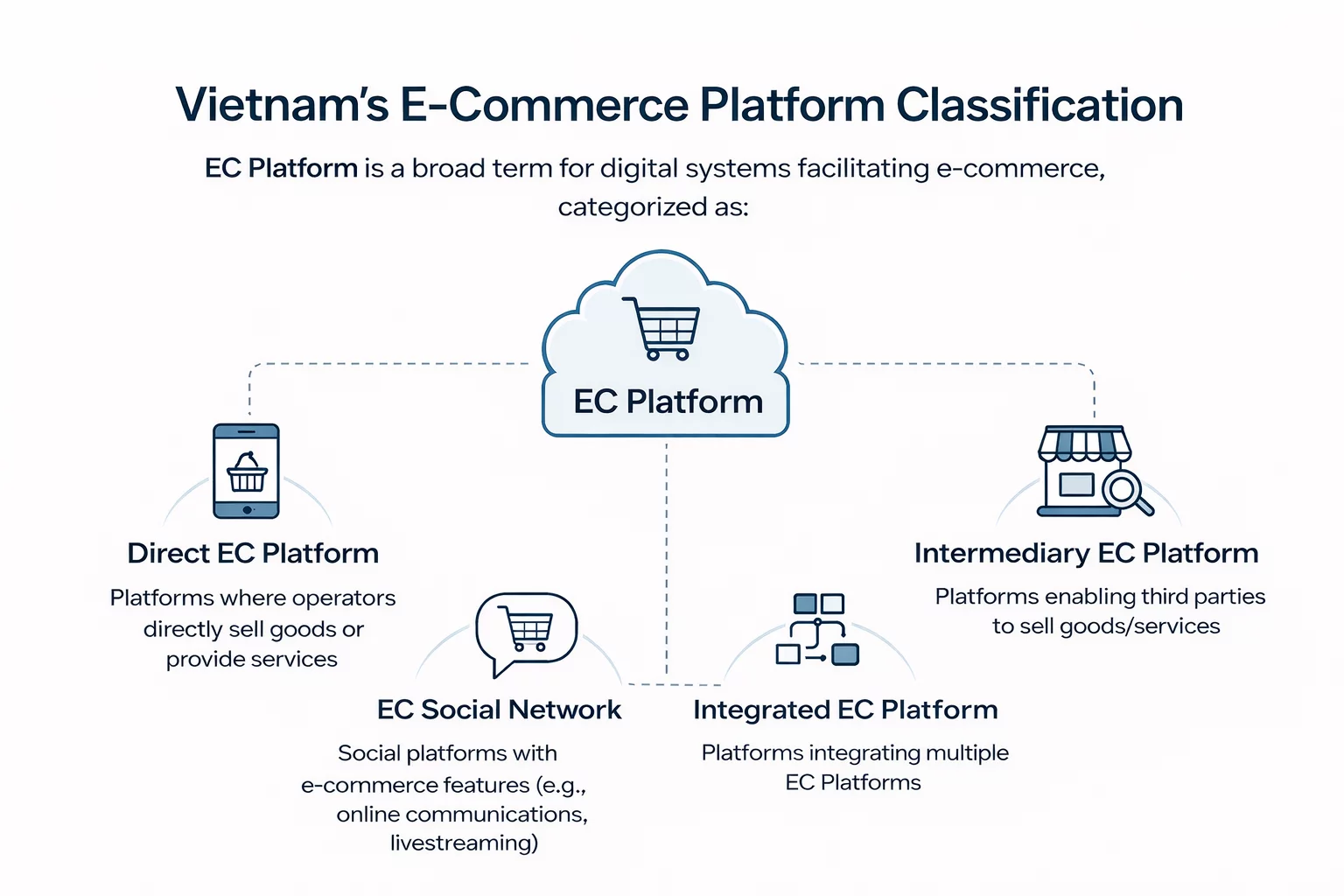
The key aspect of the E-Commerce Law is its focus on foreign and cross-border platforms. Thus, these platforms will have to either establish a legal entity in Vietnam or appoint a locally authorized representative. The representative will be responsible for ensuring compliance with Vietnamese regulations, including tax obligations and consumer protection rules.
The law also increases the platform's accountability by introducing shared liability with sellers. More specifically, platforms may be held responsible for issues such as counterfeit goods, prohibited items, and misleading or harmful content distributed through their systems.
Furthermore, the law brings stricter identification requirements for sellers. Marketplace sellers, whether individuals or businesses, will be verified through the national electronic identification system, VNeID. This will improve traceability, reduce fraud and intellectual property violations, and support Tax Authorities in monitoring transactions and preventing revenue loss.
Conclusion
To fully understand the impact of new e-commerce rules on overall VAT and tax requirements, foreign digital service providers and e-commerce businesses will have to wait for additional detailed implementing regulations from the Vietnamese government.
Regardless, it is apparent that Vietnam is moving toward a more structured and enforcement-driven regime, where foreign and domestic players alike face higher compliance expectations and greater scrutiny. For foreign businesses, it is essential to remain informed and agile in a market where regulatory changes are likely to continue.
Source: KPMG, VATabout - Vietnam Tax Reforms 2026, EY, Grant Thornton, Ministry of Industry and Trade