It should first be recalled that the Sixth Directive establishes a common system of VAT based, in particular, on a uniform definition of taxable transactions.
As regards the concept of a "supply of goods," Article 5(1) of the Sixth Directive provides that a supply of goods means the transfer of the right to dispose of tangible property as owner. In that regard, the case law of the Court of Justice states that this concept covers any transfer of tangible property by one party that empowers the other party actually to dispose of it as if that party were the owner (see, inter alia, Halifax and Others, paragraph 51).
As regards the concept of a "supply of services," Article 6(1) of the Sixth Directive makes clear that it covers any transaction that does not constitute a supply of goods within the meaning of Article 5 of that directive.
Classifying Complex Supplies: The Predominant Element Test
To determine whether a single complex supply, such as those at issue in the main proceedings, is to be classified as a "supply of goods" or a "supply of services," account must be taken of all the circumstances in which the transaction takes place to identify its characteristic elements and determine its predominant elements.
It should also be clarified that the predominant element must be determined from the point of view of the typical consumer and, in an overall assessment, about the qualitative, not merely quantitative, importance of the elements of the supply of services in relation to those of the supply of goods.
Ancillary Services That Don't Count Toward the Assessment
In this regard, it should be recalled that the marketing of goods is always accompanied by a minimal supply of services, such as displaying goods on shelves or issuing an invoice. When assessing the proportion represented by the supply of services in a complex transaction that also includes a supply of goods, only services other than those necessarily accompanying the supply of goods may be taken into account.
More specifically, in paragraph 14 of the judgment in Faaborg-Gelting, the Court of Justice held that restaurant transactions are characterized by a bundle of elements and acts, of which the provision of food is only one component and in which services largely predominate. Such transactions must therefore be regarded as supplies of services within the meaning of Article 6(1) of the Sixth Directive. The position is otherwise where the transaction relates to food to take away and is not coupled with services designed to enhance consumption on the spot in an appropriate setting.
About the supply of food and beverages on board ships (ferries), the Court of Justice noted that the sale of meals and drinks for immediate consumption is the result of a series of services, ranging from the preparation of the meal to serving it to the customer on a tray. As part of that service, the customer is provided with infrastructure such as a dining room and ancillary facilities (including a cloakroom), and so forth. Where necessary, staff are available to provide food and beverage services, including setting tables, advising customers, providing information about the beverages offered, bringing the meal, and clearing the tables afterward.
Catering on Board Ferries
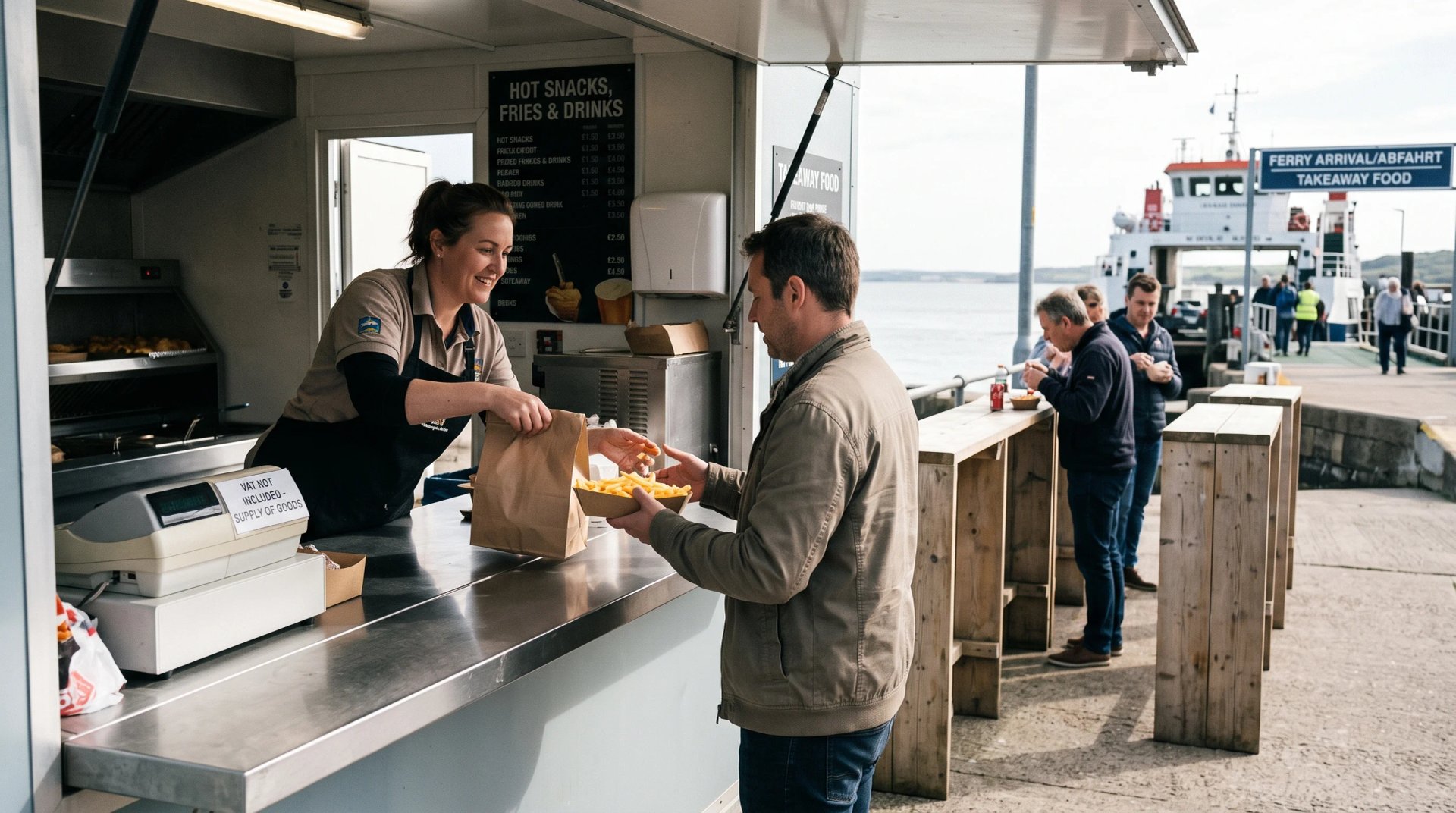
In the present case, according to the evidence provided by the referring court, the activities at issue in the main proceedings in Cases C-497/09 and C-501/09 involve the sale, from snack stalls or mobile snack bars, of hot sausages, French fries, and other food prepared for immediate consumption.
In that regard, it should first be noted that supplying such products requires them to be cooked or reheated. This constitutes a service that must be taken into account in the overall assessment of the transaction in question when determining whether it is to be classified as a supply of goods or a supply of services.
However, since the preparation of the final hot product consists essentially of basic, standardized operations that are generally not performed in response to an individual customer order, but continuously and regularly based on generally foreseeable demand, those operations do not constitute the predominant element of the transaction in question and cannot, in themselves, characterize the transaction as a supply of services.
As for the elements of a supply of services that are characteristic of restaurant and catering activities, the activities at issue in the main proceedings in Cases C-497/09 and C-501/09 involve no waiters, no real advice to customers, and no service properly speaking consisting, in particular, of transmitting orders to the kitchen, subsequently preparing the dishes, and serving them to customers at tables. There are no enclosed spaces kept at an appropriate temperature and specifically intended for consuming the food served, no cloakrooms or restrooms, essentially no dishwashing, and no furniture or place settings.
Finally, the elements of a supply of services identified by the referring court consisted solely of rudimentary facilities, namely simple counters at which customers could not sit, but where a limited number of customers could eat on the spot outdoors. Such rudimentary facilities require only negligible human intervention. In those circumstances, those elements amount only to minimal ancillary services and cannot alter the predominant character of the principal supply - the supply of goods.
The foregoing reasoning also applies to the sale of popcorn and tortilla chips (nachos) in cinemas, which is at issue in the main proceedings in Case C-499/09. These observations summarize the CJEU's approach to determining whether a transaction constitutes a supply of goods or a supply of services for VAT purposes.