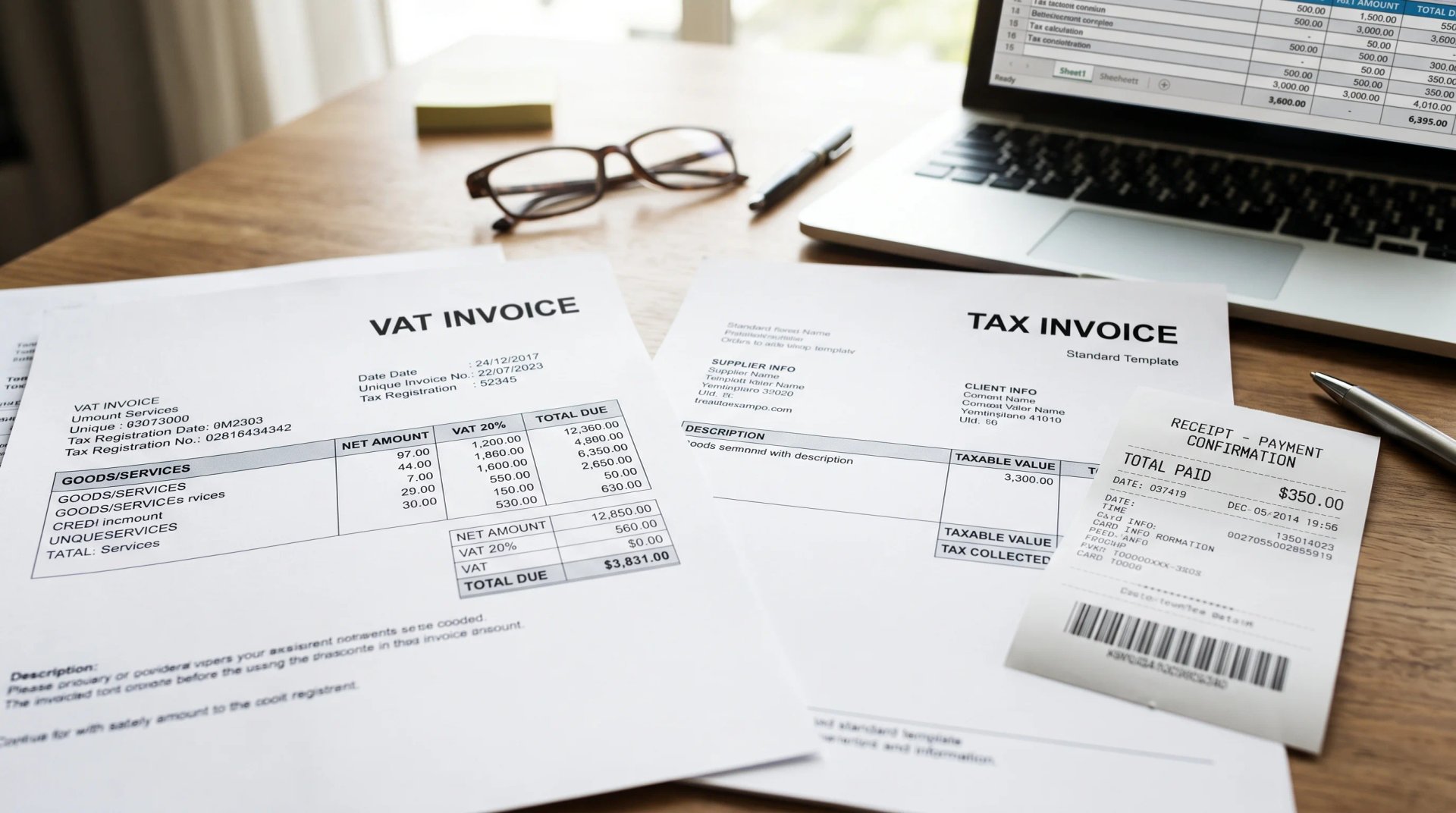
A VAT invoice and a tax invoice do the same job – they record a taxable sale and the tax charged – and which name is used mostly depends on the country: the EU and the UK say “VAT invoice”, while GST countries such as Singapore say “tax invoice”. Both are issued by a registered seller, and a VAT invoice must show the seller’s VAT number and the VAT separately. A receipt is different – it only acknowledges that payment has been made.
The terms “VAT invoice,” “tax invoice,” and “receipt” are often used differently depending on the country and its tax legislation. As a consequence, businesses operating across multiple jurisdictions, especially key stakeholders, might be confused by these terms and their meanings.
The distinction between these terms and types of documents is important, as confusing them might result in non-compliance with local rules and regulations. This overview compares VAT invoice vs tax invoice, and their correlation with receipts, highlighting key clarifications to help businesses understand not only the differences, but also the similarities.
What Is a VAT Invoice?
A VAT invoice is an official document issued by a VAT-registered or otherwise accountable business to record a taxable supply of goods or services. It contains details about the transaction and the information required under the applicable VAT rules.
VAT invoices are important because they provide the basis for determining the VAT liability arising from a transaction. They are also important for the customer because, where the customer is VAT-registered and the relevant conditions are met, the invoice can serve as evidence supporting a VAT input tax deduction or reclaim.
Depending on the jurisdiction and transaction, a VAT invoice can include information such as the supplier’s name and address, VAT identification number, customer details, invoice date, unique invoice number, description of the goods or services, taxable amount, applicable VAT rate, VAT amount, and total amount payable. Additional information may be required for transactions subject to special rules, such as reverse charge, intra-EU supplies, or VAT exemptions.
Importantly, not every invoice is necessarily a VAT invoice. A business that is not registered for VAT may issue a commercial invoice but generally cannot present itself as charging VAT unless permitted under the applicable legislation. Similarly, an invoice for an exempt or zero-rated transaction may have different VAT information from an invoice for a standard-rated transaction.
Understanding a Tax Invoice
A tax invoice is a broader term used in many countries to describe an invoice that satisfies specific tax-law requirements. It is particularly common in jurisdictions using VAT or GST terminology. In some countries, a tax invoice is effectively the formal legal term for an invoice that allows the supplier to account for indirect tax and may allow the recipient to claim an input tax credit.
The precise meaning of a tax invoice therefore depends on national legislation. In one jurisdiction, a tax invoice may be required for most taxable B2B transactions. In another, simplified invoices or other approved documents may satisfy the invoicing requirements for certain transactions.
This is really the core of the VAT invoice vs tax invoice question: a tax invoice is defined by its tax function and legal requirements, rather than simply by its appearance, while a VAT invoice is defined by the specific VAT information it must contain. It generally provides sufficient information for Tax Authorities, the supplier, and the customer to establish what was supplied, the taxable amount, and the tax charged or applicable.
Receipt: How Is It Different From an Invoice?
A receipt is primarily evidence that a payment has been made. An invoice, on the other hand, normally states an amount that a customer owes for goods or services already supplied or still to be supplied. The distinction can be illustrated simply: a business may issue an invoice for EUR 500 and receive payment several days later. Once payment is received, it may issue a receipt confirming that the EUR 500 has been paid. The invoice establishes the financial obligation, while the receipt confirms settlement.
A receipt can contain information about the transaction, including the seller, goods or services, amount paid, date, and tax included in the price. In some jurisdictions, a receipt or simplified document may also satisfy certain tax-invoicing requirements. Consequently, the legal distinction is not always absolute.
For example, UK government guidance explicitly distinguishes an invoice from a receipt. A receipt is described as an acknowledgement of payment. It also explains that VAT invoices must contain specified information where a VAT invoice is legally required.
Receipts can therefore have an important accounting and evidentiary function, but a receipt should not automatically be treated as a full VAT or tax invoice.
VAT Invoice vs Tax Invoice vs Receipt: How They Compare
Feature | VAT Invoice | Tax Invoice | Receipt |
Main purpose | Documents a VAT-taxable supply and VAT charged | Documents a taxable transaction and satisfies tax invoicing requirements | Confirms that payment has been made |
Shows tax/VAT | Yes, where applicable | Yes, where applicable | May show tax/VAT included in the amount |
Proves payment | No, unless specifically marked as paid | No, unless specifically marked as paid | Yes |
Used for tax recovery | Usually, if it meets the applicable requirements | Usually, if it meets the applicable requirements | Sometimes, depending on local rules |
Usually issued before/after payment | Usually before or at the time of payment | Usually before or at the time of payment | Usually after payment |
Commonly used for B2B | Yes | Yes | Less commonly used as the primary B2B tax document |
Key Takeaways
While the terms are often used interchangeably, a VAT invoice is specifically issued to document a VAT-taxable supply and the associated VAT charge, serving as a primary basis for determining VAT liability and enabling input tax deductions. In contrast, a tax invoice is a broader legal term for an invoice that satisfies specific tax-law requirements within a jurisdiction, focusing on its functional role in complying with Tax Authorities rather than just its VAT-specific content.
Ultimately, when weighing VAT invoice vs tax invoice, the distinction lies in whether the document is defined by its VAT-specific nature or by its broader regulatory compliance function. Receipts, by contrast, predominantly serve as confirmation that a payment has been made.