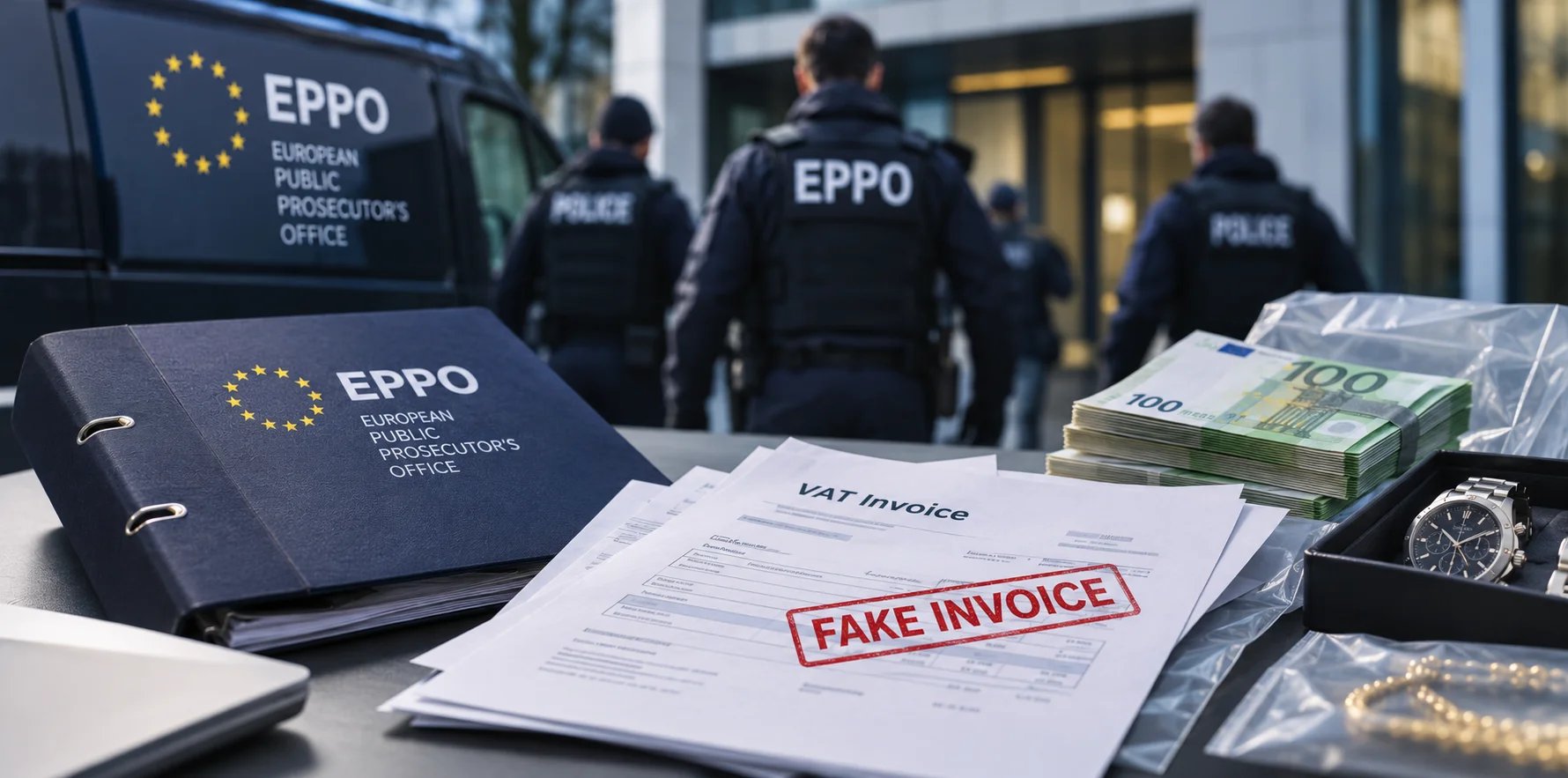
The European Public Prosecutor's Office (EPPO) in Munich has moved against an organised crime group suspected of laundering at least €120 million through a VAT fraud scheme built on fake invoices. According to EPPO, the group offered money laundering as a service, using German shell companies and an underground banking system.
The operation, known as Investigation Pecunia, was carried out on 25 November 2026 and announced the following day. More than 300 searches and seizures. 21 arrests.
Key figures
- Searches and seizures: more than 300, in 12 countries
- Officers deployed: more than 3,000 police, tax and customs officers
- Arrests: 21, in Belgium, Germany and Estonia
- Money allegedly laundered: at least €120 million
- Estimated tax loss: at least €18.9 million, in Germany
- Estimated social security loss: approximately €6 million
- Shell companies: at least 22, in Germany
- Seized: documents, storage devices, large amounts of cash, luxury cars, watches, jewellery (no value given)
The 12 countries: Belgium, Croatia, Estonia, France, Germany, Italy, Lithuania, Poland, Romania, Slovakia, the Netherlands and Moldova. Moldova is the only one outside the EU.
How the scheme allegedly worked
According to investigators, the group controlled at least 22 shell companies in Germany that allegedly issued invoices for services that were never provided. Other companies and individuals are suspected of using these invoices to claim input VAT deductions to which they were not entitled.
The shell companies allegedly failed to declare the income and VAT associated with these invoices and did not pay the taxes due.
Money sent to them was allegedly withdrawn in cash, and part of it went back to the invoice buyers. In at least one case, the cash paid wages to security workers who were not properly registered for social security.
According to a separate joint statement from EPPO and the Erfurt Main Customs Office, the estimated loss to Germany's social security system amounts to approximately €6 million.
Who took part
Europol supported the operation, along with national authorities in all 12 countries.
German partners included the Thuringia State Criminal Police Office, the Federal Police, customs units, tax investigation offices, FIU Germany and BaFin. Prosecutors in Munich, Bochum and Erfurt were involved, as was North Rhine-Westphalia's financial crime office (LBF NRW).
Abroad, the list includes Estonia's Tax and Customs Board, the Dutch FIOD, Lithuania's FNTT, Italy's Guardia di Finanza, France's ONAF, Belgium's Federal Judicial Police and Moldova's Anti-Corruption Prosecutor's Office.
A similar case in September
On 16 September 2026, LBF NRW and EPPO in Cologne moved against a network accused of something close to this. Shell companies and fake invoices were allegedly used to push cash into the banking system, pay undeclared workers and claim input VAT.
The alleged loss in that case was over €60 million in taxes and social security contributions. Neither release suggests the two cases are linked.
What EPPO has not said
EPPO has not publicly identified the suspects, specified the services described in the fictitious invoices or disclosed the period during which the alleged scheme operated. The statements issued on 26 November 2026 do not announce any formal indictments.
All persons concerned are presumed innocent until proven guilty in the competent German courts.