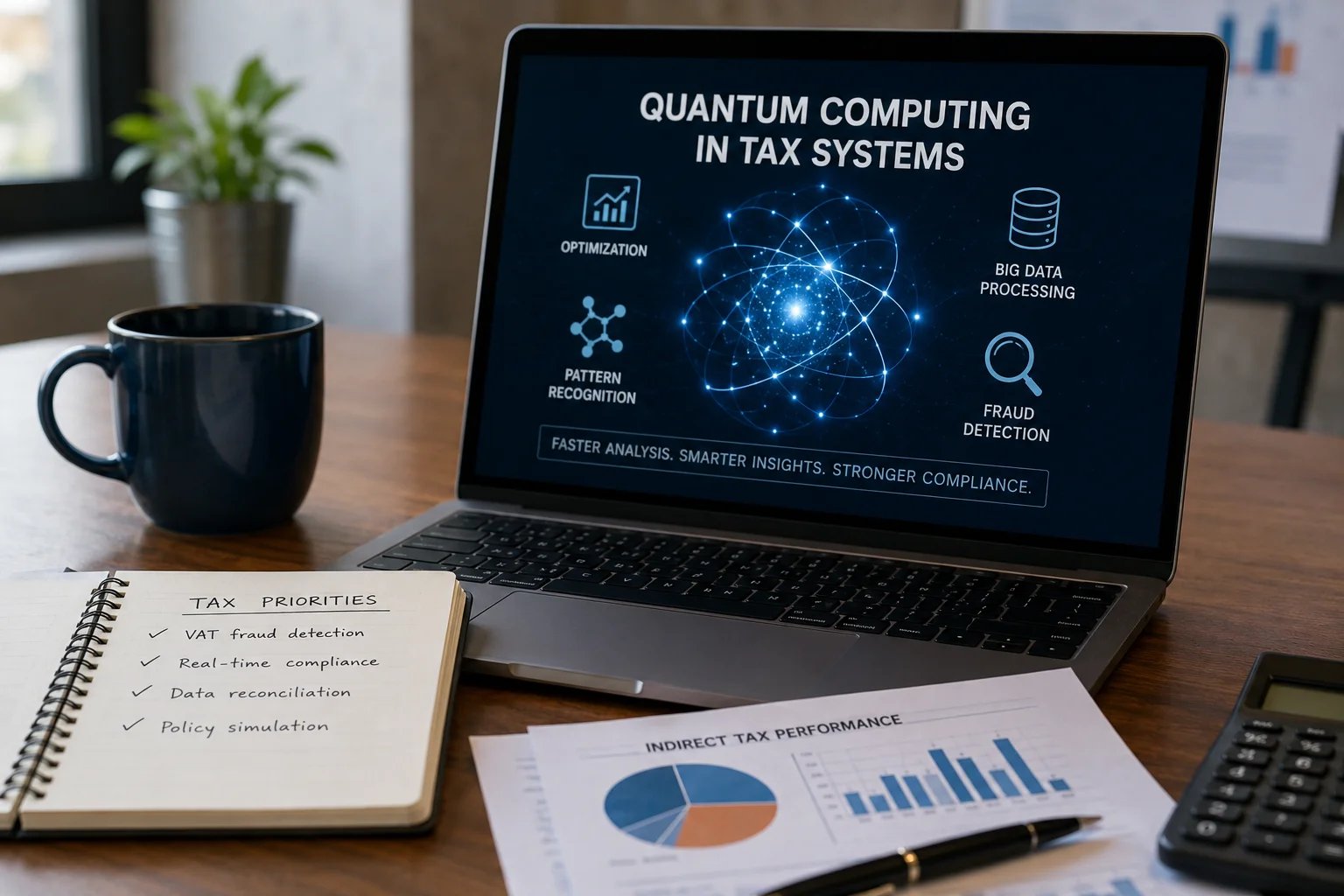
While everyone's attention is on the impact of AI in tax compliance, it seems like quantum computing is unfairly sidelined. As one of the most transformative technologies of the 21st century, it promises to reshape how complex computational problems are solved.
Quantum computing is not useful for every type of problem, but it can provide major advantages for specific categories where classical computers struggle. Indirect taxes, particularly VAT, GST, and customs duties, are especially relevant because they rely on massive volumes of transactional data, multi-jurisdictional coordination, and continuous compliance validation.
What is Quantum Computing?
Given that quantum mechanics is notoriously complex and fundamentally different from classical physics, even challenging for some of the greatest scientific minds to fully accept in its implications, attempting to teach the underlying physics would not be beneficial or relevant. However, it is necessary to explain the basics of the technology to understand how it relates to indirect taxes, and more specifically, in which cases it might be used.
Quantum computing combines computer science and engineering, relying on the principles of quantum mechanics to address problems that are beyond the reach of even the most powerful classical computers. In other words, it is a multidisciplinary area of research, including the development of quantum hardware and the design of specialized quantum algorithms.
Once fully developed, it is expected to solve certain highly complex problems much faster than traditional supercomputers, potentially reducing tasks that would take thousands of years on classical machines down to hours or minutes.
Quantum Computing Capabilities Relevant to Tax
At its core, indirect tax systems depend on data gathering and processing, reconciliation, anomaly detection, and, to a certain extent, forecasting. Quantum computing is particularly designed for these types of computational problems. More specifically, quantum computers are expected to be most valuable in two main areas: simulating physical systems and detecting patterns in complex data. While the first area might not be as relevant for indirect taxes, the second one is essential.
One of the most relevant capabilities is optimization. For example, continuous matching of invoices across supply chains and jurisdictions could be optimized by quantum algorithms. Another key capability of the technology is pattern recognition. This capability, combined with AI and quantum-enhanced machine learning models, may improve the ability to detect irregularities in tax compliance earlier and more accurately. Also, governments, or, more specifically, Tax Authorities, could significantly benefit from its simulation capabilities.
Key Quantum Use Cases in Indirect Tax Systems
Processing big data accurately in minutes rather than hours or days, combined with pattern recognition, directly implies that quantum computing in indirect taxation will have the greatest impact in VAT fraud detection. VAT fraud, particularly missing trader intra-community (MTIC) fraud, one of its most widespread forms, relies on exploiting gaps in cross-border transaction tracking.
The technology, through enhanced network analysis of transaction flows, could enable Tax Authorities to identify suspicious patterns across millions of invoices in near real time. This would result in a significant reduction in revenue leakage and improved efficiency. Moreover, by identifying anomalies in real time, the technology has the potential to reduce VAT fraud substantially.
Quantum computing could also contribute to the development of fully dynamic tax compliance systems. This system would not rely on simple periodic tax reporting by taxable persons. Still, it would instead require and enable real-time interaction between taxable persons and tax engines capable of instantly validating transactions as they occur. Handling high-volume calculations and continuously reconciling across jurisdictions could significantly impact the backend processing required for such systems.
Furthermore, governments could use this technology for policy simulation before laws are adopted. Predicting the full impact of tax reforms is challenging due to the complexity of economic behavior. Quantum computing may solve this issue by providing more advanced simulations that model multiple interacting variables simultaneously, such as consumer behavior, supply chain adjustments, and cross-border trade responses. For example, policymakers could test the impact of changing VAT rates before implementing them in the real economy.
Risks in the Quantum Tax Future
The first risk, and perhaps the most critical, is cybersecurity. Many current encryption systems rely on mathematical problems that are difficult for classical computers to solve but could be vulnerable to quantum algorithms. Consequently, sensitive tax data and financial transactions in a post-quantum world would be at greater risk.
An unequal adoption pace is another considerable risk. The global tax technology gap could further widen since advanced tax administrations in developed economies would gain significant analytical advantages over developing countries. Notably, over-reliance on these highly complex systems could introduce new forms of systemic error or bias into tax enforcement.
Final Thoughts
Even though quantum computing is still far from being capable of replacing the existing tax system, companies should keep an eye on developments in this technology. The impact of this technology on indirect taxes will likely be evolutionary rather than revolutionary. This means hybrid systems combining classical computing with early quantum applications will emerge first. Fraud detection, optimization, and data modeling are the areas most likely to be affected.
Considering how indirect tax systems have already changed with rapid digital transformation through e-invoicing mandates, real-time reporting, and advanced analytics, quantum computing will be a continuation of this trajectory rather than a sudden disruption. It is expected that, as the technology matures and becomes more accessible, it will become an integral part of the tax infrastructure, enabling more efficient, accurate, and responsive tax administration.
However, realizing the full potential of quantum computing will not be defined solely by technological capability but by how effectively governments and institutions manage its integration into complex legal and economic tax systems.