The previous article on AI and tax compliance, AI in Tax Compliance: Understanding the Stack and Use Cases, provided a glimpse into what the tax compliance stack includes and how AI can be applied at different stages of tax compliance. However, when making any strategic decision, including implementing AI in tax compliance, it is essential to consider all factors, including the advantages and challenges.
To truly capitalize on AI’s potential, businesses must strike a careful balance between leveraging machine intelligence and maintaining human oversight. As a complementary piece to the previous AI article, this article dives deep into key benefits AI brings to tax compliance, the risk it poses, and strategies for effectively implementing AI within a human–machine framework.
The Benefits of AI in Tax Compliance
With the use cases mentioned in the previous article in mind, including data collection and validation, indirect tax determination, reporting, filing, and risk management, it may not be hard to conclude what benefits businesses can realistically expect from integrating AI into their tax compliance stack. However, it is not unfit to highlight the most relevant ones.
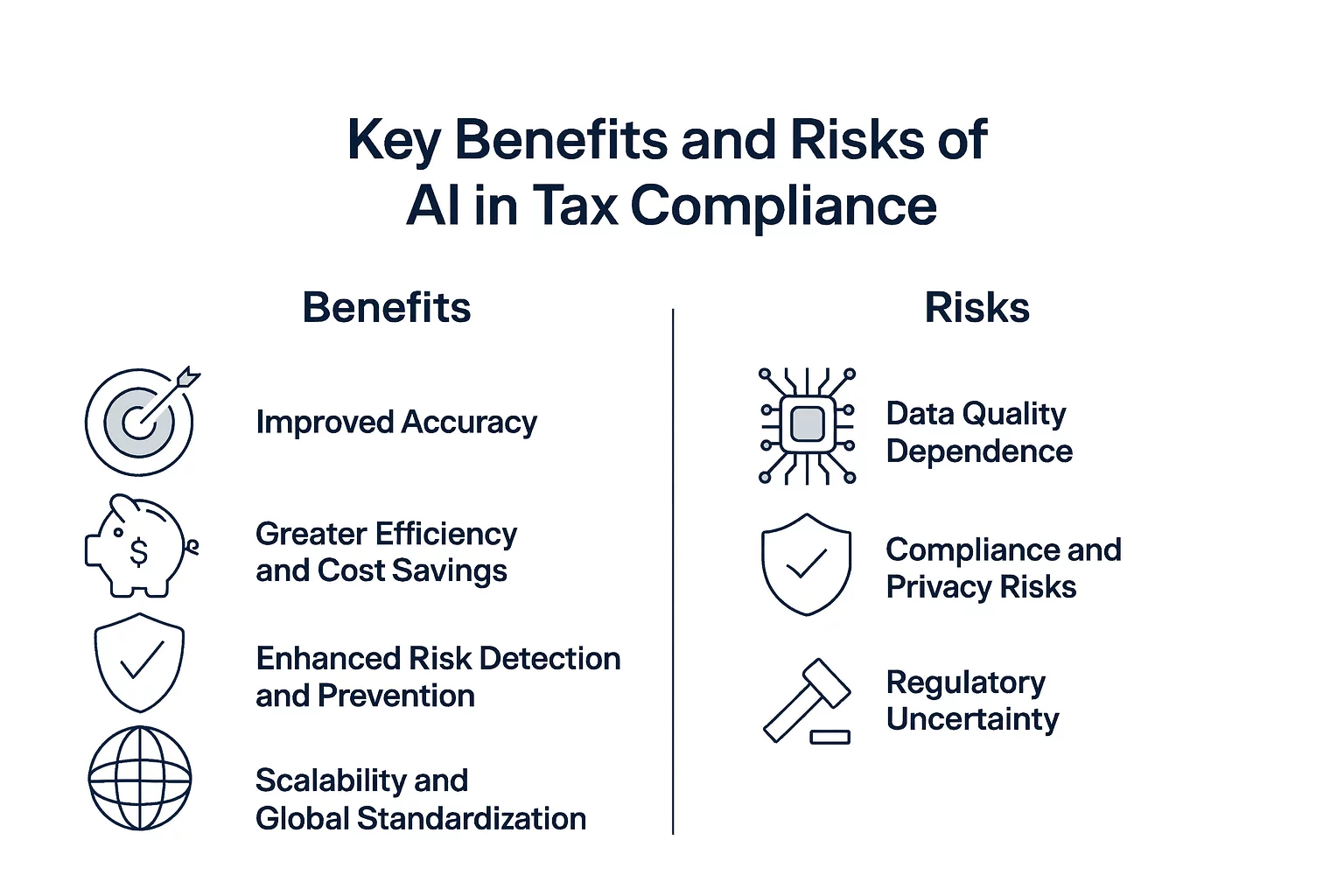
Improved Accuracy
One of the most common sources of compliance risk is human error. Humans are generally error-prone, and the fact that the tax compliance stack includes data entry, invoice transcription, tax-code assignment, and tax return preparation creates a perfect environment for human imperfection to manifest.
AI, on the other hand, with its automated data extraction, classification, checks, and validation, combined with learning capabilities, can reduce transcription mistakes, apply consistent logic across transactions, and identify discrepancies early. As a result, filled tax returns are likely to be more accurate, reliable, and compliant. One additional notable advantage of the AI over humans is its ability to identify errors or suspicious items that human reviewers might miss. This is especially true in large datasets, where human eyes may overlook specific data.
Greater Efficiency and Cost Savings
Automation of repetitive tasks significantly reduces the time and human resources required to complete them. For example, by reducing the time necessary to prepare and file tax returns, AI reduces the risk of missed deadlines or errors caused by last-minute manual work. Moreover, with less time spent on these repetitive tasks, staff can shift from routine compliance tasks to more strategic activities, such as tax planning, compliance strategy, risk evaluation, and advisory work.
Enhanced Risk Detection and Prevention
Risk detection is one of the greatest strengths of AI in tax compliance. AI models trained on historical data can detect patterns indicative of fraud, evasion, or non-compliance. Furthermore, machine learning can use historical data to detect unusual vendor behaviour, mismatched payments, repeated small transactions, or anomalous expense spikes, which can trigger alarms and help ensure that businesses are not only compliant but also fraud-proof.
Identifying risk early on also provides businesses with time to take corrective action before Tax Authorities notice these issues, which, in the long term, helps establish trust between taxable persons and Tax Authorities and reduces the likelihood of penalties, reputational damage, and financial exposure.
Scalability and Global Standardization
Scalability and global standardization are two of the most challenging issues for multinational or cross-border businesses, which face different tax regimes, languages, and currencies in other countries and markets. AI offers a promise of scalability as defined classification models, validation processes, and reporting automation can apply across a vast number of transactions, regardless of origin, currency, or language. However, proper training and localization are required.
Additionally, AI can be trained to apply the same logic or reasoning to similar transactions across entities, significantly reducing subjective interpretation and variance, enabling a more standardized compliance framework across jurisdictions. In this case, AI supports global operations, reduces the risk of misapplication, and simplifies international compliance.
The Risks and Challenges That AI Brings
All of the mentioned applicability cases and benefits could lead one to conclude that the AI is here to replace humans and is a solution for all tax compliance issues. However, despite all the apparent advantages, AI is not without its limits and risks. Overreliance on AI can be counterproductive, leading to new challenges and problems.
Data Quality Dependence
For an AI to be efficient, the quality, completeness, and correctness of data are of the utmost importance. Consequently, if the provided data is flawed or corrupted, the AI outputs may be unreliable. The so-called “garbage in, garbage out” problem is particularly critical when data is combined from multiple sources, such as ERP systems, accounting software, third‑party vendors, scanned documents, and legacy spreadsheets.
Therefore, without a strong and accurate data foundation, AI models may provide incorrect classifications, inaccurate risk scores, or fail to detect significant anomalies. Moreover, inadequate data cleaning, data governance, and structured input are among the most frequently cited obstacles to effective AI adoption in tax compliance.
Compliance and Privacy Risks
Tax data is highly sensitive and may include personal data, corporate financial data, vendor or customer information, banking details, and much more. When using an AI system, especially cloud-based or those relying on third-party vendors, data privacy and security become essential. Some of the most common and most critical issues are unauthorized data access, data leaks, or misuse. All of these may result in severe legal, financial, and reputational consequences.
These matters may be exceptionally challenging for businesses operating in strictly regulated regimes, such as the GDPR in the EU. Implementing AI in the tax compliance stack requires secure data storage, controlled access, encryption, and compliance with local privacy laws.
Regulatory Uncertainty
Tax compliance is more than a purely technical matter and requires deep legal knowledge and regulatory interpretation, and it also involves certain grey areas. AI's logic is often not easy to explain, let alone to audit. Therefore, due to this lack of transparency, solely relying on AI may negatively affect businesses' ability to remain compliant, or, in some severe cases, to challenge or appeal decisions of the Tax Authorities or the Courts.
As an additional layer of complexity, VAT and GST rules and regulations often change, and are not uniform across all jurisdictions. Therefore, if the AI misinterprets the regulation and misapplies the rules, the results for businesses are legal uncertainty, potential liability for AI-driven errors, or difficulties in explaining or defending automated tax decisions to Authorities or Courts.
How to Implement AI in Tax: Human–Machine Balance
Considering all the benefits and risks that AI brings, a successful integration into a tax compliance stack requires a balanced approach between human input and oversight on one side and AI architecture and output on the other.
First, data governance must be prioritized. Businesses must standardize data collection practices, implement data validation and cleaning workflows, and maintain secure, audited data storage. For an AI-based model to operate effectively, legacy data should be clean, standardized, and curated before deployment.
Secondly, the human touch should be incorporated at every step of the process. AI is here to assist humans, not replace them. Notable examples of balanced human-AI workflows include a tax expert reviewing AI-generated classification suggestions or key stakeholders being alerted by AI of critical audit or risk matters before any compliance or enforcement action is taken by the system. Human judgment is essential for ensuring accountability and mitigating risks of algorithmic bias or misclassification.
Furthermore, key stakeholders should be aware of how AI makes decisions. Therefore, AI models should provide a documented, versioned, and, ideally, interpretable trail. For example, when AI is used for filling or risk assessment, the logic and criteria should be transparent. Moreover, a mechanism to override or modify an AI-driven outcome should exist when the output is incorrect or unclear.
Even though the AI might be able to perform most of the tax compliance tasks, businesses must invest in technical capacity and infrastructure. Having adequate IT governance frameworks, cybersecurity protections, and capable staff, either in-house or outsourced, who understand both tax law and AI systems, is vital for effectively utilizing AI and ensuring a productive coexistence between humans and AI.
Conclusion
Ultimately, AI should be viewed as a tool to improve compliance, reduce risk, and enable professionals to focus on strategic, high-value tasks. If done correctly, the decision to adopt AI will not only be a technical upgrade but also a strategic transformation, affecting organizational workflows, internal controls, and compliance culture. Nonetheless, regardless of the possibilities that AI offers, human oversight remains central to tax compliance.
Source: OECD - Governing with Artificial Intelligence, Bloomberg, VATabout - How to Build an Indirect Tax Control Framework, IMF, PwC, VATabout - Digital Transformation & VAT Compliance: Strategies for Success in the Digital Age, AI in Tax Compliance: Understanding the Stack and Use Cases