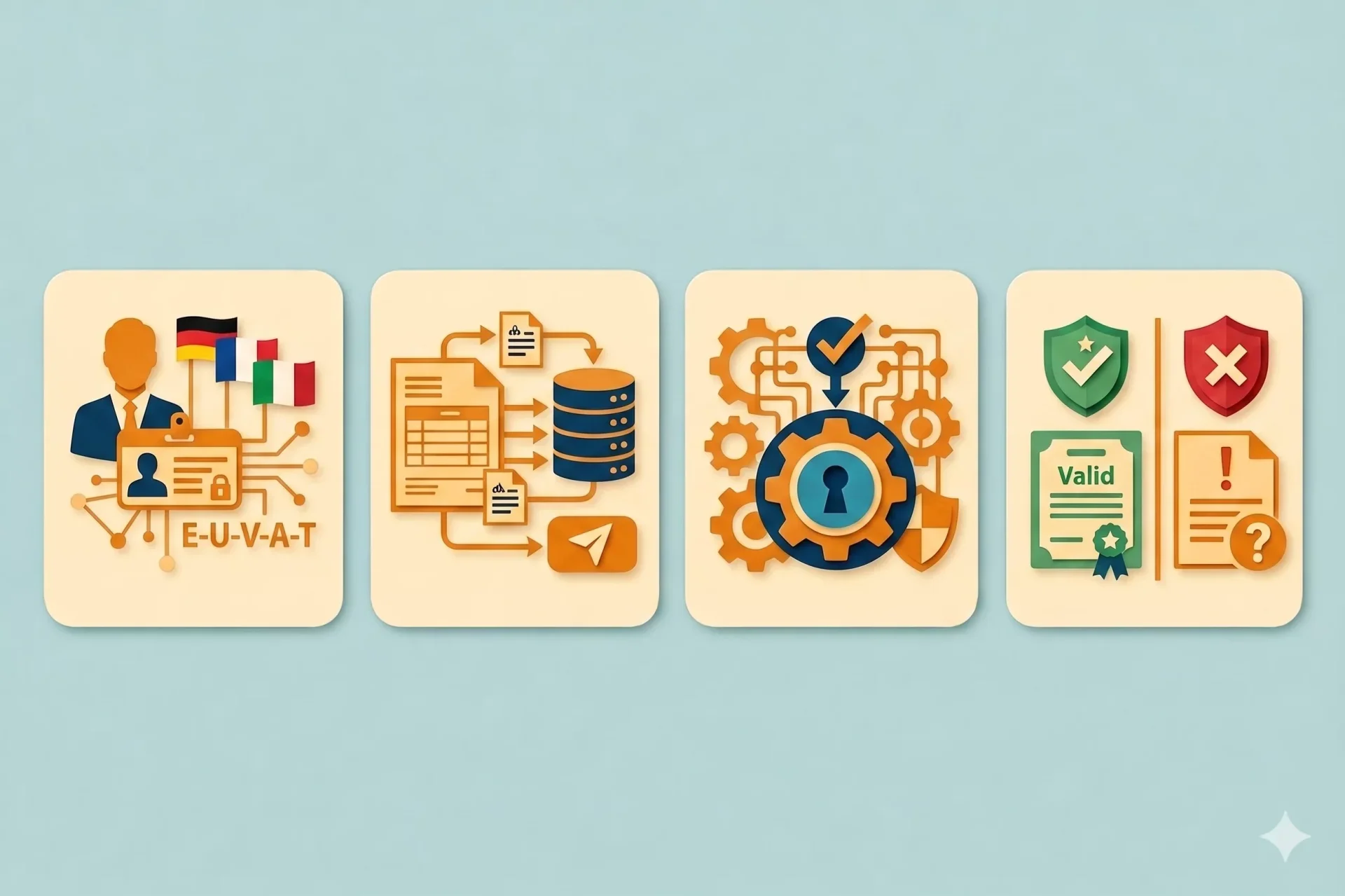
Checking the validity of VAT numbers is one of the top recommendations when dealing with new business customers, contractors, or partners. By developing the VAT Information Exchange System (VIES), the EU created a practical tool for verifying whether a VAT number issued by an EU country is valid, particularly for cross-border trade in goods and services within the single market.
While the system was well designed, due to changes in business models, particularly with the rise of e-commerce, the digital economy, and the growth of intra-EU trade, the VIES system displayed many limitations, leading to the EU’s decision to further develop the system under the VAT in the Digital Age (ViDA) package. Taken together, VIES plays a key role in both tax enforcement and commercial due diligence.
What VIES Is and How It Works
VIES was launched in 1993, alongside the EU Single Market, when customs checks at internal borders were abolished. At the time, the reform replaced physical customs controls with a VAT-based control system for intra-EU trade, significantly reducing administrative burdens for businesses by eliminating around 60 million customs documents annually.
Under the newly established system, goods supplied from one EU country became exempt from VAT in the country of departure, provided the buyer is a taxable person in another EU country and accounts for VAT in their own country. Since the exemption is dependent on the status of the customer, suppliers needed a tool or mechanism that enables quick confirmation that their business partners are VAT-registered taxable persons and that their VAT identification numbers are valid.
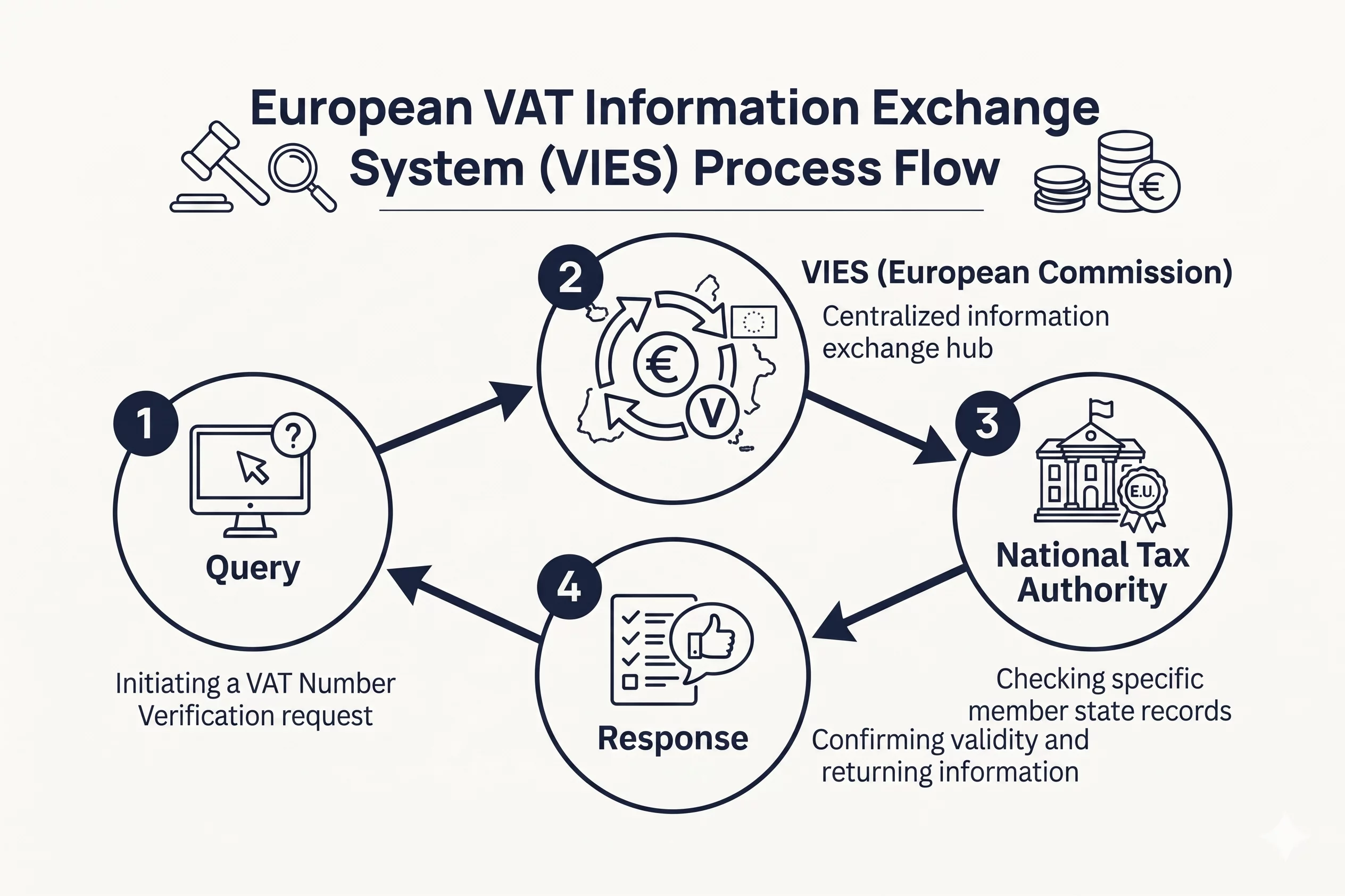
That led to the launch of VIES, an EU IT tool that enables verifying whether business entities involved in intra-EU transactions are properly registered for VAT. More specifically, VIES is an online database that includes key information such as the VAT identification number, the trader’s registered name, and their address. Tax authorities across the EU also use VIES as a central access point to check this information and confirm that transactions are completed properly.
Notably, the system does not store all the data centrally. Instead, the system operates by accessing and compiling information from national VAT databases maintained by each EU country. In more technical terms, the system sends a real-time request via a secure connection to the relevant national VAT database in the EU country where the VAT number was issued.
If the number exists in the database, the system returns a “Valid” status. In contrast, when the number is not found, an “Invalid” status is displayed. This indicates that the provided VAT number is not registered or cannot be confirmed.
Key Reasons Why Businesses Use VIES
Generally speaking, businesses use VIES to ensure compliance when engaging in cross-border trade within the EU. However, this broad application can be narrowed to few specific reasons. One of the key situations when businesses use VIES is when applying a zero-rate VAT mechanism to intra-Community supplies, or simply put, intra-EU B2B supplies.
These rules allow a supplier to apply a zero VAT rate when goods or services are sold to a business customer in another EU country, but only if that customer is properly registered for VAT and holds a valid VAT identification number. The role of VIES in this case is to confirm that this VAT number is valid at the time of the transaction. In addition to assuring the supplier, the verification also serves as important evidence for Tax Authorities in case of tax audit or compliance checks.
Given that verifying VAT numbers before issuing invoices is one of the most recommended measures in fraud prevention, such as missing trader intra-Community (MTIC) fraud, VIES also serves as a tool for businesses to reduce the risk of being involved in fraudulent chains and protect themselves from potential liability during audits.
Another major reason businesses use VIES is as part of standard compliance procedures in accounting and ERP systems. Many companies integrate VAT validation into their invoicing procedures to ensure that customer data is correct before a transaction is completed. By doing so, these businesses reduce administrative errors.
Finally, VIES is a valuable tool in the due diligence process. When faced with a tax audit, businesses may use VIES checks as evidence that they acted in good faith when applying zero-rated VAT, and that they took reasonable steps to verify their customer’s VAT status.
Limitations of the VIES System
While the system is practical, it is not without its limitations. First, the system is only as accurate as the national VAT databases it relies on. Therefore, if the database of a certain EU country is outdated or unavailable due to maintenance, the VIES response may be incomplete or unavailable. For example, a newly registered business may not immediately appear in the system, even though it is legally registered. Or, businesses that have recently been deregistered may still appear as valid for a short period.
In addition, VIES does not provide detailed information on taxable persons. Essentially, successful validation only confirms that a VAT number exists and is active. However, it does not provide additional business details such as company size, financial status, or trading history, all of which are important for comprehensive due diligence.
Future of VAT Data Sharing in the EU
As EU VAT rules and regulations evolve in response to the changing business world, VIES, as we know it today, will also be updated as part of the ViDA. The European Commission is designing the overall architecture of a centralized VIES system, while defining the implementation requirements and the specific data that national tax administrations will need to report to it.
In 2026, the Commission will publish two Implementing Regulations on the central VIES to define the common electronic message format and to establish access rights and permissions. Thus, the detailed design of the central VIES should be finalized in 2026, and system development is planned to begin in January 2027. Once this is completed, a testing phase involving EU countries is scheduled to start in January 2029, and a new Central VIES portal is scheduled to launch in July 2030, when EU countries will begin submitting data to the central VIES.
Source: European Data, European Commission, Your Europe, VATabout - VAT Fraud in Online Sales: Key Risks and Prevention Tips, VATabout - EU - How to Stay Off the Tax Authorities’ Watchlist: Key Risk Indicators Explained, Implementation Strategy - ViDA, VATabout - EU ViDA 2026 Work Programme and VAT Changes