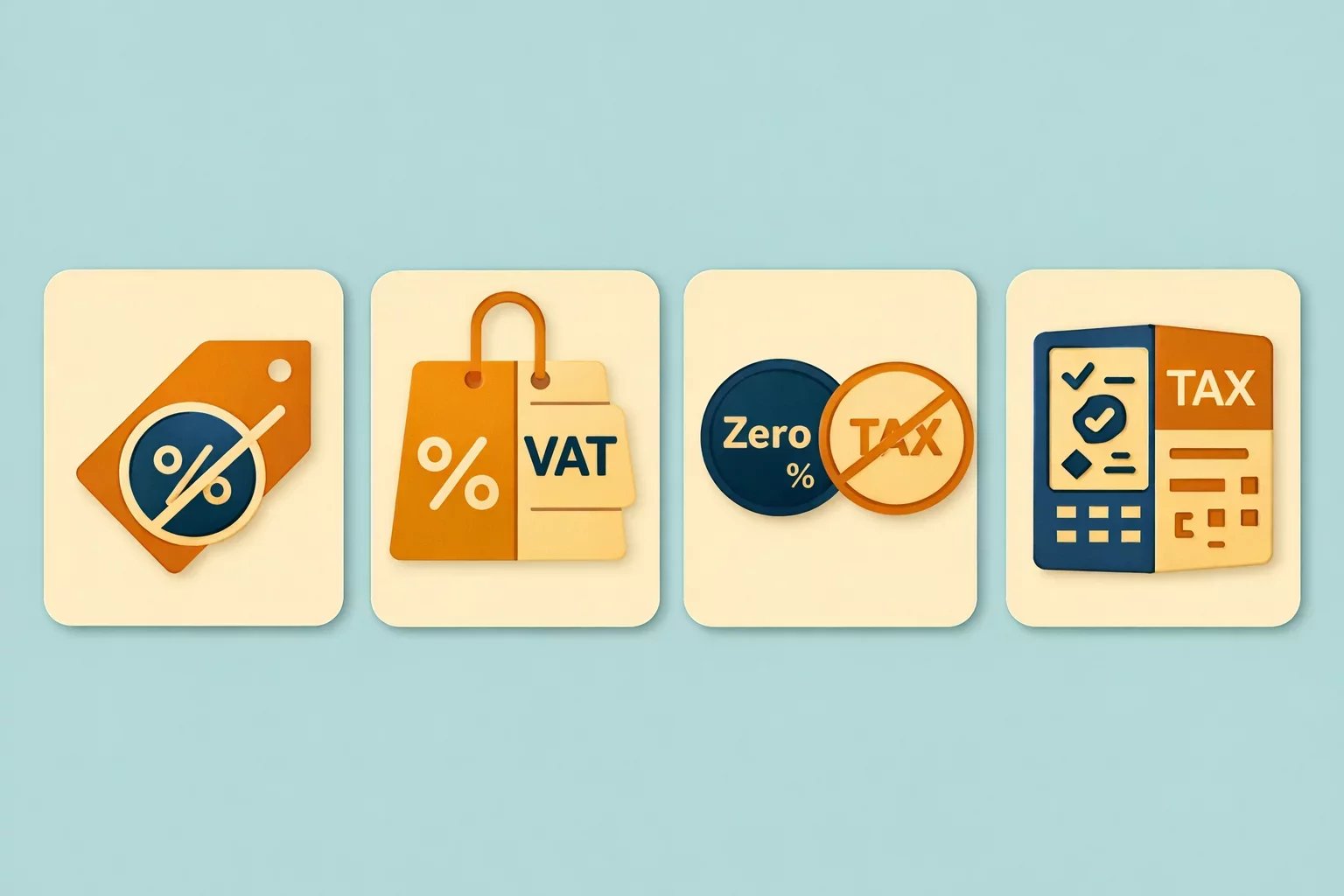
Indirect tax systems, most commonly VAT or GST, are designed around the principle of taxing at consumption while maintaining neutrality for businesses operating within the supply chain. However, not all transactions are taxed the same way. While most transactions are subject to standard or reduced tax rates, some of them are taxed at a zero rate, while others are tax-exempt altogether.
Although both zero-rate and tax exemption appear similar from a customer’s perspective, with no VAT charged on the invoice, the legal and economic consequences for businesses differ significantly. Misunderstanding the distinction between these two directly affects input tax recovery, pricing structures, reporting obligations, and ultimately business profitability. Thus, understanding how these mechanisms operate in practice is essential not only from a compliance perspective but also from the business perspective.
Zero-Rated Transactions in Practice
Simply put, zero-rated transactions are taxable transactions subject to a 0% VAT rate. From a practical point of view, this means that suppliers do not charge customers VAT but remain fully within the VAT system and retain the right to recover input VAT incurred on related purchases.
The zero-rate typically applies to exports and certain cross-border transactions to ensure that goods and services are taxed in the country of consumption rather than the country of origin. This mechanism was set to preserve neutrality in international trade by preventing domestic VAT from being embedded in export prices.
The ability to apply a 0% VAT rate to certain transactions helps businesses, primarily exporters, international transport providers, or suppliers of essential goods, to improve cash flow and competitiveness. Businesses that apply 0% VAT rate to their supplies may regularly receive VAT refunds because their outputs are taxed at 0% while input VAT remains recoverable.
Notably, zero-rated supplies still count as taxable turnover. This means that businesses must report them in VAT returns, include the VAT rate in their invoices, and transaction-related documents.
Policy Logic Behind Tax Exemptions
While zero-rated transactions are taxable at 0% rate, tax exemptions follow a fundamentally different policy rationale. In contrast to supporting trade neutrality, exemptions are typically introduced for social, economic, or administrative reasons.
For example, under EU VAT rules, EU countries must exempt certain activities considered to be in the public interest, including healthcare, education, financial services, insurance activities, and specific social services. The main reasons for exempting these sectors from VAT are that taxing them could increase the cost of essential services, or determining the taxable value added may be administratively complex.
A key feature of tax-exempt transactions is that they do not grant the right to deduct input VAT. For businesses engaged in exempt transactions, this means that they bear VAT on their operational costs, which becomes embedded in the final price charged to consumers.
Tax exemptions should be viewed as a compromise between revenue collection and broader social objectives. Also, they can be viewed as a deliberate acceptance by governments of a loss of revenue to ensure the affordability of key services or to simplify compliance for sectors where taxation would be difficult to administer effectively.
Key Differences Between Zero-Rated and Tax-Exempt Supplies
There are several key differences between zero-rated and tax-exempt supplies, including their positions within the VAT system, input VAT deduction rights, VAT registration obligations, reporting requirements, compliance requirements, and economic impact on businesses.
| Zero-Rated Supplies | Tax-Exempt Supplies |
Position Within the VAT System | Fully within the VAT system | Outside the scope of VAT rules |
Input VAT Deduction Rights | Yes - taxable persons retain the right to deduct input VAT | No - taxable persons cannot deduct input VAT |
VAT Registration Obligations | Registration is required once the registration threshold is exceeded | No need to register for VAT |
Reporting and Compliance Requirements | Taxable persons must issue VAT-compliant invoices, file VAT returns, maintain supporting documents, and comply with audit and record-keeping obligations | No need to submit VAT returns or report transactions under VAT rules (unless taxable activities are also performed). |
Economic Impact on Businesses | No hidden VAT costs | Often creates hidden VAT costs |
Compliance Challenges and Common Mistakes
The similarity between “no VAT charged” outcomes may lead to misclassification of transactions, further resulting in incorrect VAT claims or VAT costs.
For example, treating an exempt transaction as a zero-rate may result in an incorrect input VAT recovery claim. Apart from denying this claim, Tax Authorities may also perceive this mistake as an intentional attempt to obtain undue tax benefits fraudulently or to recover VAT to which the taxable person is not entitled. Consequently, they might conduct a tax audit. On the contrary, treating zero-rated supply as exempt may result in VAT costs and lost refund opportunities.
Those engaged in cross-border transactions may also face additional risks. Given that a zero rating typically depends on strict documentation proving export or international supply conditions, failure to maintain the required documentation and other relevant data may result in reclassifying the transaction as domestically taxable.
Financial, educational, or healthcare businesses and organizations that frequently conduct both taxable and exempt activities face an additional layer of complexity. These businesses or organizations are faced with partial exemption rules that limit input VAT recovery, where calculating deductible VAT proportions requires continuous monitoring and accurate allocation methodologies.
Finally, the impact of e-invoicing and digital reporting requirements must not be overlooked in the context of compliance issues. As inconsistencies between declared VAT treatment and transactional data become easier to detect, businesses are at greater audit exposure for incorrectly classified supplies.
Conclusion
In VAT and GST regimes, assumptions can be costly, especially when two transactions appear identical on an invoice but behave very differently in practice and under the law. While both zero-rated and exempt transactions may result in no VAT being charged, confusing the two can reshape margins, distort pricing decisions, and trigger regulatory scrutiny. Getting the classification wrong is not a minor technical error. It can mean denied refunds, unexpected costs, or a tax audit knocking at the door.
Source: The Norwegian Tax Administration, European Commission - VAT Exemptions, International Monetary Fund, HMRC - Partial exemption