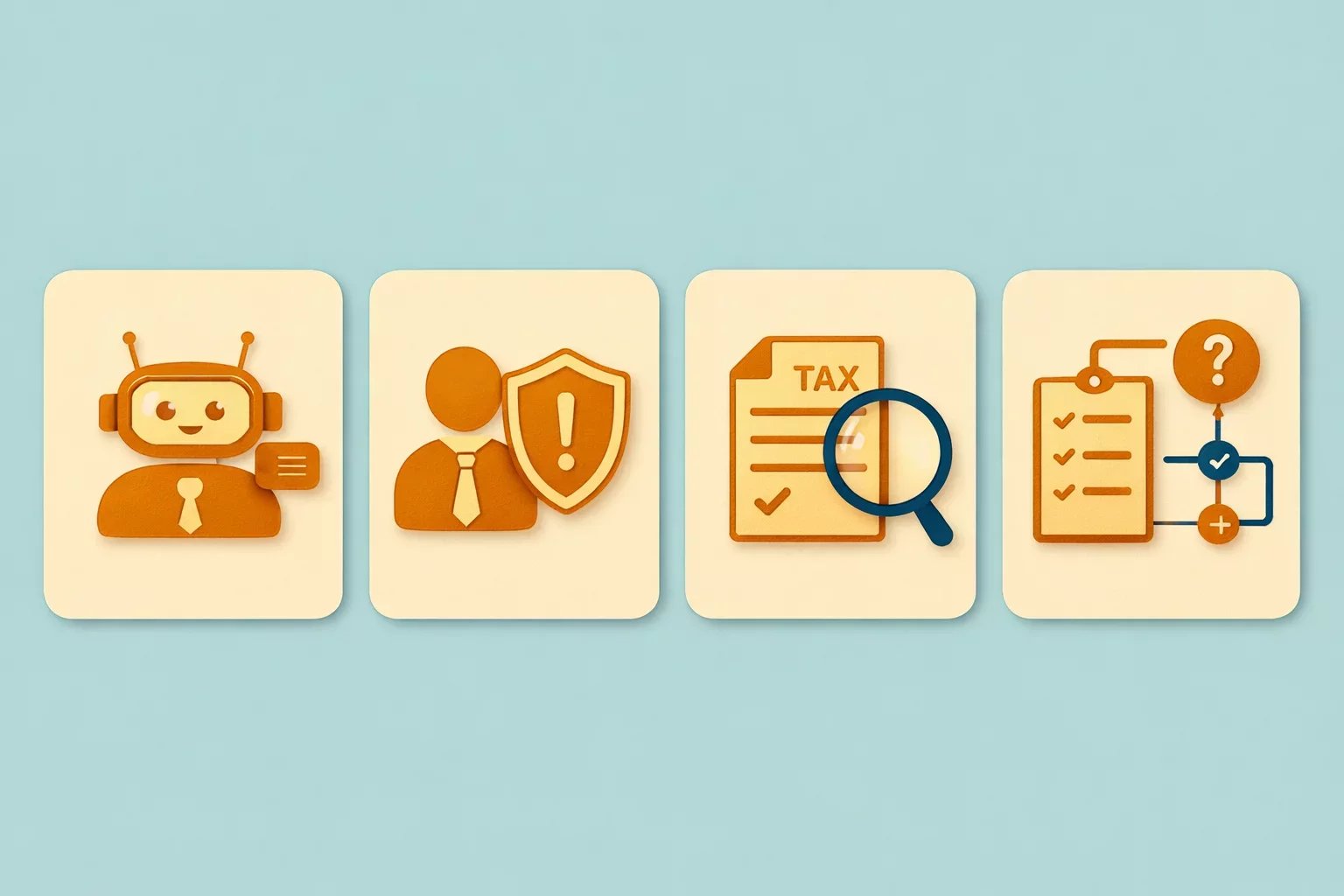
The role of AI in tax compliance is not new, but it is a critical point of debate for the future of tax compliance. While the previous two-article series on AI in tax compliance focused on understanding the tax compliance stack and how AI can be used across the compliance lifecycle, here the focus will be narrowed to AI-powered chatbots, which have emerged as a promising technology to assist governments, tax professionals and taxable persons.
However, as governments and tax professionals increasingly experiment with AI tools to modernize tax administration and improve their support to taxable persons, carefully balancing innovation with responsible implementation is a key concern for many who rely on the promises of AI's positive impact.
Why Traditional Tax Assistance Is Struggling
Tax compliance has undergone drastic changes in recent years, and the rise of AI has accelerated these changes, affecting both how the government monitors and processes data and how taxable persons complete and file their tax returns. As a result, the traditional tax assistance and compliance models increasingly struggle to keep up with the demands of modern tax systems.
While human interaction, whether through tax professionals, customer service centers, or official guidance published by Tax Authorities, which traditional tax assistance models rely on, is essential, many challenges can no longer be addressed efficiently without AI.
For example, tax laws frequently change, and the growing digital economy has introduced new issues such as cross-border e-commerce, digital services taxation, and complex reporting obligations. Relying solely on human effort to track, monitor, and interpret all these changes, while necessary, is often insufficient and inefficient.
The government bodies and agencies, on the other hand, face resource constraints. Annually, Tax Authorities handle millions of inquiries, and traditional support channels, such as call centers, in-person assistance, or e-mails, become overwhelmed during peak filing periods.
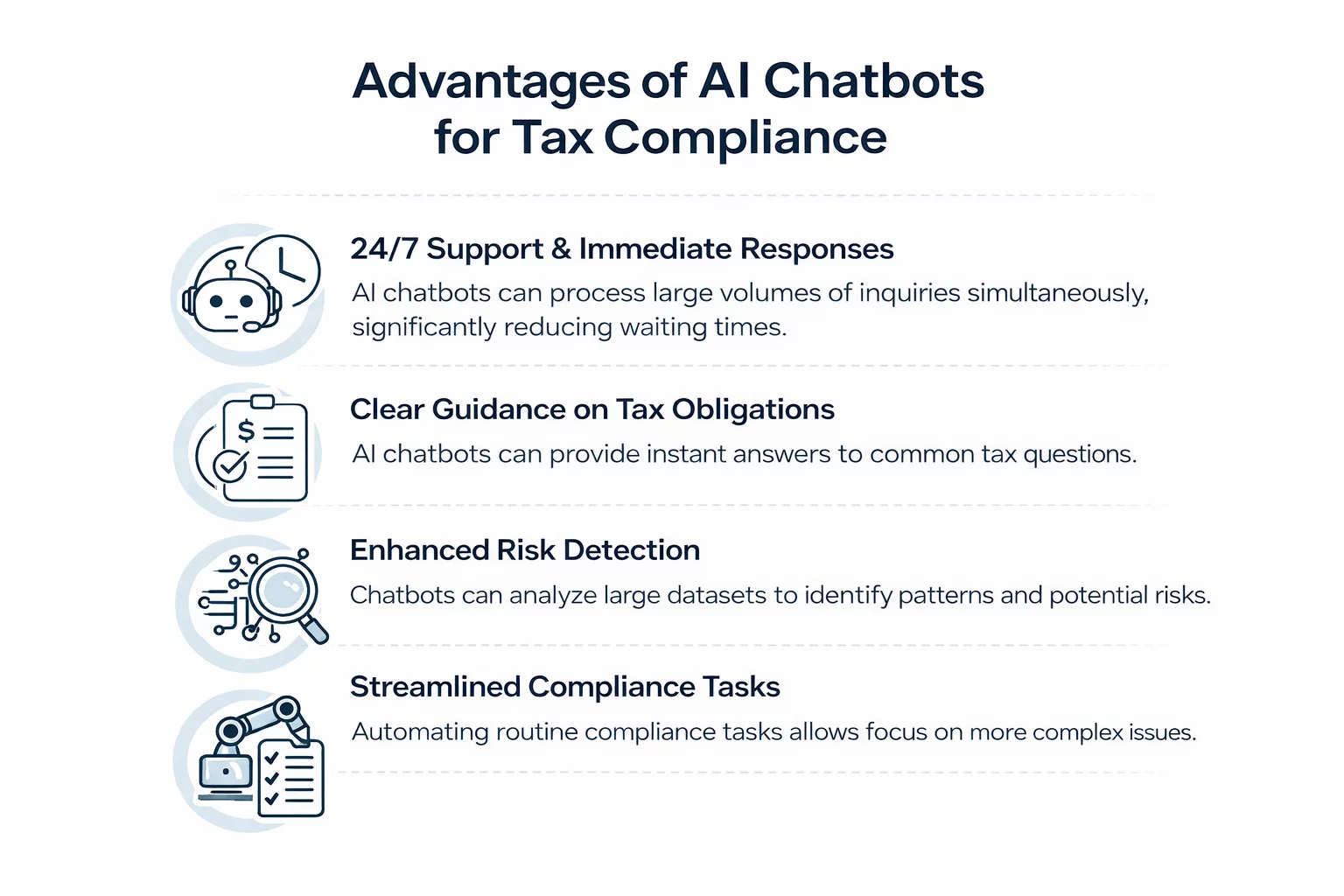
In an era where businesses, consumers, and people in general are accustomed to instant online assistance, waiting days or weeks for responses to tax questions is no longer practical. Taxable persons in the first line increasingly expect real-time digital services from government agencies and tax professionals. As a part of the solution, the AI chatbots emerged.
The Role of AI Chatbots in Improving Tax Compliance
Since 2016, when only 9% of the tax administrations used AI, that number increased to 69% in 2023. Moreover, between 2018 and 2023, the OECD noted a 36.2% increase in administrations that use virtual assistants, such as chatbots. One of the primary tasks of these chatbots is to cope with more complex questions being asked by taxable persons and to provide more personalized answers.
For example, the Austrian Tax Administration developed the Bot Federation, a network of specialised chatbots used by the public administration. Fred was the first chatbot of that kind developed by the Austrian government to assist taxable persons with tax-related inquiries. Building on Fred's success, the Tax Authority decided to fuse its knowledge base with that of the ID-Austria Chatbot. That enabled Fred to consult ID-Austria for specialised knowledge, offering users a unified and enriched source of information.
Singapore also launched its AI-based solution, the Government Virtual Intelligent Chat Assistant (VICA) platform in 2021. The platform is designed as a chatbot that efficiently handles common queries on individual income tax, GST, stamp duty, withholding tax, and other tax matters. In addition to answering inquiries, taxable persons can conveniently check their outstanding tax balance, view payment plans, check payment status, cancel or reinstate payment plans, as well as make tax payments via self-service payment terminals and mobile channels.
Compared to traditional digital service channels, a single VICA session saves up to 10 minutes per action for taxable persons. In its 2024 financial report, the Inland Revenue Authority of Singapore noted that VICA handled about 70,000 queries, which saved nearly 11,700 hours of work for taxable persons.
Another notable example is South Korea, where a chatbot guides taxable persons through the filing and payment process, thereby reducing not only the risk of error but also the need for additional oversight by government officials. Moreover, this step-by-step guidance increases on-time filing, which benefits both taxable persons and the government.
In 2022, the US developed voicebots and chatbots in English and Spanish that assist taxable persons with tax payment issues, answer frequently asked questions, and help them understand notices they may have received from the IRS. In October 2025, the UK government announced that it had launched GOV.UK Chat, the country's first AI-powered chatbot that helps, among other matters, taxable persons receive quick answers to their tax-related questions.
The Risks and Limitations
One of the most notable risks associated with AI is the phenomenon known as AI hallucinations. While in most cases, the system generates outputs by relying on patterns it learned during training, there are situations in which the AI produces responses that are inaccurate, unsupported by its training data, or formed through faulty pattern interpretation.
Whether it is due to overfitting to specific data patterns, biases, inaccuracies in the training data, or the model's complexity, AI chatbots may generate responses that sound convincing but do not reflect real or reliable information. As a direct consequence, taxable persons who rely on incorrect or outdated tax guidance may violate tax regulations, leading to tax audits and penalties.
Transparency is another critical issue. Since AI systems typically operate as black boxes, meaning their decision-making processes are not easily explainable, the lack of transparency can create difficulties when taxable persons wish to understand or challenge automated decisions.
Taxable persons who utilize AI chatbots for their tax compliance must be aware of the dangers of overreliance on automated systems. Even though AI chatbots serve to handle routine tasks effectively, complex tax issues often require professional judgment and legal interpretation. Thus, overreliance on AI in tax matters without professional oversight may be counterproductive, leading to oversimplified guidance or misunderstandings of tax rules.
Best Practices for Using AI Chatbots Safely
Maintaining human oversight is one of the essential steps to maximize the benefits and minimize the risk of using AI chatbots. An AI system should be viewed as a complement rather than a replacement for human expertise, particularly in complex or high-risk tax decisions.
Another consideration for those who use tax chatbots is to ensure that AI-driven systems provide clear explanations of how conclusions are reached. By adopting this approach, taxable persons or tax professionals will have a clearer understanding of how answers are provided and may double-check if the information is correct and up to date.
Given that the tax data is among the most sensitive information, data privacy is one of the biggest concerns associated with AI. Taxable persons should understand how AI systems handle data, assess the transparency of the AI model, identify the safeguards in place to prevent data leakage, and the procedures used to test for bias or errors before feeding the system with any tax-related information.
Source: VATabout - AI in Tax Compliance: Understanding the Stack and Use Cases, VATabout - AI in Tax Compliance: Benefits, Risks, and Smart Integration, IMF, OECD - Governing with Artificial Intelligence, IBM Center for the Business of Government, Inter-American Center of Tax Administration, OECD Tax Administration 2025, Internal Revenue Service, IBM