Adopting and implementing digital solutions and processes is a well-established trend among governments and businesses. In the world of digital reporting and monitoring, e-documents have gained prominence not just as administrative tools but as core legal and fiscal records.
Moreover, e-documents seem to be the missing piece in transforming indirect tax compliance into a fully automated, accurate, and transparent system. A system where transactions can be validated in real time, errors are minimized, and businesses can demonstrate compliance effortlessly while Tax Authorities gain reliable, auditable data for enforcement and policymaking.
What Are E-Documents and Why They Matter
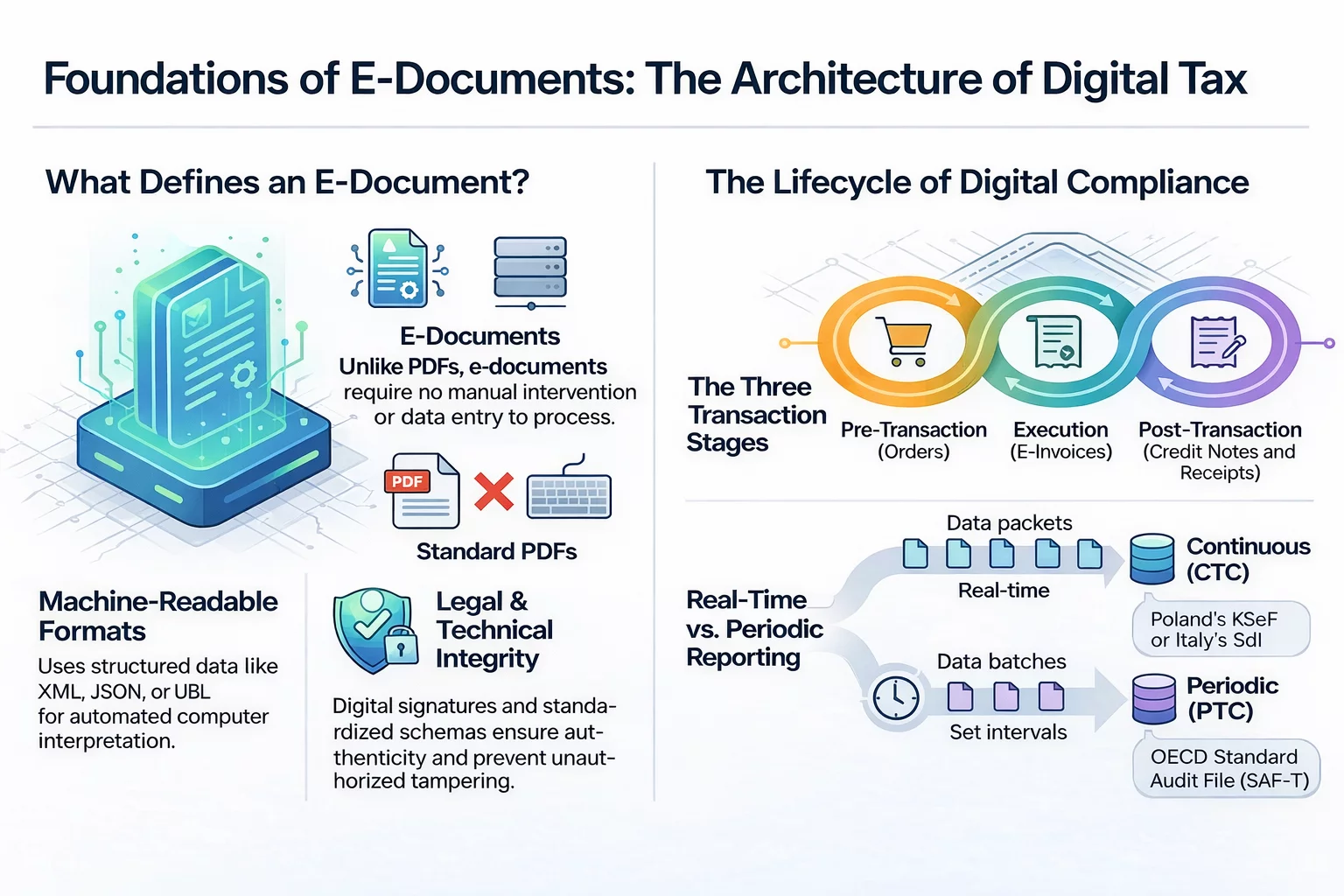
E-documents are structured digital files created, processed, and stored so that computers can read and interpret their content automatically. The most common association for e-documents is financial records, which we will focus on. Nonetheless, it is necessary to clarify that the use of e-documents goes beyond financial records, such as e-invoices or e-receipts, and includes e-contracts, dispatch notes, delivery confirmations, payroll slips, customs declarations, and HR forms.
The main difference between PDFs, for example, and e-invoices, as one of the most widespread forms of e-document, is that PDFs lack standardized data structures and cannot be automatically processed without manual intervention. The fact that PDFs and similar documents in digital form are unstandardized and can be communicated via e-mail makes them easily manipulable and misused.
In contrast to PDFs, scanned documents, or images, e-documents use machine-readable formats like XML, UBL, JSON, or XBRL, enabling automated validation, routing, archiving, and transmission without human intervention. This provides governments, or better said, Tax Authorities, with real-time, high-quality data that can be analyzed to better understand economic activity and inform policymaking.
Notably, taxable persons also benefit greatly from the use of e-documents, including reducing errors in tax calculations, ensuring the timely declaration of taxable transactions, and improving overall compliance efficiency. In general, the structured and tamper-resistant nature enhances both accountability and cybersecurity, especially compared to paper-based systems that can be altered, lost, or forged.
The Most Common Types of E-Documents
The easiest way to understand the variety of e-documents used in indirect tax systems is to categorize them by the stage of the commercial transaction at which they are used. Depending on the stage, these documents not only facilitate commercial exchange but also ensure that tax-related data flows are captured accurately and in compliance with applicable laws.
Pre-Transaction E-Documents
Pre-transaction e-documents, such as digital purchase orders, pre‑invoices, and electronically managed contracts, are essentially records created before the actual supply of goods or services. Even though they are typically not required by Tax Authorities, these documents play a crucial role in planning, procurement approval, and establishing contractual terms in a digital format that can be linked with subsequent fiscal records.
Transaction Execution Documents
The transaction execution documents, or simply transaction documents, are at the core of indirect tax compliance. These are e-documents generated during the exchange of goods or services that reflect financial and tax obligations.
As previously mentioned, the most well-known transaction documents are e-invoices, which record the details of a sale and its tax implications in a structured digital format. However, this type of e-document includes various sales documents, such as standard e-invoices for B2B or B2G transactions, simplified e-invoices for B2C sales, and adjustment e-documents.
E-waybill, a digital transport and logistics document used to track the movement of goods and ensure compliance with tax and cross‑border regulations, is another important e-document, as it contains details about the consignor, consignee, goods, and their transport. Typically, this document must be issued before transport of goods begins.
Post-Transaction Documents
Even though the transaction document plays a vital role, post-transaction e-documents are also significant, especially for adjusting financial and tax records. The most notable representatives of post-transaction e-documents are e-credit notes issued for returns or discounts, e-debit notes for additional charges, and supplemental or corrective e-invoices that correct previously issued records. Although these documents serve as adjustments, they must still adhere to structural standards and be integrated with accounting systems to ensure accurate tax reporting.
Additionally, e-delivery notes confirm the delivery of goods, serve as proof of receipt, and verify that items match the order specifications. Similarly, e-goods receipt notes are used to confirm receipt of goods at a warehouse or facility, documenting condition, quantity, and compliance with order specifications. Both these documents include data relevant to tax purposes.
Reporting and Compliance of E-Documents
When it comes to reporting and compliance, indirect tax regimes require periodic or real‑time reporting of e‑documents to Tax Authorities. Depending on the level of control they want, governments impose two types of mechanisms: Continuous Transaction Controls (CTC) and Periodic Transaction Controls (PTC).
CTC mandates that taxable persons provide transaction data to the Tax Authority or an authorized platform before or immediately after a transaction, enabling near real-time monitoring. When considering CTC, one should consider e-invoicing systems such as Poland's KSeF or Italy's SdI.
In contrast, the PTC requires businesses to report transactional data at set intervals, such as monthly, quarterly, or annually, rather than in real time. One of the most widely used standards for PTC is the Standard Audit File for Tax (SAF‑T), an XML‑based format recommended by the Organisation for Economic Co‑operation and Development (OECD) for exchanging reliable financial data between taxable persons and Tax Authorities.
Key Legal and Technical Requirements for E-Documents
For e-documents to be accepted as valid, they must meet several legal and technical requirements that ensure their validity, security, and interoperability. From a legal perspective, e-documents must include defined mandatory elements such as unique identifiers or detailed tax information. Furthermore, digital signatures or legally recognized electronic signatures are often required to guarantee the authenticity of origin and integrity of content.
On the technical side, e-documents must be presented in one of the standardized data formats such as XML, UBL, or, in some cases, country‑specific schemas. Additionally, standards such as EU EN16931 or Peppol in many international markets provide interoperability and data-structuring frameworks that facilitate cross‑system exchange and validation.
Other technical requirements refer to secure transmission protocols, encryption to protect data in transit, and structured data fields that align with tax rules and reporting requirements. Also, technical standards for archiving, or in this case, e-archiving, are critical. Therefore, many governments mandate long‑term storage of e‑documents in accessible and tamper‑proof formats to support audits and legal inquiries years after issuance.
E-Documents: The Next Phase
Looking at the pace of implementation of e-invoicing and digital reporting systems worldwide, it is clear that e-documents are set to become the foundation of a fully digital, connected, and proactive tax environment. However, to live up to this expectation, e-documents must evolve from static records into active components of the tax system itself, and interoperable and intelligence-driven data assets that enable real-time validation, seamless system integration, and automated compliance across not one but multiple jurisdictions.
A great example of what is to come and in which direction e-document can contribute to further modernize tax compliance is the EU Digital Reporting Requirements (DRR) under the EU VAT in the Digital Age (ViDA) legislative framework, which requires that all EU countries have a uniform reporting and tracking system for all relevant VAT data.
Source: VATabout - EU Digital Reporting Requirements, OECD Forum on Tax Administration, Thomson Reuters, UK Electronic Trade Documents Act 2023, VATabout - SII or Verifactu: A Dilemma for Businesses Operating in Spain