April 2, 2025, now widely known as the Liberation Day, shed a completely new light on US President Donald Trump's signature policy and, a year later, marked one of the most significant legal losses, raising a question worth around USD 195 billion in collected tariffs.
While the future of tariffs is blurry, their imposition has significantly disrupted the global trade ecosystem, pushing countries to negotiate and sign deals and to establish a new geopolitical order. With April 2, 2026, around the corner, it is the right time to assess the results and consequences of these broad-based tariffs on imports, intended to address trade deficits and boost US manufacturing.
The Prelude to Economic Disruption
Since the start of his second term on January 20, 2025, Donald Trump has expanded tariffs on imports from nearly all US trading partners, relying on several legal tools to justify these measures. Primarily, the US President relied on the International Emergency Economic Powers Act (IEEPA), which allows action during national emergencies, and Section 232 of the Trade Expansion Act of 1962, which permits tariffs on national security grounds.
What is important to note regarding the Liberation Day is that it had an introduction or preface. On March 4, 2025, the US President imposed sweeping 25% tariffs on imports from Canada and Mexico, affecting a wide range of goods from everyday groceries to electronics. Simultaneously, trade pressure on China was increased by doubling an existing tariff rate from 10% to 20%, building on measures that had already taken effect in early February 2025. Nonetheless, a day later, on March 5, a one-month exemption for goods traded under the United States–Mexico–Canada Agreement, a regional trade deal negotiated during his first term, was announced.
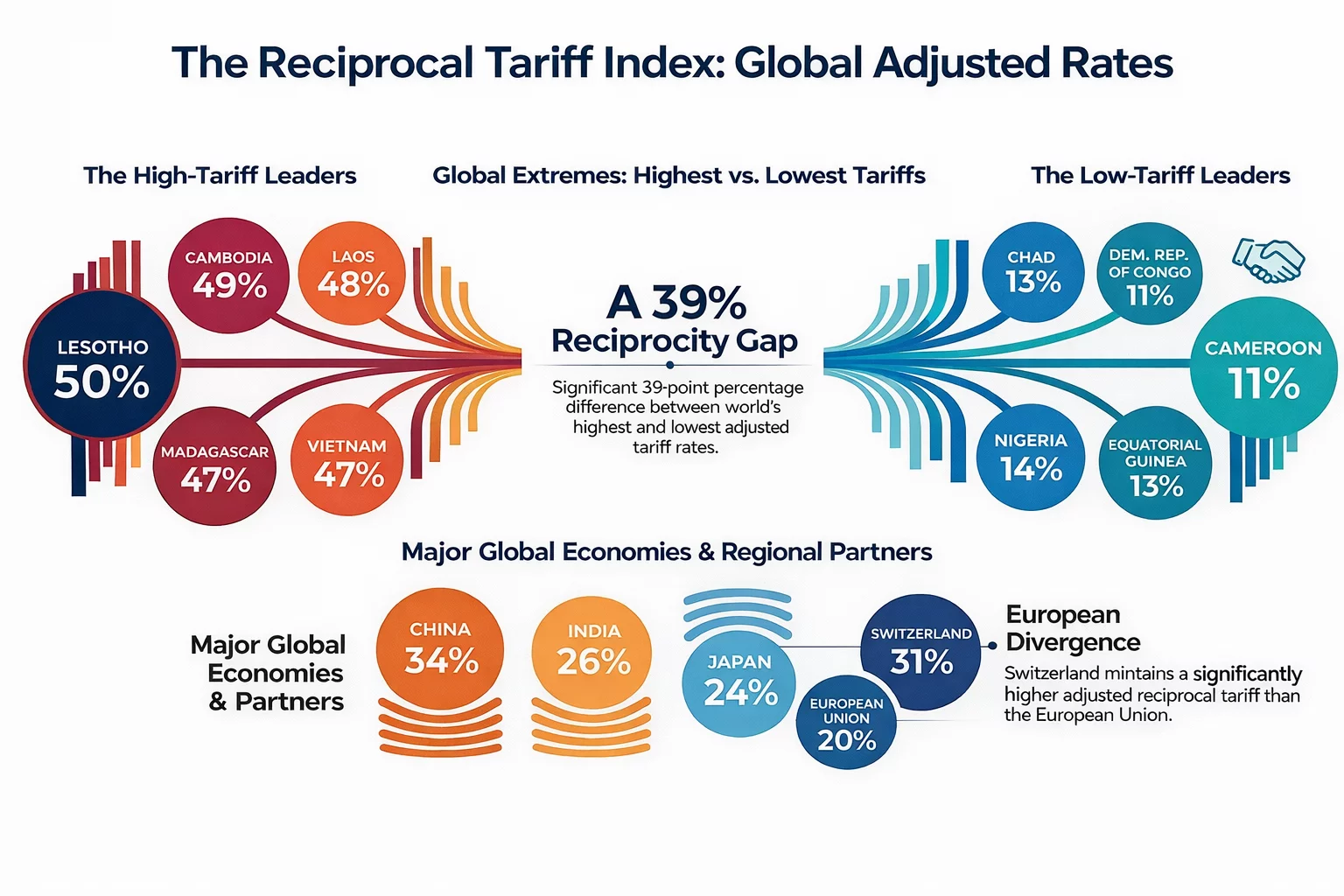
This decision protected most exports from Canada and Mexico into the US from new tariffs until April 2. In the meantime, 25% tariffs on all steel and aluminum imports to the US have been imposed. All these actions led to Liberation Day, when the Trump administration announced a 10% universal tariff and reciprocal rates up to 50% on all trading partners. The tariff rates hit both long-standing US trade partners, such as the EU and Japan, and those who pose the greatest threat to US global economic primacy, such as China.
Note: Data in the image is from Annex I published by the White House
Trade War Abroad, Legal War at Home
Given that the tariffs were designed to reduce the US trade deficit, countries with large trade surpluses with the US were threatened with reciprocal tariffs of up to 50%. In contrast, countries with smaller surpluses or trade deficits faced a standard 10% rate.
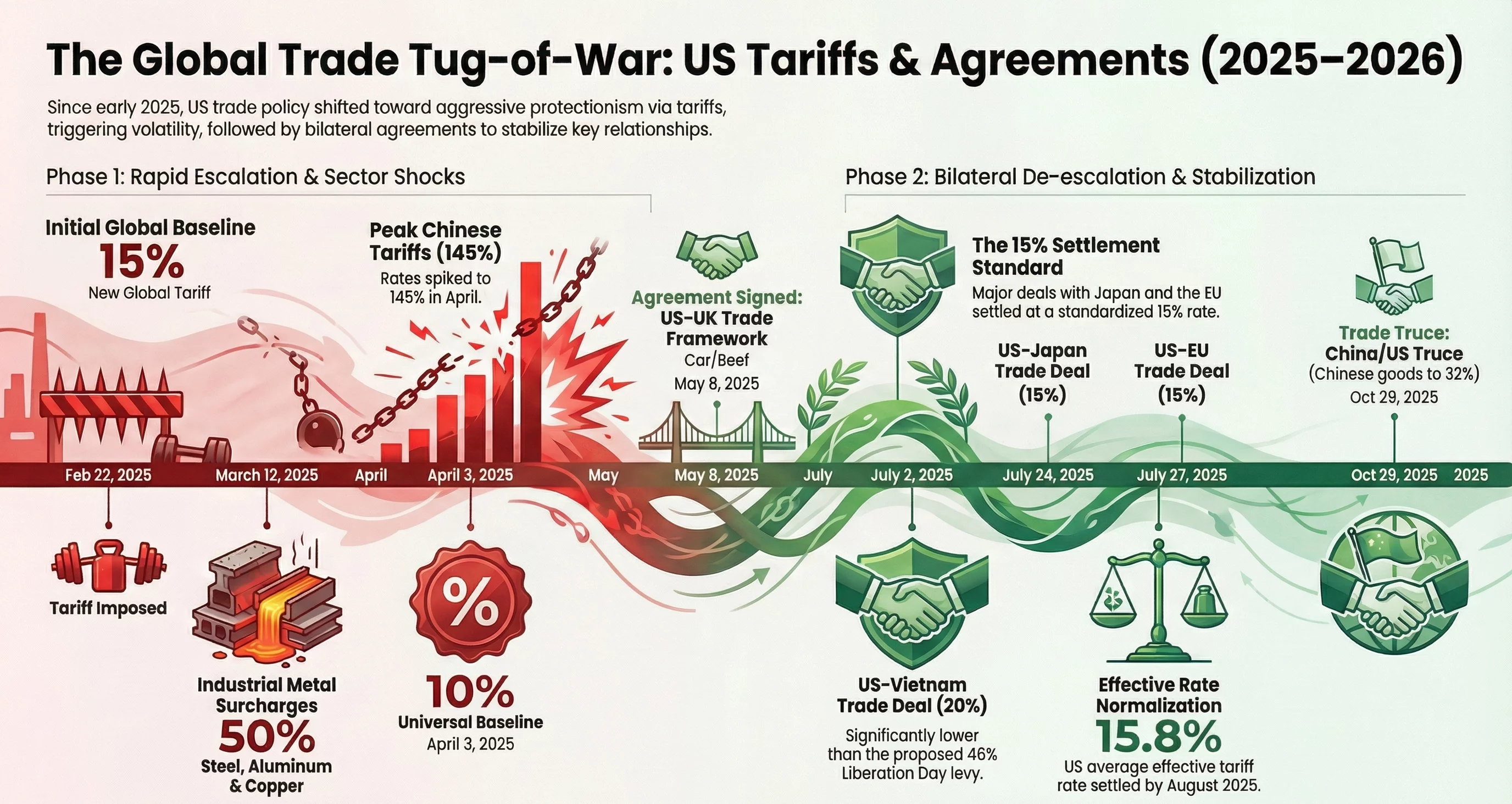
The enactment of the tariffs sparked negotiations between the US and other countries, leading to a series of framework agreements through joint statements between the US and its partners, such as the EU, Japan, South Korea, the UK, and Switzerland, and to temporary tariff truces with China. These trade agreements are supposed to reshape global trade, reduce the US trade deficit, and ensure the US remains the world's leading economy.
Note: Data in the image is from J.P. Morgan's research - US tariffs: What’s the impact on global trade and the economy?
However, the impact extended beyond immediate trade costs. The uncertainty surrounding US trade policy and the Trump Administration's shift in tone increased market volatility and affected investment decisions. Ultimately, the full impact depends on how further negotiations and legal challenges unfold. Nonetheless, the current global effect can be measured in raised costs for global producers and consumers, reduced trade volumes in certain sectors, and creates economic headwinds that slow both US and global economic activity through 2026.
Supreme Court Decision on IEEPA Tariffs Limits
The Trump tariffs were a subject of dispute before the US Supreme Court, as small businesses and several US states challenged the administration, arguing that the President exceeded the powers granted by IEEPA and that the law was never intended to authorize such broad tariff measures. On February 20, 2026, in a 6-3 decision, the Supreme Court ruled that President Trump is not authorized under the IEEPA to impose country-specific tariffs. As a result, more than 65% tariffs were declared illegal.
What was not clear at that time was how the already collected tariffs, estimated at around USD 195 billion, would be refunded. That question was answered on March 4, when the US Court of International Trade (CIT) issued a decision on the refund of duties following the Supreme Court's decision.
Following the CIT's ruling, the US Customs must process all pending import entries without applying the previously imposed tariffs found to be invalid under the IEEPA. For entries that have already been processed but are not yet legally final, Customs must recalculate the duties, remove any invalid tariffs, and refund any amounts already collected, including interest, where applicable. Essentially, this decision nullifies the IEEPA-based tariffs on both pending and recently processed imports, effectively reducing tariff revenue to USD 36 billion from Section 232 tariffs.
Restructuring Tariffs in a Post-Ruling Landscape
However, the Trump administration is not backing down on its tariff ideas. On the same day, the Supreme Court announced its decision, the White House introduced a major shift in tariff policy through a set of coordinated executive actions.
The administration published an Executive Order titled “Ending Certain Tariff Actions,” which immediately abolished all tariffs imposed under the IEEPA and instructed that their collection stop as quickly as possible. At the same time, with the Presidential Proclamation, a new temporary, uniform 10% tariff on imports from all countries, effective February 24, 2026, was introduced.
Additionally, with another Executive Order, “Continuing the Suspension of Duty-Free De Minimis Treatment for All Countries,” the treatment of low-value shipments was adjusted. Under this Order, imported goods which had already lost their duty-free status under earlier measures are now brought in line with the new system by being subject to the same 10% surcharge.
The Domestic Cost of Protectionism
In 2025, the US had a goods trade deficit of around USD 1.2 trillion, almost the same as in 2024. The main impact tariffs had was a reshuffling of trade away from China and towards Mexico and other Asian countries, rather than reducing the aggregate trade deficit. And so far, Trump's trade policies have failed to deliver on another long-held promise, reviving US manufacturing.
Considering that tariffs are a tax on imports, they raise the cost of goods entering the US. The costs are typically shared between foreign producers, US businesses, and consumers. In other words, non-US exporters can accept lower prices, importers may absorb some of the cost through reduced profit margins, and consumers may end up paying higher prices or experiencing lower real purchasing power.
The available price data shows that tariffs are contributing to higher consumer goods prices. More specifically, core goods prices, which exclude volatile items like food and energy, rose by 2.0% during 2025, and durable goods prices rose by 2.1% after previously declining by 2.2%. Moreover, both categories of goods were notably above their expected pre-tariff trends.
Additionally, data showed that the manufacturing sector continued to lose jobs, with around 80,000 factory jobs closing in 2025. Many manufacturers even point out the negative effects of these tariffs, as they increase the price of the materials and machinery required to produce.
The Future of Tariffs and Global Trade
From the current perspective, the promise of tariffs as a tool to rebalance trade and revive US industry looks far less like a strategic masterstroke and more like a high-stakes gamble with uneven returns. While the legal loss caused by the Supreme Court ruling exposed the fragility of the legal foundations underpinning one of Trump’s most defining economic policies, it also showed that the administration is prepared to pivot rather than to retreat.
What is to come is hard to say. With new 10% tariffs in place, it looks like global trade and supply chains will be shaped less by cost optimization and more by political alignment. On the other side, countries around the globe are actively diversifying trade routes, forming new alliances, and quietly accepting that the era of predictable, rules-based globalization is fading.
In such unpredictable times, businesses have no other choice but to stay informed and adapt to a more politicized system where uncertainty is the only constant, and where every tariff cut or increase is less about economics and more about leverage.
Source: J.P.Morgan, US Congress - Presidential 2025 Tariff Actions: Timeline and Status, The White House, VATabout - US Court Orders Refunds for Invalid IEEPA Tariffs, VATabout - US-Switzerland Agreement, VATabout - US-EU Trade Agreement, VATabout - US-Japan Trade Deal Strengthens Trans-Pacific Ties, VATabout - US-China Trade Deal, VATabout - UK-US Trade Deal & Digital Services Tax, Yale University - The Budget Lab at Yale