The multi-channel sales approach has been a long-standing practice that, in the 21st century, unlocked significant growth opportunities for e-commerce businesses. Nonetheless, the same approach is also accompanied by one of the most complex compliance environments in modern commerce: US sales tax.
Unlike income tax, which is governed at the federal level, the sales tax is a state-by-state dependent regime that includes thousands of local rates and rules. Online sellers who use a mix of marketplaces, direct web stores, and third-party logistics services may find themselves in a tough position if they lack a clear picture of when, where, and how to comply with these rules.
Mapping Sales Channels
To set the tone for this article, it is important to clarify what multi-channel sales are and who multi-channel sellers are. Generally, multi-channel sellers use two or more selling avenues simultaneously. For example, an individual or business can make direct-to-consumer sales through their own website or an online store hosted on Shopify, BigCommerce, or WooCommerce, while also selling on Amazon, eBay, or Etsy. Additionally, sellers may also have a physical store in some cities or states.
While all these sales options and channels are more than practical for sellers, each of them interacts differently with sales tax rules and regulations, creating an intricate web that sellers must unravel. And the cause of all these leads to the Wayfair ruling.
The Post-Wayfair Era and Multi-Channel Complexity
In the pre-Wayfair era, the US sales tax system required sellers to have a physical presence in a state, such as an office, employees, or inventory, before mandating sales tax collection and remittance. This practice was rooted in the 1992 Quill Corp. v. North Dakota ruling, which prevented states from collecting sales tax on retail purchases made over the internet or other e-commerce channels unless the seller had a physical presence in the state.
However, that practice changed dramatically in 2018 with the Supreme Court’s landmark decision in South Dakota v. Wayfair, Inc., which led to the widespread introduction of economic nexus rules among US states, followed by marketplace facilitator rules. From that moment on, remote or out-of-state sellers without a physical presence may be required to collect and remit sales tax, provided they exceed each state's threshold.
For multi-channel sellers, this meant a new era in which they must maintain detailed tracking across all channels to determine where and when they have established an economic nexus. Adding to the mix, disunified marketplace facilitator rules that make marketplace operators liable for sales tax only further complicate the threshold calculation.
More specifically, tracking nexus-related sales becomes particularly complicated when splitting total sales between direct channels and marketplaces, each of which may count differently toward thresholds.
How Marketplace Facilitator Rules Impact Liability
It is well-established that, in the post-Wayfair era, marketplace facilitators are responsible for calculating, collecting, and remitting sales tax on all sales made by marketplace sellers through platforms such as Amazon, eBay, Etsy, and others. While this greatly reduces the seller's burden for those transactions, the relief is not absolute.
However, the situation for sellers becomes tricky when they need a marketplace facilitator who is not required to collect and remit sales tax. Typically, this means the marketplace did not exceed the state-level nexus threshold. In such cases, sellers must calculate marketplace sales toward their economic nexus, and if they exceed the threshold, they must collect and remit sales tax on marketplace transactions.
An additional issue with the unharmonized marketplace facilitator rules is that states tend to treat marketplace sales differently when determining whether sellers exceed economic nexus thresholds.
For example, in Alabama, marketplace sales are excluded from the threshold for individual sellers. Meaning, only direct-to-consumer retail sales are relevant for the economic nexus. In contrast, the California marketplace facilitator law includes marketplace sales in calculating the threshold for individual sellers, making all sales relevant to establishing economic presence in the state.
Notably, marketplace facilitator rules exclude customs stores on Shopify, BigCommerce, or WooCommerce, as well as payment service providers that do not engage in other sales-related activities. Consequently, sellers whose online stores are hosted on one of these platforms remain liable for any due taxes on sales through those platforms and must independently determine their nexus, calculate and collect the appropriate sales tax, file required returns, and remit the tax to the relevant jurisdictions.
Inventory Placement and Physical Nexus
Even with economic and marketplace nexus rules in place, sellers must not neglect the physical nexus. Remote or out-of-state sellers may establish a physical nexus even if they have no stores, warehouses, or employees in a state. The key question in this case is whether storing inventory in a warehouse, including those operated by third-party logistics providers like Amazon’s Fulfillment by Amazon (FBA) program or other 3PLs, creates a nexus. As is usually the case with US and sales tax, these rules are not always straightforward.
For example, in Oklahoma, if the seller's only physical presence in the state is inventory stored in a third party's warehouse over which the seller has no control, the seller does not have a physical nexus in Oklahoma. So, for a seller to have a physical nexus, it is critical that it controls the warehouse, not just owns and stores the inventory.
In New York, the mere storage of inventory at a third-party fulfillment center does not, by itself, create a physical nexus for the seller, so long as the unaffiliated third party's services are limited to the statutory definition of fulfillment services, such as accepting orders, responding to customer inquiries, billing, collection, and shipping orders.
In contrast, maintaining inventory in Arizona, including through third-party fulfillment centers like Amazon FBA, creates a physical presence, requiring registration, collection, and remittance of sales tax, known as transaction privilege tax (TPT), regardless of sales volume.
Notably, there is a difference in how states define or phrase inventory in their legislation. For example, Texas has a broad definition that, after thorough interpretation, ultimately means that storing inventory in third-party warehouses creates a physical nexus. By contrast, the Pennsylvania Department of Revenue explicitly states that a physical nexus is created when remote sellers store their property, or the property of their representatives, in a distribution or fulfillment center located in the state.
Key Compliance Risks to Avoid
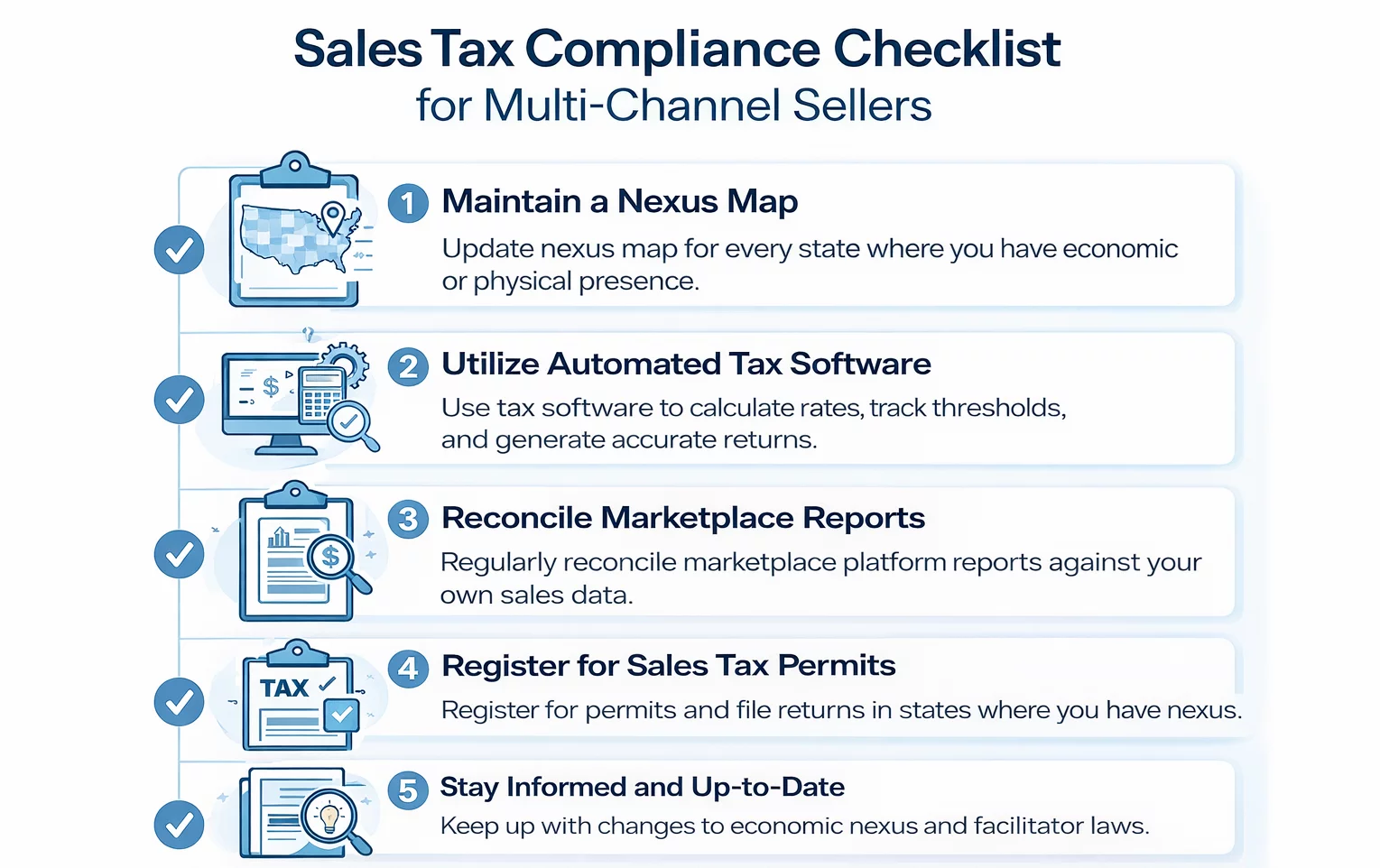
Since marketplace facilitator laws do not cover every sales scenario for multi-channel sellers, sellers should accurately distinguish between marketplace and direct-channel sales. Additionally, sellers should not ignore the impact of inventory placement on the physical nexus. Record-keeping is another frequent source of compliance failure. States may conduct audits comparing marketplace reports against seller filings.
Failing to comply with any of these obligations can result in back taxes, penalties based on estimated or presumed sales values, and interest assessments. That is why sellers must keep up with evolving state laws, which periodically revise economic nexus thresholds, marketplace facilitator definitions, and filing requirements.
Source: Colorado Department of Revenue, VATabout - U.S. Sales and Use Tax Guide, VATabout - US – Challenges for Tax Compliance of the Foreign E-Commerce Providers, Quill Corp. v. North Dakota, VATabout - Oklahoma Sales Tax Nexus Ruling for Marketplace Inventory, VATabout - NYDTF: Out-of-State Retailers Not Vendors Under Sales Tax Rules, VATabout - Arizona Sales Tax Nexus: Key Rules for Out-of-State Businesses, Texas Limited Sales, Excise, and Use Tax Act, Pennsylvania Department of Revenue