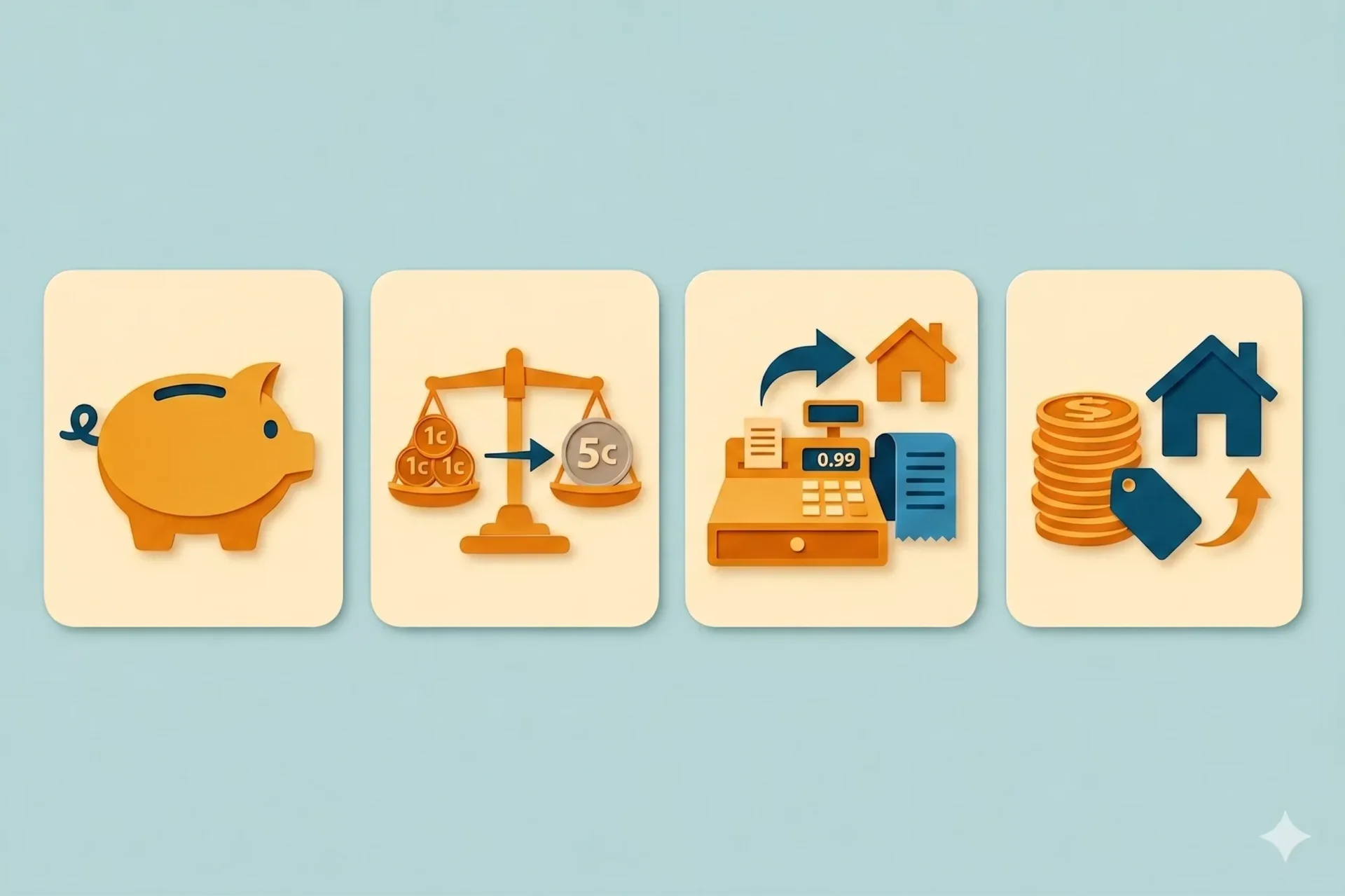
The decision to end penny production announced last November at the U.S. Mint ceremony in Philadelphia marked the conclusion of a long-running debate about the usefulness and cost of the one-cent coin. Besides ending the 232-year-old chapter in U.S. currency, the decision signaled that businesses and consumers must adapt to a new reality where exact one-cent payments are no longer feasible in cash transactions.
While pennies in circulation remain legal tenders, the spotlight is on rounding rules. Even though they might be seen as simple adjustments, in practice they carry important implications for pricing, customer experience, and, critically, sales tax compliance.
Why Did the US End Penny Production?
The primary reason for ending penny production is that it has become economically inefficient and increasingly unnecessary in modern, predominantly digital commerce. Over the past decade, the cost of producing a single penny has risen sharply from 1.3 cents to 3.69 cents. The main contributors to the increase in production costs include materials, minting operations, and general overhead.
An additional argument for ending production is that the economic usefulness of pennies has declined in recent years. In an economy where most transactions are digital, and the purchasing power of one cent is extremely limited, the U.S. Department of the Treasury determined that continued production is no longer a responsible use of taxpayers' funds. The decision to end penny production will save around USD 56 million annually in reduced material costs.
Notably, the Federal Reserve will continue to recirculate the estimated 114 billion pennies already in circulation, keeping them in use for as long as they naturally remain in circulation. How quickly they will be withdrawn from circulation depends largely on how often consumers continue to use cash and return coins to circulation..
Cash Rounding Rules and Sales Tax Challenges
Until pennies gradually disappear from everyday use, the businesses, retailers, and payment system providers must adapt to and rely on rounding rules when handling cash transactions. Electronic transactions, checks, and other non-cash methods will continue to be processed to the exact cent, preserving accuracy in digital payments and accounting systems.
The National Conference of State Legislatures recommended that states adopt the symmetrical rounding method as a standard approach. Under this method, totals ending in one, two, six, or seven cents are rounded down, while those ending in three, four, eight, or nine cents are rounded up, with very small totals typically rounded up to five cents. For example, a total of USD 10.02 would be rounded to USD 10.00, while USD 10.03 would be rounded to USD 10.05.
On the other hand, most of the states that addressed this matter adopted the general rule that the final cash total is adjusted to the nearest five cents. Other states adopted a more flexible approach. Regardless of the method, the common theme surrounding the impact of this change on sales tax is that sales tax is calculated on the exact sales price, that rounding applies only to the final cash total, and that taxable persons must remit the full, unrounded sales tax collected.
The wrong application or misunderstanding of rounding in relation to calculating sales tax could result in under- or over-collection. Thus, even small inconsistencies in applying the rounding rule can amount to significant sales tax underpayment or overpayment, especially for high-volume retailers.
State Responses to the End of the Penny
What is important to keep in mind is that the National Conference of State Legislatures' recommendation is not binding, and that there is no comprehensive federal guidance. Consequently, the US states have taken the lead in regulating rounding practices, resulting in a variety of rules and approaches
Arizona
On March 12, 2026, Arizona published the Arizona Cash Transaction Rounding Law: Guidance for Businesses, requiring businesses that no longer use pennies to round cash transactions to the nearest five cents. Importantly, the Arizona Department of Revenue clarified that although the final cash amount paid by a customer may be rounded, this does not affect transaction privilege tax reporting, Arizona's form of sales tax. Thus, taxable persons must continue to calculate, report, and remit tax based on the full, unrounded transaction value, including all taxable components.
Nebraska
Nebraska enacted the Legislative Bill on April 14, 2026, requiring businesses selling goods or services to round cash payments to the nearest amount divisible by five cents when pennies are not used. The rounding applies only to the final cash amount exchanged with the customer and does not change the actual sales price of goods or services. Similarly to Arizona, rounding rules do not affect how taxes are calculated or imposed under state or local law, nor does it alter any regulatory fees, surcharges, or other government-mandated charges.
Alabama
Alabama also adopted the rounding of cash transactions to the nearest five cents when pennies are no longer used. The Alabama law explicitly confirms that rounding does not affect the sales price, the amount of sales tax due under state or local law, or any additional surcharges, fees, or assessments tied to the sale.
In addition to the law, the Alabama Department of Revenue further clarified how this rounding can be applied in practice, providing a certain level of flexibility. Thus, businesses may either round the total transaction amount or adjust the change given back to the customer.
Florida
Florida took a slightly different approach and focused on preserving existing sales tax rules while allowing flexibility in how cash transactions are completed. As a result, businesses are still required to calculate state sales tax and any applicable local taxes exactly as they do today, regardless of whether a customer pays with cash or electronically.
When businesses are faced with a shortage of pennies and cannot collect the exact amount due or provide precise change, they are allowed to round up, round down, or round to the nearest five cents. Essentially, they can choose whichever method they want. However, the key condition is that the business must clearly notify customers of its chosen rounding practice to ensure transparency. Similar to other states, this rounding only affects the amount of cash exchanged and has no impact on sales tax obligations.
Other US States
In addition to the mentioned states, other US states, including Texas, Kentucky, North Carolina, Wisconsin, and Utah, have published rounding rules. While the rules vary, one principle is common: calculate sales tax first, round later.
Key Compliance Considerations for Businesses
As seen in the provided examples, states lean more towards nearest five cents rounding methods, or in the case of Florida, a completely flexible approach to rounding, emphasizing other criteria as more relevant. What is particularly important for businesses handling cash transactions is that they should continue giving penny change where possible. Once pennies are no longer available, rounding is an acceptable alternative.
Until each state updates and addresses this change, businesses must navigate the mismatch carefully, ensuring that sales tax is calculated correctly, while the final cash amount paid may be rounded. While the National Conference of State Legislatures' recommendation directed to US states on which rounding method to adopt gives businesses an insight into how the state might resolve this matter, key stakeholders should monitor how each state in which they operate actually regulates this matter.
The key takeaway for businesses is to apply rounding rules uniformly, clearly communicate them to customers, and ensure their systems are updated to handle both precise sales tax calculations and rounded cash payments. It is worth remembering that what may seem like a minor operational change could lead to customer confusion or regulatory issues if not applied consistently.
Source: U.S. Department of the Treasury, VATabout, Deloitte - Phasing out the penny, Arizona Department of Revenue, Alabama Secretary of State, Nebraska Money Transmitters Act, U.S. Mint, National Conference of State Legislatures, Tennessee Department of Revenue, Texas Comptroller of Public Accounts, Kentucky Department of Revenue, North Carolina Department of Revenue, Wisconsin Department of Revenue