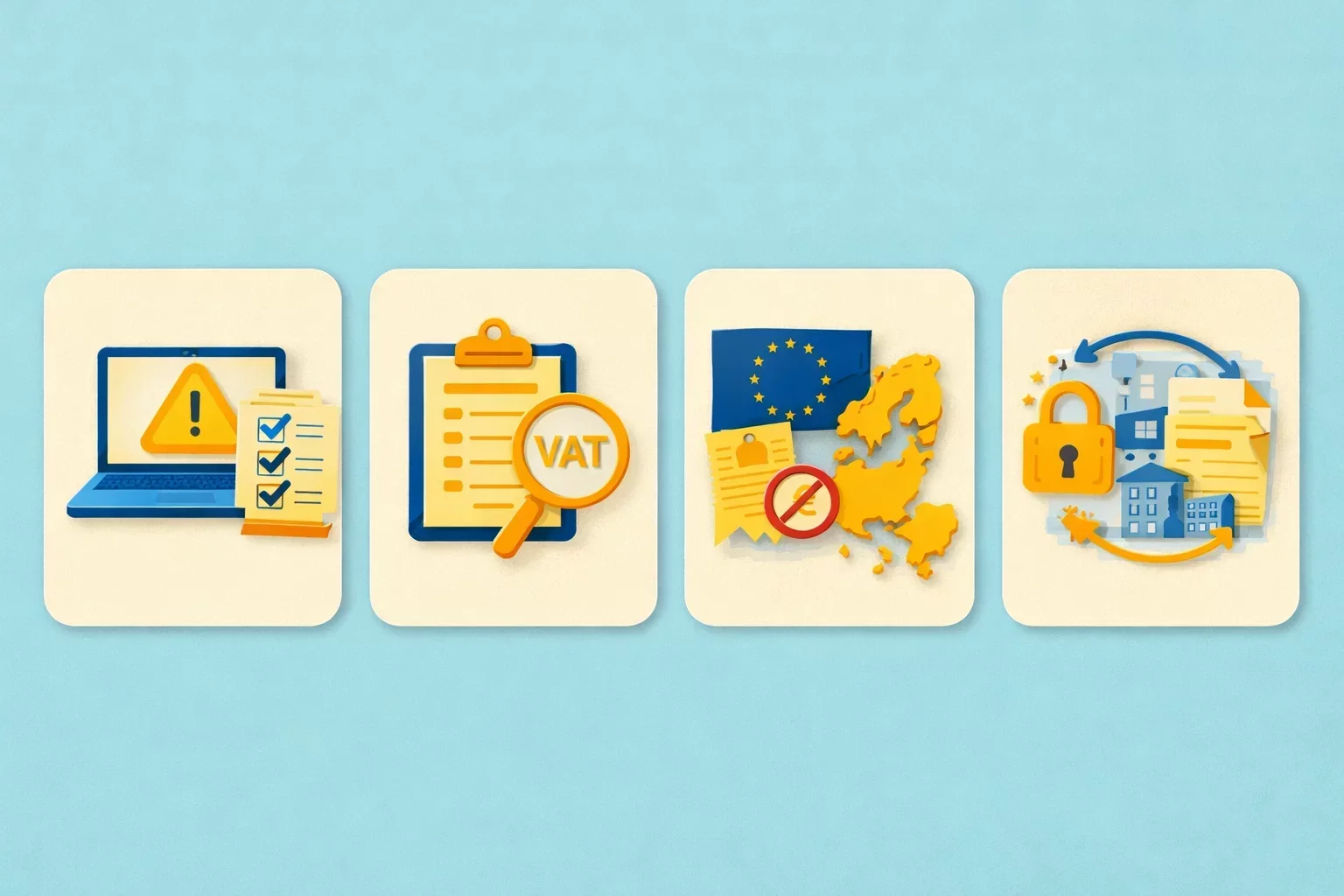
Did you know hundreds of EU businesses lose access to the OSS each year, mostly due to late filings, missed payments, or failing to answer warnings from tax authorities? Expulsion from the OSS is more than a slap on the wrist. It means businesses have to register for VAT in every country they sell into, which increases costs and swallows time with paperwork and admin headaches. For many growing companies, this can bring business to a halt and make cross-border sales almost impossible to manage.
Falling out of the OSS usually happens for preventable reasons. Common triggers include missing the VAT return deadline, paying late, or ignoring official tax notices. Once expelled, taxable persons are blocked from rejoining the OSS for two years, making it even harder to get back on track. The good news is that OSS expulsion is easily avoided with the right habits and systems.
How to Avoid OSS Expulsion in the EU: 5 Essential Steps
Step #1: Submit VAT OSS Returns Before the Deadline
Staying ahead of deadlines is the first and most critical defense against OSS expulsion. OSS authorities watch due dates closely. This means that missing a single return can prompt warnings from tax offices and set off a cascade of problems.
The solution is to set up digital calendars and enable email or text reminders for each quarterly VAT OSS deadline. Additionally, businesses and individuals can use purpose-built OSS VAT software to streamline submissions, helping reduce human errors. Deadlines sneak up faster than one might think, so trusting memory alone is risky,
Step #2: Pay OSS VAT Liabilities Promptly
Even when a taxable person files on time, it is not safe until payment lands in the OSS account. Late or skipped VAT payments are flagged as high risk by EU tax authorities, leading directly to embarrassing expulsion notices and a two-year ban.
To mitigate this risk, a taxable person can set up automated payments, such as direct debit, to cover OSS VAT liabilities, so they are never scrambling at the last minute, and double-check for payment confirmations, not just outgoing transfers.
Step #3: Respond Quickly to Tax Authority Notices
If a tax office emails, posts, or calls about overdue filings or missing payments, taxable persons need to take action immediately. These messages are not optional. In contrast, they are often an early warning signal that OSS status is at risk.
Therefore, businesses should monitor registered email addresses and online portals associated with their OSS registration. If they get a notice, they should resolve the issue and send a detailed reply, documenting the fix and keeping all records for their files. Notably, ignoring two or three reminders puts businesses on a fast track to OSS exclusion.
Step #4: Keep Business and OSS Details up to Date
Business operations change, and so do the requirements for OSS eligibility. If businesses change their address, structure, or even key activities, they must notify their OSS tax authority within 10 days. Failure to update this info can trigger retroactive cancellation of their OSS participation.
Practical steps include tracking any changes to the business structure, address, or sales channels, and updating the OSS system immediately. Those who relocate within the EU but still want to use OSS must inform the relevant agencies in both their old and new EU countries.
Step #5: Fix Compliance Issues Without Delay
Mistakes happen. What matters is how quickly they are corrected. If a taxable person discovers an error in their OSS return, a missed payment, or an outdated business detail, they must not wait to address it. Fast remediation shows tax authorities they are invested in staying compliant and can often stop expulsion proceedings before they start.
Some of the critical steps include auditing OSS filings and payments at least quarterly to catch issues early, and hiring a dedicated VAT compliance partner, if keeping up is taking too much time or focus from core business.
What is essential to keep in mind is that expulsion is not just an inconvenience. After losing access, taxable persons must register for VAT in every EU country where they sell, with additional audits, costs, and paperwork. The “OSS quarantine” lasts two years and means taxable persons cannot use the scheme even if they fix the original issue. Thus, fixing compliance issues immediately is the secret weapon that keeps one in the OSS and out of paperwork purgatory.
Best Practices to Avoid OSS Expulsion
Every business using the OSS wants to keep things simple, save time, and lower the risk of expensive mistakes. Sticking to a set of smart habits protects OSS status, helps focus on growth, and keeps businesses from getting buried under red tape. Below are the essential best practices that will help companies stay compliant and go the distance.
Automating OSS Filing and Payment Tracking
Relying on reminders from staff or one's own calendar puts one a slip away from missing a deadline or payment. Setting up trusted VAT compliance tools, such as specialized software or platforms that handle OSS filing and payment scheduling, and send alerts when action is needed, is a perfect solution for these tasks. These tools catch missed steps, reduce data-entry errors, and keep the VAT process on autopilot, lowering the risk of expulsion.
Scheduling Routine Internal OSS Audits
Setting a fixed day each quarter to check OSS eligibility and review key activity is essential to remain compliant. During these audits, taxable persons should confirm that every VAT return and payment is logged, identify any gaps or errors, and ensure their business details match their OSS registration. Regular OSS audits help spot problems before they become expensive, keeping the compliance record clean.
Responding to All Tax Office Queries Within 48 Hours
The clock starts ticking the second one gets a letter or email from a tax office. Even minor questions can quickly turn into major issues if ignored. Making it a policy to respond to every email or phone call from tax authorities within 48 hours is a significant step forward. Fast, clear communication shows that taxable persons take OSS compliance seriously and helps prevent misunderstandings that might put their access at risk.
Tracking and Adapting to EU OSS Regulation Changes
Tax laws and OSS rules can change, so staying sharp is key. Subscribing to EU tax authority newsletters and alerts, or setting up Google Alerts for OSS and VAT updates, are all valuable steps towards compliance. Whenever spotting a change, taxable persons should assess how it affects their product catalog, sales channels, or reporting obligations. Adapting quickly to new rules keeps OSS status safe and guards against accidental non-compliance.
Investing in Ongoing Expert Support for VAT
Using a reliable tax advisor or VAT compliance partner helps keep one's processes running smoothly. Experts stay on top of regulation changes, handle complex OSS filings, and catch issues that taxable persons might miss. Their guidance can be the difference between worry-free compliance and surprise expulsion. Proactive help is especially valuable when the company is scaling, entering new markets, or lacking VAT expertise in-house.
Centralizing OSS Records and Keeping Them for 10 Years
Storing every VAT return, sales invoice, payment receipt, and official communication in a single, organized digital location is a must. Cloud-based document management works best since one can search and retrieve records instantly. EU law requires keeping VAT records for 10 years, so this step is not just a good habit. It is mandatory for OSS compliance and helps if one ever faces an audit.
Actively Monitoring for OSS Scheme Updates and Adjusting Workflows
Scheduling quarterly reviews of the OSS scheme itself to identify changes in eligibility, reporting, or documentation requirements would be considered proactive compliance nurturing. One way to do this is to assign a staff member or VAT partner to track updates and brief the team.
Conclusion
Following these best practices protects OSS status, keeps the EU sales engine running, and stops compliance worries before they start. Consistency and early action go a long way. Moreover, building these steps into daily business routines makes expulsion nearly impossible. Therefore, consistent on-time filings, quick payments, and keeping details current protect businesses from paperwork nightmares and unexpected costs.
Source: European Commission, Austrian Business Service Portal, Estonian Tax and Customs Board, VATabout