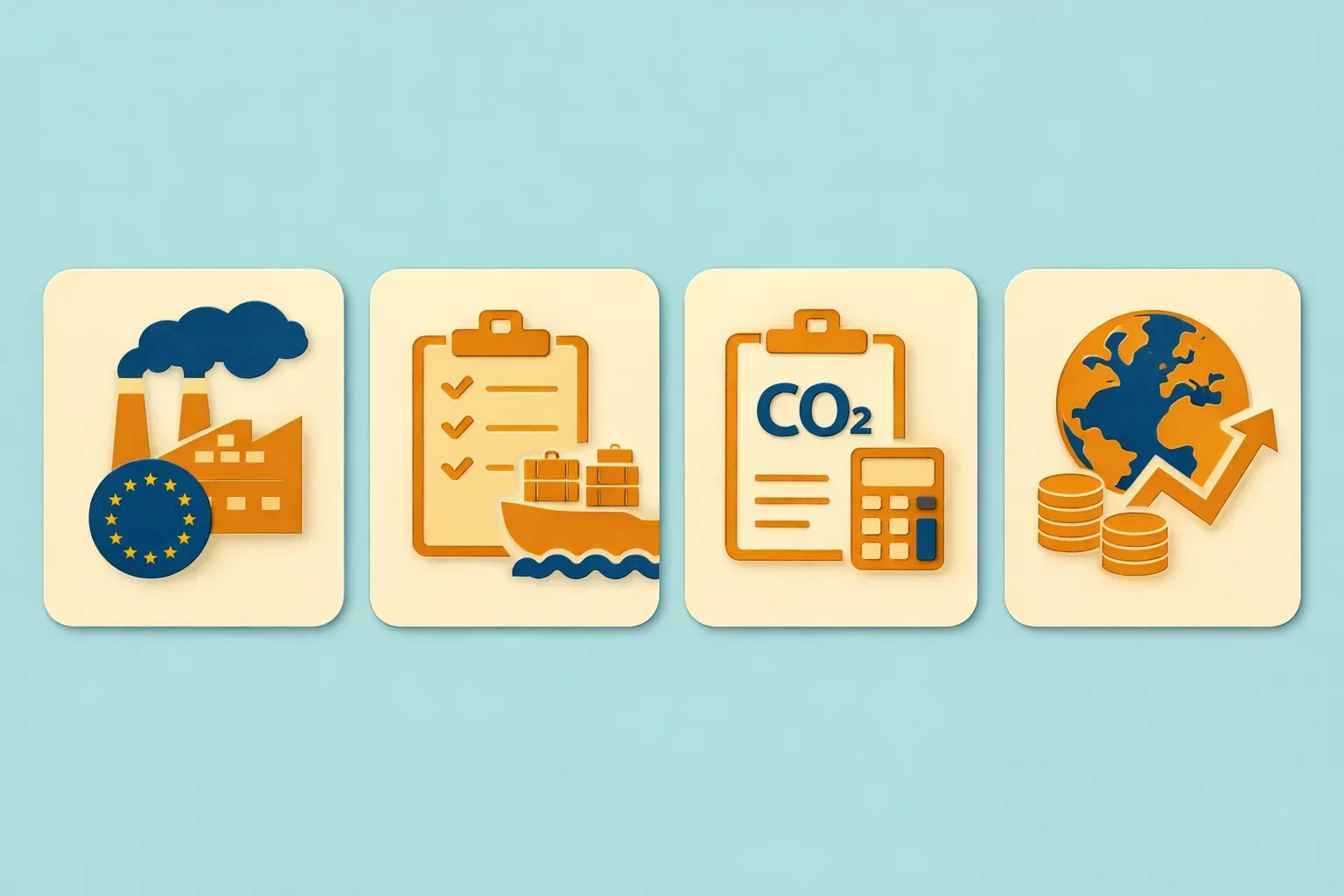
The EU's Carbon Border Adjustment Mechanism (CBAM) represents a paradigm shift in global trade and climate policy. Developed to price the carbon emissions embedded in imported goods, the CBAM's primary goal is to prevent carbon leakage, where production shifts outside the EU to jurisdictions with weaker environmental standards.
Following a transitional period from October 2023 to December 2025, CBAM entered its full operational phase on January 1, 2026, introducing new obligations for importers of carbon-intensive goods and requiring rigorous emissions accounting and reporting.
An Overview of the EU CBAM
The CBAM is a regulatory instrument established by EU legislators that imposes a carbon price on select imported goods with high greenhouse gas (GHG) emissions. As part of the EU’s Fit for 55 package and broader climate strategy, the CBAM is designed to align carbon costs for imports with those for goods produced within the EU.
Currently, CBAM covers a defined range of carbon-intensive products imported into the EU, including iron and steel, aluminium, cement, fertilisers, hydrogen, and electricity. The mechanism's structure addresses both direct emissions, such as those from on-site fuel combustion, and indirect emissions, such as those associated with electricity used in production.
While earlier proposals required reporting only goods above a low-value threshold, recent amendments have introduced a de minimis exemption. Under this exemption, importers with cumulative annual imports of CBAM goods not exceeding 50 tonnes may be exempt from certain obligations. However, this does not apply to all categories, such as electricity and hydrogen.
CBAM Registration Process and Requirement
As of January 1, only registered and authorised declarants can import CBAM-covered goods for release into free circulation in the EU's single market. The authorization is obtained through the CBAM Registry, an electronic platform managed by the European Commission, which also interfaces with national customs systems. Notably, importers must obtain authorisation before exceeding the CBAM goods threshold or meeting applicable deadlines set by their national authorities.
The entire process is facilitated by the Authorisation Management Module (AMM) in the CBAM Registry, where in-scope companies submit an application containing legal and business information, proof of establishment, and relevant registration numbers.
Non-EU importers must appoint an indirect customs representative established within the EU to fulfil registration and reporting duties on their behalf. Other key requirements for completing the registration include having an Economic Operators Registration and Identification number (EORI), submitting company and contact details, and providing documentation evidencing commercial activity related to CBAM goods.
List of National Competent Authorities for CBAM | |
EU country | National Competent Authority |
Austria | Office for the National Emissions Trading System, Customs Authority |
Belgium | Federal Public Service for Health, Food Chain Safety and Environment Change Service |
Bulgaria | Executive Environment Agency |
Cyprus | Department of Environment, Ministry of Agriculture, Rural Development and Environment |
Czech Republic | Customs Administration and Ministry of Environment |
Germany | Emissions Trading Authority |
Denmark | Danish Energy Agency |
Estonia | Environment Board |
Greece | General Directorate of the Financial and Economic Crime Unit, Ministry of Economy and Finance |
Spain | Ministry for Ecological Transition and Demographic Challenge |
Finland | Customs Authority |
France | Directorate General for Energy and Climate |
Croatia | Ministry of Environmental Protection and Green Transition |
Hungary | National Climate Protection Authority |
Ireland | Environmental Protection Agency |
Italy | Ministry of Environment and Energy Security |
Lithuania | Environmental Protection Agency |
Luxembourg | Environment Agency, Permits and Subsidies Unit - Register of Greenhouse Gas Emissions Quotas |
Latvia | State Revenue Service |
Malta | Climate Action Authority |
The Netherlands | Dutch Emissions Authority |
Poland | National Centre for Emissions Management, The Institute of Environmental Protection - National Research Institute |
Portugal | Climate Agency |
Romania | General Directorate of Fiscal Legislation and Customs and Accounting, Ministry of Finance |
Sweden | Swedish Environmental Protection Agency |
Slovakia | Ministry of Environment |
Slovenia | Financial Administration |
Note: Data in the table is from the European Commission - List of National Competent Authorities for CBAM
How to Calculate Embedded Carbon Under CBAM
One of the key steps in CBAM compliance is calculating embedded carbon emissions. As already noted, embedded emissions encompass both direct and indirect GHG emissions produced during the manufacture of imported goods. The calculation follows specific CBAM methodologies to ensure consistency and accuracy across sectors and supply chains.
Embedded emissions are calculated using either actual data or default values published by the European Commission. Default values are standard emission intensity figures assigned to specific products when detailed supplier data is unavailable. Notably, the default values for the transitional period, from 2023 to 2025, and from January 1, 2026, differ.
In practice, importers must collect precise emissions data from their non-EU suppliers or calculate emissions based on production inputs and processes. When actual values are used, they typically require verification by an accredited third-party to ensure accuracy and credibility. In such cases, the emission is measured in terms of tons of CO₂ equivalent (CO₂e) per unit of product or energy. For example, CO₂e per tonne of steel or CO₂e per MWh of electricity.
The default values are defined in the EU's Implementing Regulation 2025/2621. For instance, electricity default emission values are based on the country of origin's average CO₂ emission factor. The emission factor itself is calculated as a simple average over the most recent five-year period for which reliable data are available. Notably, all default values are subject to review by December 2027, even though the Commission aims to revise them in collaboration with EU member states in 2026.
It is important to note that the calculation also accounts for carbon prices paid abroad. Therefore, if a carbon price has already been charged and paid on the emissions in the country of origin, that amount can be deducted from the EU carbon price liability, ensuring that importers do not pay twice for the same carbon cost.
EU CBAM Reporting and Submission Requirements
Reporting under CBAM involves submitting detailed emissions data and related information through the CBAM Registry. Contrary to the transition phase, when importers filed quarterly reports, with the start of the definitive regime, reporting transitions to an annual declaration system.
The first CBAM declaration for calendar year 2026 should be submitted by September 30, 2027. The annual report must include the total quantities of each type of goods imported in the previous calendar year, measured in megawatt-hours for electricity and in tonnes for all other goods. Additionally, the report must state the total embedded emissions associated with those goods, calculated under the CBAM methodology and verified by an accredited verifier.
Furthermore, importers must indicate the total number of CBAM certificates to be surrendered, reflecting the embedded emissions after accounting for any carbon price already paid in the country of origin and for adjustments linked to the continued free allocation of allowances under the EU Emissions Trading System. Finally, the report must include copies of the verification reports issued by accredited verifiers, confirming the accuracy of the reported emissions data.
Ongoing Compliance Under the EU CBAM
For importers, the ongoing EU CBAM compliance means continuously meeting a range of regulatory obligations, such as ensuring they are registered and authorised as CBAM declarants before importing covered goods into the EU, accurately calculating the embedded carbon emissions associated with each shipment using either actual supplier data or default values, and submitting verified annual emissions reports through the CBAM Registry promptly.
Furthermore, importers must surrender the appropriate number of CBAM certificates corresponding to those embedded emissions, after accounting for any carbon prices already paid abroad, with failure to comply potentially leading to penalties and restrictions on market access. Given recent amendments to the CBAM rules, including the declaration deadline, affected businesses should regularly monitor for additional updates, with changes to default values most likely due to calculation methodology and the indicated revision in 2026 or 2027.
Source: VATabout - The EU Carbon Border Adjustment Mechanism (CBAM), Dutch Government - Carbon adjustment at the border on EU imports (CBAM), EU CBAM Regulation, European Commission - CBAM Registry and Reporting, European Commission - List of National Competent Authorities for CBAM, Ireland's Environmental Protection Agency - EU Carbon Border Adjustment Mechanism, Implementing Regulation (EU) 2025/2621