
The series of articles, Doing Business in Poland & Lithuania, is designed to provide a clear, structured overview of what it takes to do business in Poland compared with Lithuania. The focus will be on the key factors that influence the true costs and conditions of running a company in each country. Ultimately, the main purpose of this series is to serve as a practical guide for in-depth analysis and informed decision-making.
The series will cover some of the most relevant business and tax matters, including legal structures and incorporation, corporate tax, employment costs, profitability and distribution, tax reliefs and incentives, VAT-related matters, and strategic insights. Each article will include data-driven comparisons, practical examples, and insights to help key stakeholders navigate business opportunities across these two markets.
Executive Overview of Business Environments
Although Poland and Lithuania are geographical neighbors and close EU partners, their tax systems, social security burdens, and business incentives differ significantly.
One of the most notable structural differences is the employer’s labor costs. In Poland, employer social contributions amount to approximately 17.93% of gross salary, whereas in Lithuania they are only 1.77% for permanent employment contracts and 2.49% for fixed-term contracts. This sharp contrast stems from Lithuania’s 2019 reform, which shifted most social contributions to employees by increasing gross salaries and reducing employer rates. While the overall tax burden for employees remains comparable, the employer-side cost difference is substantial and has a major impact on profitability, particularly in labor-intensive sectors.
On the other hand, Poland offers a larger internal market and a more complex, yet generous system of tax incentives, including reliefs for R&D and investment, the “Runway for Companies” program that minimizes certain public burdens for startups and small entrepreneurs, tax relief for robotization, and access to a broad ecosystem of EU co‑financed grants with a funding pool of approximately EUR 76 billion for 2021–2027.
In addition, Poland’s strategic decision to significantly increase defense spending not only strengthens national security but also drives demand for advanced technologies. Importantly, many defense-related projects may qualify for Poland’s extensive R&D and investment reliefs, creating additional opportunities for companies developing innovative, dual-use, or high-tech solutions.
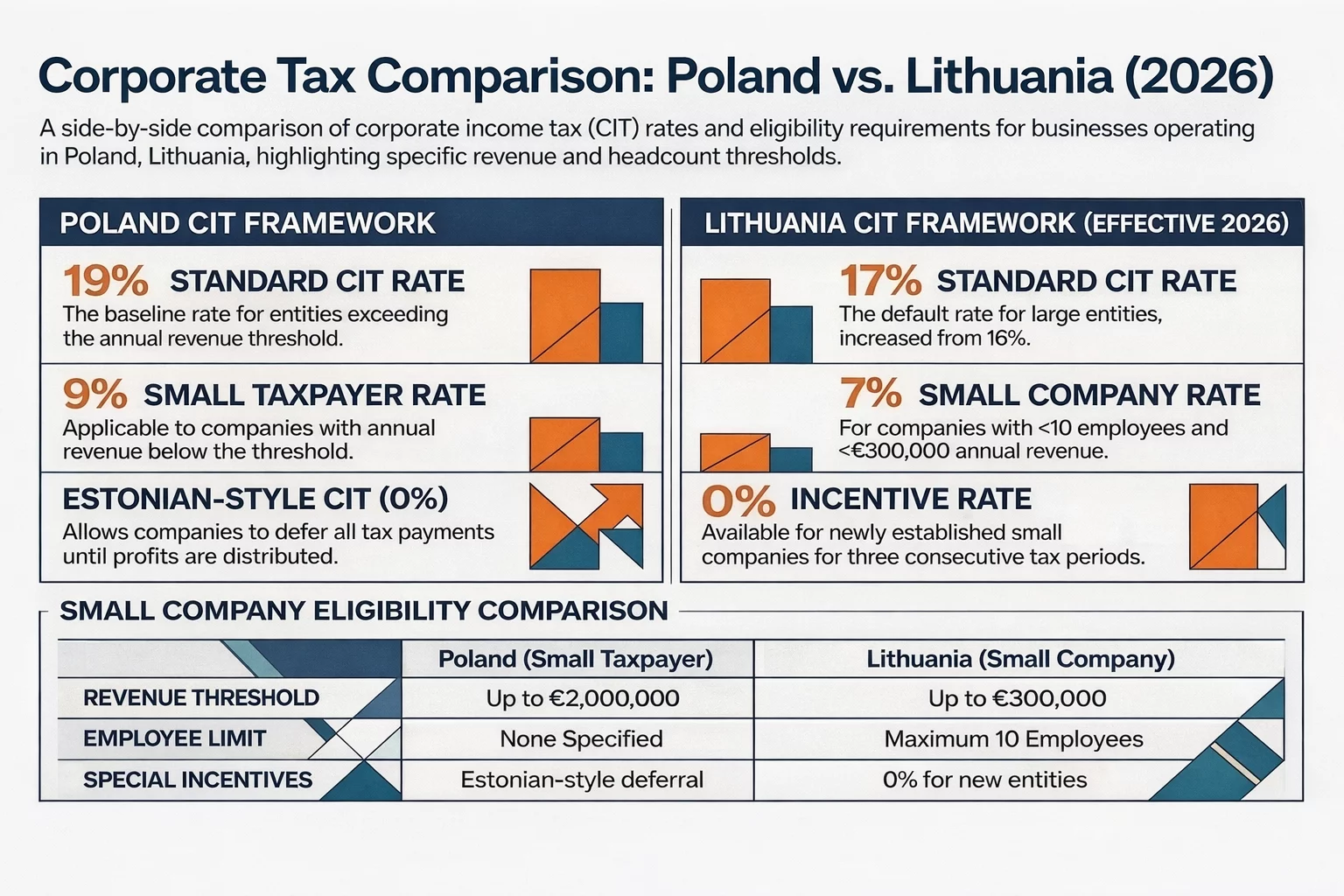
Meanwhile, Lithuania compensates with simpler rules and highly digitalized processes, a triple deduction for R&D costs, up to 100% additional deduction for investment projects, a 0% CIT rate for up to 20 years for large-scale investment projects, immediate depreciation for fixed assets (from 2026), a reduced 7% CIT rate for small businesses (from 2026), two years instead of one of 0% CIT for small companies (from 2026), and structurally lower employment costs - EUR 16,3/hour in Lithuania versus EUR 18,2/hour in Poland.
Methodology: Comparing Poland and Lithuania
To make the comparison transparent and relatable, the following assumptions have been used throughout the series:
- Exchange rate: 1 EUR = 4.30 PLN (used for converting Polish amounts to euros, including minimum wage and share capital).
- Legal forms: Polish sp. z o.o. (limited liability company) and Lithuanian UAB.
- Time frame: regulations as applicable in 2025–2026, based on current law and already approved changes in Lithuanian legislation as of 2026.
- Scenarios: three revenue models (10k, 40k, 100k EUR per month) and three salary levels (minimum wage in Poland, 2,000 EUR gross, 5,000 EUR gross).
Polish sp. z o.o. vs Lithuanian UAB: Capital, Registration, and Procedures
Poland – Spółka z Ograniczoną Odpowiedzialnością (sp. z o.o.)
Minimum Share Capital and Ownership
The Polish sp. z o.o. is the standard corporate vehicle for SMEs and foreign investors. The minimum share capital is 5,000 PLN. With the assumed exchange rate of 1 EUR = 4.30 PLN, this corresponds to approximately 1,163 EUR. This threshold is therefore slightly higher than the Lithuanian UAB minimum share capital of 1,000 EUR. A sp. z o.o. can have a single shareholder and one or more management board members.
Registration Procedures and Costs
There are two main registration routes. The first one is online registration via the S24 system, using a template Articles of Association. Court and publication fees total roughly 350 PLN (around 81 EUR), and registration often takes 1–2 business days.
The alternative route is a traditional notarial deed. This approach is more flexible, but it involves Articles of Association and higher costs. Including the notary fee and tax on civil law transactions, the total cost is usually 1,200–1,500 PLN (approx. 280–350 EUR). Registration typically takes 7–14 days.
Lithuania – Uždaroji Akcinė Bendrovė (UAB)
Minimum Share Capital and Ownership
The Lithuanian UAB is broadly equivalent to the Polish sp. z o.o. The minimum share capital is EUR 1,000, which is slightly lower than the Polish threshold when converted from PLN. This amount must generally be paid before registration. The UAB legal form is one of the most widely used by local entrepreneurs and is also popular among foreign investors seeking to establish a subsidiary or business presence in Lithuania.
Registration Procedures and Costs
Registration of a UAB can also be completed online via the E-Government Gateway. The cost of registration typically ranges from EUR 150 to EUR 300, depending on whether documents are prepared and filed independently, whether notarial services are used, and the fees for a local business address and bank account. These costs are broadly comparable to Poland’s S24 registration or the traditional notarial procedure for a sp. z o.o. The process usually takes 2–3 business days and requires opening a local bank account, obtaining a local business address, and providing proof of paid-in minimum share capital.
Corporate Taxation (CIT) Overview: Key Differences Between Poland and Lithuania
From Incorporation to Workforce Costs
With the foundation in place, covering methodology, assumptions, and corporate structures, the next article in this series will go deeper into employment cost structures, employee tax burdens, and salary scenarios. Understanding these will be crucial for accurate profitability planning in both markets.