After reforming the EU-wide VAT rules and regulations and agreeing on further improvements under the VAT in the Digital Age (ViDA) package, the EU is embarking on another quest: to reform the EU Customs Union. As announced by EU officials, the reform of EU customs will be the most significant and impactful in decades.
At the core of this reform lies the need to modernize how customs work across the EU, particularly in light of the challenges posed by the digital economy. As presented by the European Commission, the answer to addressing these issues is the establishment of a more transparent, data-driven, and equitable EU customs system.
Historical Overview of the EU Customs Union
Established in 1968, the EU Customs Union is one of the core achievements of European integration. Its establishment marked the creation of a simpler, more efficient trading system among EU countries, in which all EU countries acted as a single customs territory.
In practice, this meant applying the same tariffs to goods from outside the EU and eliminating tariffs entirely on goods traded between the EU countries. Thus, once goods enter the EU and clear customs in one EU country, they can move freely across all other EU countries without additional checks or duties. Overall, this reduced administrative burdens, lowered business costs, and sped up trade. Simultaneously, the system enabled the EU to enforce common standards protecting consumers, the environment, and market fairness.
In 2016, the Union Customs Code came into effect. This EU-wide legal framework ensures that all EU countries follow the same procedures for importing, exporting, and transiting goods, creating consistency and predictability for businesses and consumers across the EU. In addition to forming a Customs Union, the EU also entered separate customs agreements with Andorra, San Marino, and Turkey, aligning certain trade rules without admitting these countries as full members of the EU Customs Union.
Factors Driving Changes to EU Customs Rules
While EU customs rules have changed several times since 1968 to adapt to new trends and challenges, no deep, fundamental change addressing structural weaknesses has been undertaken. As a result, the system is failing to keep up with modern trade realities.
The rapid growth of e-commerce, with nearly 5.9 billion low-value parcels entering the EU each year, of which the vast majority originate from China, is emphasized as one of, if not the biggest, challenges for EU customs. The sheer volume of e-commerce puts enormous pressure on Customs Authorities to monitor and control goods effectively.
Combined with widespread undervaluation and misuse of the EUR 150 duty exemption threshold, which allowed many goods to enter the EU without customs duties, negatively impacted the EU. These negative effects include reduced public revenues and unfair competition for EU-based businesses that must comply fully with customs and regulatory requirements.
Since the true reform of EU customs was not conducted, mounting issues were addressed responsively. This approach left EU countries responsible for enforcing a growing number of EU rules and standards, not just tariff-related, but also a wide range of prohibitions and restrictions tied to key policy goals, such as preventing illegal goods, ensuring product safety, protecting the environment, and enforcing controls on certain sensitive items.
Given the pace and rate at which global trade and geopolitical change, custom policies emerged as one of the key factors in implementing sanctions and ensuring supply chain continuity during emergencies. As such, effective customs policies serve both as protective and facilitative instruments. Again, something the existing customs system failed to do, creating a sense of urgency and unpredictability.
Finally, because the existing system is highly fragmented and operates without a single unified framework, businesses must interact with 27 national customs administrations and navigate over 100 separate IT systems, many of which are not interconnected.
Architecting the Digital EU Customs Union Reform
The EU Customs reform is based on three-pillar solutions: establishing a smarter, data-driven approach to customs checks; strengthening the partnership with businesses by simplifying the customs process and requiring them to submit customs data only once; and adopting a modern approach to e-commerce.
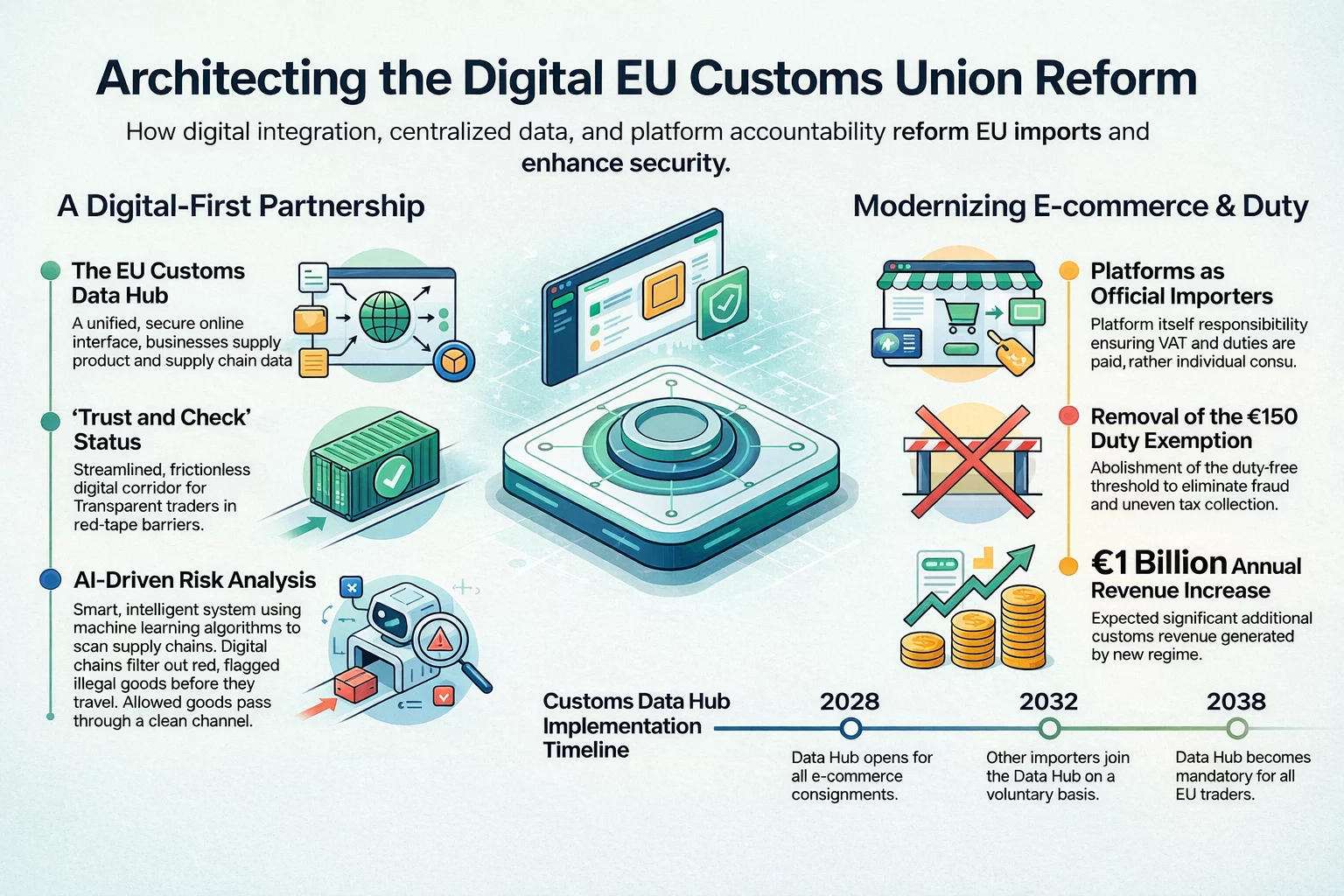
At its core, the reform centers on establishing an EU Customs Authority to manage an EU Customs Data Hub expected to be operational around 2028. With this centralized system in place, real-time data-sharing across the EU will be possible. The key feature of the system is the use of AI to analyze a vast amount of data, monitor shipments, and predict risks before goods even begin their journey to the EU.
Stricter rules for cross-border e-commerce are another key element of the new system. The new e-commerce framework includes eliminating the EUR 150 customs exemption for parcels sent from non-EU countries to EU consumers. As part of this decision, from July 1, 2026, the EU will introduce a temporary EUR 3 customs duty on online purchases to level the playing field for e-commerce sales.
Additionally, a handling fee on goods imported into the EU to compensate for the increasing costs for customs authorities will also be introduced. Also, digital platforms will become central players in the customs process, serving as the official importers.
Impact on Authorities, Businesses, and Consumers
Customs Authorities and EU Countries
With the new EU Customs Data Hub, the EU Customs Authority and national Customs Authorities will be able to access and share the same data through a unified platform, enabling faster, more coordinated, and more consistent responses to potential risks. Instead of relying on controls at border entry points, the goods will be controlled throughout the process, starting even before they are loaded for transport, upon arrival in the EU, during transit within the Union, or at their final destination.
With implemented AI tools and solutions, Customs Authorities will be able to detect threats more effectively and address safety, security, fraud, and attempts to bypass rules on prohibited and restricted goods. Moreover, they will be able to issue “do-not-transport” instructions, preventing the shipment of non-compliant or dangerous goods to the EU.
Overall, it is expected that the transition to the EU Customs Data Hub will save up to EUR 2 billion annually in IT development and maintenance costs for the fragmented national IT systems currently used across EU countries. Conversely, by reducing the risk of fraud and evasion, public revenue should increase considerably.
Businesses
The reform of the EU customs system is designed to make customs procedures faster, simpler, and more cost-efficient for businesses. One of the key features of the reform is the transition from a traditional declaration-based system toward a data-driven model. As a result, the repetitive paper-based model for each shipment will be replaced with a more structured, digital model that enables data reuse and continuous analysis.
The EU's decision to introduce the EU Customs Data Hub in phases is also beneficial for businesses, as they will have time to adapt while already benefiting from early simplifications and cost savings. Additionally, the establishment of a new category of highly trusted businesses, “Trust & Check,” will allow traders to benefit from maximum simplification. One of the main benefits is the ability to clear imports through the Customs Authority of their home EU country, regardless of where goods enter the EU.
Consumers
Making digital platforms liable for calculating customs duties and VAT, and for ensuring these duties and taxes are paid, represents a significant relief for consumers who will no longer face unexpected fees or administrative burdens when their parcels arrive.
Moreover, consumers will no longer be considered the official importers of goods purchased online from non-EU countries, simplifying their shopping experience and increasing certainty about compliance with safety standards. Additionally, consumers will be more certain that the goods they ordered and received meet EU safety, environmental, and ethical standards.
What This Means for the Future of Trade
The reform of EU customs brings significant novelties and introduces a new model in which compliance is embedded in the transaction itself rather than enforced at the border. Digitalization, data centralization, and real-time risk analysis will certainly reshape trade within the EU.
However, the EU's approach may also serve as a model for other jurisdictions seeking to modernize their customs systems. Thus, the EU's reform may also help reshape global supply chains. For example, to reduce costs and adapt to these new rules, businesses may decide to transition to bulk imports into EU warehouses rather than direct-to-consumer shipping from non-EU countries. Consequently, the volume of individual parcels entering the EU could decline, while the importance of EU logistics hubs could rise.
Source: European Commission, PwC, European Council - Customs: Council agrees to levy customs duty, European Council - Modernising the EU customs union, VATabout - New EU EUR 3 Customs Duty Per Item Explained for Overseas Vendors, VATabout - EU Customs Reform: New Rules for E-Commerce & Trade